584 results for: Alaska
Photograph
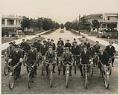
Seattle Motorcycle Club, circa 1910
The Seattle Motorcycle Club was organized in February 1909 with a membership of 20 riders. The members met in August 1909 to approve the club's constitution and by-laws, elect the club officers, and form a committee on the club's participation in the Alaska-Yukon-Pacific Exposition (AYPE), where they were invited to participate in the AYPE Seattle Day parade and in races…
ID Number:SHS333
Date:Circa 1910
Photograph
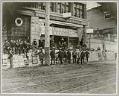
Miners and supplies outside Cooper & Levy, circa 1897
After news of Klondike gold reached Seattle in July 1897, many of Seattle's stores joined the excitement and became gold rush outfitters. Cooper & Levy, just south of Pioneer Square, provided gold seekers with crates and sacks of flour, bacon, dried fruit, condensed milk, tea, soap, matches, and many other items needed for life in the north.This 1897 photo shows…
ID Number:SHS401
Date:Circa 1897
Photograph
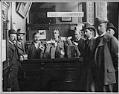
Alaskan gold at the Scandinavian American Bank, circa 1901
Between 1897 and 1910, gold and money from the gold rush poured into Seattle's banks. Between May 1897 and September 1903, deposits at Seattle's Scandinavian American Bank grew from $170,594.08 to nearly $2.7 million.This photo was taken sometime between 1897 and 1902, at the Scandinavian American Bank in Seattle. It shows bank president Andrew Chilberg (right, behind counter) and a…
ID Number:SHS404
Date:circa 1901
Photograph
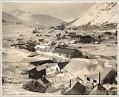
Town of Bennett, Yukon Territory, February 13, 1900
In 1897 and 1898, the Klondike gold seekers sailed down Lake Bennett to get to the Yukon River. The town of Bennett grew up to cater to the travelers. Once regular railroad and steamboat service was established, the town shrank and became primarily a railroad stop and telegraph office.This photo, taken in February 1900, shows the town of Bennett after…
ID Number:SHS410
Date:1900
Photograph
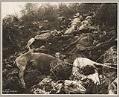
Dead horses on White Pass Trail, 1898
In 1897 and 1898, many of the Klondike stampeders used pack horses and mules to carry supplies along the White Pass Trail. Smart pack train owners took good care of their animals, but the trail was rough and the work was extremely hard. There was no feed in the mountain canyons and no water in winter. Animals who were too…
ID Number:SHS411
Date:1897
Photograph
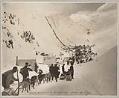
Scales and summit of Chilkoot Pass, 1898
The gold seekers packed their supplies from Sheep Camp to just below Chilkoot Pass. At this point, they assembled their goods, weighed them, and, if they could afford it, arranged have their supplies carried to the top of the pass by packers or tramway. Packers charged more to carry the load up the steep slope than along the trail from…
ID Number:SHS412
Date:1898
Photograph
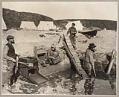
Group of miners using conveyor and rockers, circa 1899
Around 1898, gold was found in inland creekbeds near what would become Nome. It wasn't until early 1899, when word leaked out that gold had been discovered in beach sand, that the Nome gold rush truly began. Extracting gold from beach sand called for different methods. Conveyors and rockers worked more efficiently than sluices and panning.This 1899 or 1900 photo…
ID Number:SHS414
Date:Circa 1899
Photograph
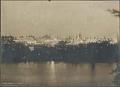
Alaska-Yukon-Pacific Exposition grounds at night, Seattle, 1909
The Alaska-Yukon-Pacific Exposition (AYPE) was a world's fair held in Seattle in 1909, publicizing the development of the Pacific Northwest. The fairgrounds became the campus of the University of Washington.This view across Lake Union shows the AYPE grounds at night, with buildings and a ferris wheel outlined in lights. Caption on photo: The "Fair Beautiful" at NightHandwritten on back of…
ID Number:SHS487
Date:1909
Photograph
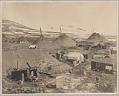
Cabins and mining activities near Nome, circa 1905
By 1901, many of Alaska's small scale mining operations had been replaced by large industrial mining companies. Miners lived in camps near the mining operations.This B.B. Dobbs photo shows cabins and mining activities somewhere near Nome. Piles of pay dirt dwarf the small buildings. The small structure in the foreground may be an outhouse. The building to the far right,…
ID Number:SHS516
Date:Circa 1905
Photograph
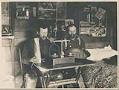
Two miners weighing gold in cabin, near Nome, Alaska, circa 1900
The last stage in the mining process was called the cleanup. After the last of the gold was washed from the pay dirt, the miners weighed it to see how much gold they had gotten.This photo shows two miners weighing gold in a comfortably furnished cabin. One man (left) weighs the nuggets in a pan balance while the other holds…
ID Number:SHS550
Date:Circa 1900