584 results for: Alaska
Photograph
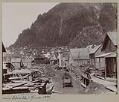
Juneau, Alaska, June 1897
Juneau, Alaska, was settled in 1880 and named after Joseph Juneau, one of the early discoverers of gold in the area. By 1901, Juneau was an important gold mining center and the capital of Alaska Territory.This 1897 photo of Juneau shows a street and businesses in the growing city. Loggers have cut the trees on some of the nearby hills,…
ID Number:SHS30
Date:1897
Photograph
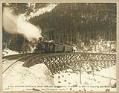
First passenger train to summit of White Pass, February 20, 1899
On February 20, 1899, the first passenger train on the White Pass & Yukon Route crossed over the summit of White Pass. The railroad owners had targeted Christmas 1898 as the day they wanted to reach the summit, but brutal weather caused construction delays and drove some workers to quit.In this photo by Eric Hegg, the White Pass & Yukon…
ID Number:SHS38
Date:1899
Photograph
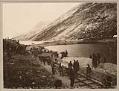
White Pass & Yukon, laying at Bennett, track, 1899
On July 6, 1899, construction workers finally completed the White Pass & Yukon Route railroad line through White Pass to Lake Bennett, British Columbia. It took fourteen months to build the 40-mile railway line from Skagway, Alaska.This photo by Eric Hegg shows the laying of the last track on the White Pass & Yukon Route railroad between Skagway, Alaska, and…
ID Number:SHS40
Date:1899
Photograph
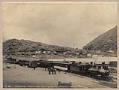
Terminus of White Pass and Yukon Railroad at Bennett, British Columbia, August 5, 1899
The White Pass & Yukon Route railroad reached the shores of Lake Bennett on July 6, 1899. For a short time, freight and passengers transferred to steamboats at Bennett which carried them to Carcross. There, they boarded the train again for Whitehorse, and transferred to steamboats again to get to Dawson, the closest port to the Yukon gold fields. Eventually…
ID Number:SHS41
Date:1899
Photograph
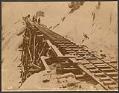
Icy tracks on the White Pass & Yukon Route, circa 1899
Winter snow in the coastal mountains was a constant problem for the White Pass and Yukon Route railway. Subzero temperatures, icy conditions, and snowfalls of several feet were common. The railroad's snowplows couldn't always get through, and sometimes passengers had to help clear the tracks.This photo by Eric Hegg shows workers clearing ice from the tracks of the White Pass…
ID Number:SHS42
Date:Circa 1899
Photograph
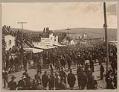
July fourth, Dawson, Yukon Territory, July 4, 1899
In 1898 and 1899, most of the people who poured into Dawson were Americans. The Fourth of July was a big holiday in this Canadian city.This photo, probably taken in 1899 by Eric Hegg, shows the crowds enjoying the Independence Day celebration in Dawson, Yukon Territory. Some spectators have climbed on the roofs of the buildings to watch the festivities.…
ID Number:SHS47
Date:1899
Photograph
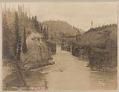
Miles Canyon, circa 1898
Miles Canyon was one of the most dangerous parts of the Yukon River between Lake Bennett and Dawson. It was only 100 feet wide, with steep cliffs, a whirlpool midway, and a large rock at the lower end. The gold rush stampeders could pay professional guides to take them through the canyon, but many couldn't afford the expense.This E. A.…
ID Number:SHS48
Date:1898
Photograph
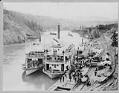
Three steamboats at the Miles Canyon tramway, circa 1898
Miles Canyon and White Horse Rapids were among the most dangerous parts of the Yukon River between Lake Bennett and Dawson. In 1898, a five-mile tramway was built around these two obstacles, and travelers could ride around them in safety. The tramway operators charged 25 cents a pound to haul gold seekers' goods on horse-drawn flat bed cars. Many miners…
ID Number:SHS49
Date:Circa 1898
Photograph
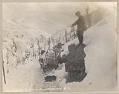
Man with two loaded sleds on Dyea trail above Lindeman, April 10, 1899
The trail from Dyea led across Chilkoot Pass to Lake Lindeman (sometimes spelled Linderman) and Lake Bennett in British Columbia. Many of the gold seekers who crossed Chilkoot Pass in the winter from 1897 to 1899 camped by Lake Lindeman waiting for the ice to thaw. Others hiked further to Lake Bennett.This photo, taken by Eric Hegg in April 1899,…
ID Number:SHS50
Date:1899
Photograph
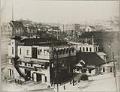
City Hall at 3rd and Jefferson, Seattle, circa 1900
In 1876, King County purchased a lot from Henry Yesler for the price of $3,500 and built the first King County building on county owned property. The two-story wood, stone and brick structure occupied the corner of Third Avenue and Jefferson Street (the present site of City Hall Park) and cost $17,000 to build. It housed the jail in the…
ID Number:SHS250
Date:Circa 1900