584 results for: Alaska
Photograph
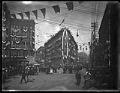
Crowds gathered in Pioneer Square celebration, Seattle, circa 1910
This photograph shows Pioneer Square festively decorated and with crowds gathered about 1910. It is possible that this was a celebration in junction with the Alaska-Yukon-Pacific Exposition, held in Seattle in 1909 on a site that later became the University of Washington.This photo was taken by either Clarence R. Langstaff or his brother Otto Langstaff, who were both prolific amateur…
ID Number:Lib1993.8.32
Date:Circa 1910
Photograph
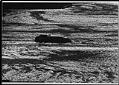
Ferry Kalakala in Puget Sound, Seattle, 1948
The ferry "Kalakala" began service in 1935. Its streamlined design made it internationally famous and popular with visitors and residents alike. The ferry made six daily runs between Seattle and Bremerton, and made summer evening excursions around Puget Sound. Unfortunately, the ferry vibrated badly; it was difficult to handle and expensive to repair. Service ended in 1967, and the ferry…
ID Number:Lib1993.20.188
Date:1948
Photograph
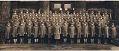
Students' Army Training Corps group on steps of Washington State Museum, University of Washington campus, circa 1918
During World War I a temporary Naval Training Station was set up on the University of Washington campus, near where the university's health sciences center is now located. The training camp was active from 1917-1919, during which time over 5,000 mostly college students were trained for both naval and naval aviation units.This image shows a Students' Army Training Corps group…
ID Number:Lib1993.35.2.10
Date:Circa 1918
Music, notated
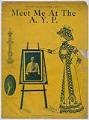
Meet Me at the A.Y.P.
Seattle held its first world’s fair, the Alaska-Yukon-Pacific Exposition (AYPE) in 1909. The fair promoted the region’s growth and prosperity that had begun with the 1897 arrival of the first shipment of Yukon gold. “Meet Me At The A.Y.P” was but one of the songs written at the time to promote the AYPE. Harry G. Robinson wrote the music and…
ID Number:Lib1993.41.343
Date:1909
Music, notated
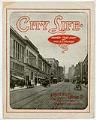
City Life
The music for "City Life," a march and two-step, was composed by George A. Edmunds and arranged by musician Sol Levi (1881-). The sheet music was printed by Liberal Music Printing Co. in Seattle, and sold at Rhodes Bros. in Seattle. Considering the date of publication, the song was likely one of many written for the Alaska-Yukon-Pacific Exposition (or A.Y.P.E.),…
ID Number:Lib1996.10.10
Date:1909
Music, notated
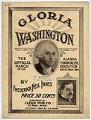
Gloria Washington
The words and music for "Gloria Washington," the official march of the Alaska-Yukon-Pacific Exposition, were written by Frederick Neil Innes (1854-1926), a musician and conductor from Chicago who served as the Fair's director of music. The score was copyrighted by F. B. Innes and published by Clegg Publishing Company of St. Paul, Minnesota. The AYPE was a world's fair held…
ID Number:Lib1996.28.17
Date:1909
Ephemera
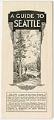
A Guide to Seattle, circa 1925
This pamphlet was published by the Seattle Chamber of Commerce in order to highlight places of interest for tourists visiting Seattle. The "Brief History" section highlights Seattle as a quick growing city able to offer a "range of attractions" that are argued to be unmatched on the continent. The pamphlet highlights many of the city's parks and outdoor recreational activities.…
ID Number:MS.COLL.1362.1
Date:Circa 1925
Photograph
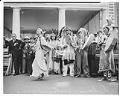
Native American leaders performing at Victory Square, Seattle, August 15, 1942
Victory Square, on University Street between Fourth and Fifth Avenues, was the hub of Seattle's home front activities during World War II. Crowds gathered here for parades, war bond rallies and many other patriotic events.In the center of this photo, Tulalip Tribes leader Harriette “Hiahl-tsa” Shelton Dover dances as part of a Discovery Day event held by the Alaska-Yukon Sourdoughs…
ID Number:PI28263
Date:1942
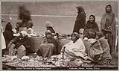
Photograph
Indigenous women merchants at Treadwell Mines on Douglas Island, Alaska, July 1897
The Tlingit people have lived on the coast and islands of what is now southeastern Alaska since time immemorial. Tlingit society is organized into clans, which follow maternal descent. Fishing, gathering, and hunting were central to historic Tlingit lifeways – they used salmon, shellfish, seals, berries, deer, and other food sources. They used every part for different purposes, not wasting…
ID Number:SHS9
Date:1897
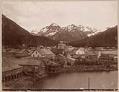
Photograph
Sitka, Alaska, June 1897
Some of the shipping companies which carried gold seekers to Skagway and Dyea had already been carrying visitors to Sitka and other southeastern Alaskan ports. Sitka was settled by Russians in 1802 and was the center of their American fur trade. The city overlooks a sheltered harbor on the west shore of Baranof Island, nearly 1,000 miles northwest of Seattle.This…
ID Number:SHS29
Date:1897