844 results for: Puget Sound
Photograph
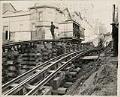
Madison Street Cable Railway at 3rd Avenue, Seattle, 1907
The Madison Street Cable Railway provided public transportation along one of Seattle's busiest thoroughfares from 1890 to 1940. Built to connect downtown Seattle with Lake Washington, Madison Street was Seattle's steepest cable line, terminating downtown at a turntable on West Street (now Western Avenue), near the present-day ferry terminal on Puget Sound. In this image a Madison Street Cable Railway…
ID Number:SHS915
Date:1907
Photograph
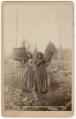
Indigenous women picking hops, Snoqualmie Hop Ranch, circa 1895
From the late 1860s to the early 1890s, hop farming was an important activity in the valleys of the Puget Sound region, including Puyallup, White River, and Snoqualmie. Indigenous workers came from throughout the Pacific Northwest, Canada, and Alaska (but especially from regional tribes like the Puyallup, Snoqualmie, Muckleshoot, Duwamish, Sammamish, Lummi, and Nisqually) as a seasonal labor force to…
ID Number:SHS1052
Date:Circa 1895
Photograph
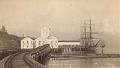
West Seattle grain elevator, circa 1895
Colonel Thomas Ewing, the major developer of West Seattle, foresaw a great industrial center on the peninsula. In 1890, Ewing built a grain elevator and hailed it as the key to Seattle's future as a worldwide grain exporter. Ewing convinced the Northern Pacific Railroad to build a trestle across the tide flats to reach his grain elevator. The railroad carried…
ID Number:SHS1053
Date:Circa 1895
Photograph
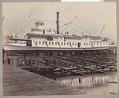
Steamboat "Bailey Gatzert" at yard, circa 1890
The "Bailey Gatzert," named for an early Seattle businessman and mayor, was launched in Ballard in 1890. The luxury sternwheeler carried passengers on the Columbia River and Puget Sound and was one of the fastest vessels of its day. In 1920, the "Bailey Gatzert" became the first vessel to be rebuilt specifically for ferrying automobiles on Puget Sound. The ferry…
ID Number:SHS1076
Date:Circa 1890
Photograph
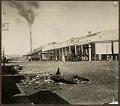
Yesler Way and Yesler's Mill, Seattle, 1873
Henry Yesler arrived in Seattle in 1852 and soon built the first steam-powered sawmill on Puget Sound. It was located on the waterfront at the foot of Mill Street, now called Yesler Way.This 1873 image also shows the Pioneer Drug Store and the Seattle Bakery. Yesler's Wharf, where lumber schooners docked, would be beyond the mill's tall smokestack. Title from…
ID Number:SHS1108
Date:1873
Photograph
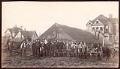
Men posing in front of tent near Jacob Furth home, 1889
The Great Fire of June 6, 1889 was a significant turning point in Seattle's history and changed both the physical and political landscapes of the City. In this image men pose in front of a tent set up after the fire during regrading operations, in which streets were raised up to 22 feet in places, helping to level the hilly…
ID Number:SHS1359
Date:1889
Photograph
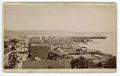
Waterfront and downtown, Seattle, circa 1887
Label on verso: Warner & Davis, Landscape Photographers, Front & Cherry Sts., Seattle, Wash. Ter.Typed on verso: Seattle looking south showing waterfront and railroad tracks before the fire 1889.SHS category: Views
ID Number:SHS1376
Date:Circa 1887
Photograph
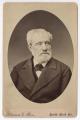
Henry Yesler, circa 1885
Henry Yesler arrived in Seattle in 1852 looking for a waterfront sawmill location. Other settlers moved the boundaries of their land claims to accomodate space for the mill, its pier, and a skid road, now Yesler Way. Yesler's sawmill, the first steam-powered mill on Puget Sound, started operation in the spring of 1853. In addition to his mill, Yesler owned…
ID Number:SHS1582
Date:Circa 1885
Photograph
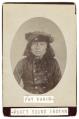
Pat Kanim, Snoqualmie Chief, circa 1855
The Snoqualmie people are a Coast Salish group who have lived in the Snoqualmie River Valley since time immemorial. They made dugout canoes which they used to navigate the river and reach Puget Sound. Traditionally the Snoqualmie burned off the bottom lands of the Snoqualmie Valley to create open areas that ensured an abundance of edible plants for foraging as…
ID Number:SHS1679
Date:Circa 1855
Photograph
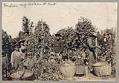
Indigenous men, women, and children working in hop field, Kent, circa 1895
From the late 1860s to the early 1890s, hop farming was an important activity in the valleys of the Puget Sound region, including Puyallup, White River, and Snoqualmie. Indigenous workers came from throughout the Pacific Northwest, Canada, and Alaska (but especially from regional tribes like the Puyallup, Snoqualmie, Muckleshoot, Duwamish, Sammamish, Lummi, and Nisqually) as a seasonal labor force to…
ID Number:SHS1975
Date:Circa 1895