844 results for: Puget Sound
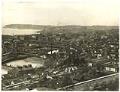
Photograph
Waterfront from Beacon Hill, Seattle, circa 1898
The area south of downtown Seattle was originally made up of tidal flats; soil dredged from the Duwamish River and sluiced from the Denny triangle and Beacon Hill regrades was used to create this industrial area needed by area businesses and railroads. This image, taken between 1890-1900, shows what much of Seattle's waterfront looked like before the tidal flats were…
ID Number:SHS462
Date:Circa 1898
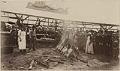
Photograph
Puget Sound tribal members at the Railroad Jubilee barbecue, Seattle, September 1883
Northern Pacific Railroad Company President Henry Villard (1835-1900) visited Seattle shortly after he and U. S. President Ulysses S. Grant (1822-1885) drove the "golden spike" on September 8, 1883, near Independence Creek, Montana, symbolizing the completion of the of Northern Pacific Railroad. A celebration honoring the transcontinental railroad was held on the grounds of the Territorial University (now University of…
ID Number:SHS468
Date:1883
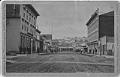
Photograph
Seattle's downtown before the Great Fire, Seattle, 1883
n the 1880s, Seattle's business district was near Pioneer Square. Loggers, miners, and others came to this part of the city to find work, supplies, and entertainment. Others came to Seattle to attend the Territorial University, which stood on a hill above the city.This photo, taken around 1884, shows the intersection of Commercial Street (now First Avenue South) and Main…
ID Number:SHS470
Date:1880
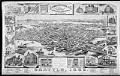
Photograph
Photo of map of Seattle before fire, 1889
Seattle in the 1880s was a rapidly growing city, aided in no small part by the 1883 connection with the Northern Pacific Railway Company. Lumber and coal were the primary industries, but the growth of fishing, wholesale trade, shipbuilding, and shipping also contributed to the town's economic expansion and population growth. The Seattle City Census of 1888 records population at…
ID Number:SHS483B
Date:1889
Photograph
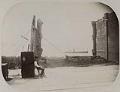
Man guarding a safe after Great Seattle Fire, June 6, 1889
The Great Fire of June 6, 1889 was a significant turning point in Seattle's history and changed both the physical and political landscapes of the city. The fire started at 2:30 p.m. in a shop at Front Street (now First Avenue) and Madison Street and swept across 100 acres of Seattle's business district and waterfront. The fire left little standing…
ID Number:SHS511
Date:1889
Photograph
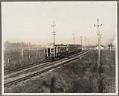
Seattle-Tacoma interurban trolley near Kent, Washington, circa 1909
Interurban trolley service between Seattle and Tacoma began in 1902. The high-speed Puget Sound Electric Railroad won passengers and freight away from the slower Puget Sound steamers. Regular trolley service on the line also speeded the development of the area between Seattle and Tacoma. Service ended in 1928, a victim of the more-popular automobile.This photo shows car 500 and two…
ID Number:SHS720
Date:Circa 1909
Photograph
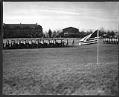
Signal Corps troops marching at Fort Lawton, January 29, 1944
In 1897, the city of Seattle donated land on Magnolia Bluff to the US government to build a new Army post as part of a defense system for Puget Sound; this was designated as Fort Lawton in 1900. During most of its active service, the fort served as an embarkation station where troops gathered before being sent to duty in…
ID Number:SHS822
Date:1944
Photograph
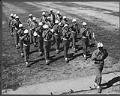
Signal Corp marching band at Fort Lawton, August 6, 1946
In 1897, the city of Seattle donated land on Magnolia Bluff to the US government to build a new Army post as part of a defense system for Puget Sound; this was designated as Fort Lawton in 1900. During most of its active service, the fort served as an embarkation station where troops gathered before being sent to duty in…
ID Number:SHS827
Date:1946
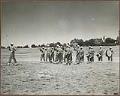
Photograph
Military band parading at Fort Lawton, Seattle, August 9, 1946
In 1897, the city of Seattle donated land on Magnolia Bluff to the US government to build a new Army post as part of a defense system for Puget Sound; this was designated as Fort Lawton in 1900. During most of its active service, the fort served as an embarkation station where troops gathered before being sent to duty in…
ID Number:SHS873
Date:1946
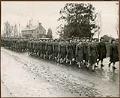
Photograph
WACs parading at Fort Lawton, Seattle, February 3, 1944
In 1897, the city of Seattle donated land on Magnolia Bluff to the US government to build a new Army post as part of a defense system for Puget Sound; this was designated as Fort Lawton in 1900. During most of its active service, the fort served as an embarkation station where troops gathered before being sent to duty in…
ID Number:SHS876
Date:1944