843 results for: Puget Sound
Photograph
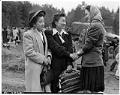
Japanese American women saying goodbye to friend during forced removal, Bainbridge Island, March 30, 1942
In this image two young Japanese American women, Yoshie Terayama and Ritsuko Teryama, say goodbye to a white friend from school at an exclusion assembly point near the ferry dock on Bainbridge Island. Civilian Exclusion Order No. 1 was issued at Bainbridge Island, ordering 227 residents of Japanese descent to leave with six days' notice. They departed by ferry on…
ID Number:PI28051
Date:1942
Photograph
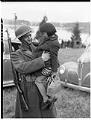
U. S. soldier holding Japanese American girl during forced removal, Bainbridge Island, March 30, 1942
In this image a U. S. Army soldier holds a Japanese American child, Jane Nakamura, at an exclusion assembly point near the ferry dock on Bainbridge Island. Civilian Exclusion Order No. 1 was issued at Bainbridge Island, ordering 227 residents of Japanese descent to leave with six days' notice. They departed by ferry on March 30, 1942. The island had…
ID Number:PI28052
Date:1942
Photograph
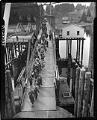
Japanese Americans boarding ferry for forced removal, Bainbridge Island, March 30, 1942
In this image Japanese Americans board the ferry for forced removal from Bainbridge Island under U. S. Army guard. Civilian Exclusion Order No. 1 was issued at Bainbridge Island, ordering 227 residents of Japanese descent to leave with six days' notice. They departed by ferry on March 30, 1942. The island had a total of 276 Japanese American residents at…
ID Number:PI28053
Date:1942
Photograph
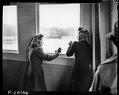
Ritsuko Terayama and Sumiko Furuta at window of ferry crossing Puget Sound, 1942
On March 30, 1942, the United States Army removed the over 200 Japanese American residents from their homes and businesses on Bainbridge Island and escorted them to the ferry. The Seattle Post-Intelligencer reported that the forced removal was peaceful. The incarcerees, most of whom were American citizens, continually professed their loyalty to the United States and gave that loyalty as…
ID Number:PI28056
Date:1942
Photograph
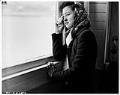
Mrs. Sumiko Furuta on ferry during forced removal, Bainbridge Island, March 30, 1942
In this image a Japanese American woman, 19-year-old Mrs. Sumiko Furuta, cries while looking out the ferry window after forced removal from Bainbridge Island. Civilian Exclusion Order No. 1 was issued at Bainbridge Island, ordering 227 residents of Japanese descent to leave with six days' notice. They departed by ferry on March 30, 1942. The island had a total of…
ID Number:PI28057
Date:1942
Photograph
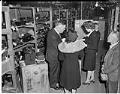
Room with property confiscated from Japanese Americans, Seattle, November 1945
On February 19, 1942, shortly after Japan's attack on Pearl Harbor and United States entry into WWII, President Franklin Roosevelt signed Executive Order 9066, calling for the exclusion of all civilians of Japanese descent from "designated military areas." In March 1942 Japanese Americans living on Bainbridge Island were the first in the country to be taken from their homes by…
ID Number:PI28086
Date:1945
Photograph
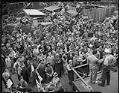
Puget Sound Bridge & Dredge Co. employees on V-J Day, Seattle, August 14, 1945
Handwritten on negative: V-J day rally at Puget Sound Bridge & Dredge.Handwritten on sleeve: World War II - Seattle - V-J Day.Date photograph was filed at the Seattle Post-Intelligencer (date of photograph and file date may differ by a month or more): August 15, 1945.
ID Number:PI28310
Date:1945
Photograph
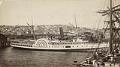
East-facing view of Seattle and the Alaskan, 1888
Seattle in the 1880s was a rapidly growing city, aided in no small part by the 1883 connection with the Northern Pacific Railway Company. Lumber and coal were the primary industries, but the growth of fishing, wholesale trade, shipbuilding, and shipping also contributed to the town's economic expansion and population growth. The Seattle City Census of 1888 records population at…
ID Number:SHS201
Date:1888
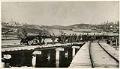
Photograph
Arrival of the first log shipment via the Columbia & Puget Sound Railroad, Seattle, 1880
As Seattle grew, the trees on the hills above the city were gradually cut down, and logs needed to be hauled a longer distance to the sawmills along the waterfront. In this 1880 image, dignitaries pose by part of the first shipment of logs carried into the city by the Columbia & Puget Sound Railroad. Original photo copied by Webster…
ID Number:SHS330
Date:1880
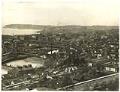
Photograph
Waterfront from Beacon Hill, Seattle, circa 1898
The area south of downtown Seattle was originally made up of tidal flats; soil dredged from the Duwamish River and sluiced from the Denny triangle and Beacon Hill regrades was used to create this industrial area needed by area businesses and railroads. This image, taken between 1890-1900, shows what much of Seattle's waterfront looked like before the tidal flats were…
ID Number:SHS462
Date:Circa 1898