121 results for: Japanese American Incarceration
Photograph
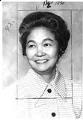
Kiyo Sakahara, Seattle, March 27, 1974
This image shows Kiyoshi (Kiyo) Sakahara (1920-2013), a leader in Seattle’s Japanese American community. She attended the University of Washington majoring in chemistry, but shortly before graduation her studies were interrupted by the forced removal of Japanese Americans. Sakahara was incarcerated in the Puyallup Assembly Center, then the Minidoka concentration camp. Sakahara and her family obtained early release and she…
ID Number:2000.107.159.13.01
Date:1974
Photograph
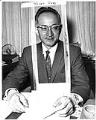
Toru Sakahara, April 27, 1967
This image shows Toru Sakahara (1916-2008), a leader in Seattle’s Japanese American community. During World War II, Sakahara was incarcerated at the Puyallup Assembly Center and the Minidoka concentration camp. He was one of the first Japanese American students to attend the UW School of Law. He used his legal skills to aid Japanese Americans in reclaiming property after their…
ID Number:2000.107.159.13.02
Date:1967
Photograph
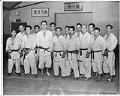
Seattle Dojo members posing at club, Seattle, November 21, 1952
Established sometime before 1907, Seattle Dojo is the oldest judo dojo in the continental United States. The club moved several times before the present (as of 2019) dojo at 1510 Washington Street in Seattle's Chinatown - International District was built in the 1930s by first generation Japanese Americans. Wartime curfews during World War II and the Japanese American incarceration caused…
ID Number:2000.107.170.25.05
Date:1952
Photograph
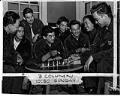
Japanese American servicemen playing chess at Fort Lawton, Seattle, July 22, 1945
In spite of having their loyalties questioned after the Japanese attack on Pearl Harbor, and with more than 110,000 people of Japanese descent incarcerated in camps in the western U.S, Japanese Americans served in the U.S. armed forces in disproportionate numbers. Most served in the segregated 442nd Regimental Combat Team, the most decorated unit in U.S. military history for its…
ID Number:2000.107.217.01.01
Date:1945
Photograph
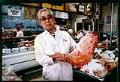
Dick Yoshimura at Mutual Fish Company, Seattle, March 6, 1984
Dick Yoshimura (1914-2012) founded the Mutual Fish Company and is credited with the region’s first live seafood tanks and other innovations. Born in Japan, Yoshimura came to Seattle in 1929 and developed a reputation for working hard for fish companies along the Alaskan Way waterfront. He was imprisoned for three years at a Japanese incarceration camp during World War II,…
ID Number:2000.107.234.22.01
Date:1984
Photograph
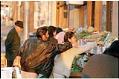
Shoppers in the International District, Seattle, April 5, 1997
Seattle's Chinatown - International District (CID) has been home to Asian American communities since the late 1800s. The original Chinatown was located directly south of Pioneer Square, but was pushed east to the CID's current location by construction on 2nd Avenue in the 1920s. At this time, the CID was home to flourishing communities of Chinese, Japanese, and Filipino immigrants…
ID Number:2000.107.19970405.2.28
Date:1997
Photograph
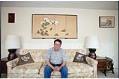
Ken Nakano, Jefferson Award Winner, Kirkland, April 7, 1997
In April 1997, a panel chose five Washingtonians to receive the state’s Jefferson Award. One of these was Ken Nakano, an American citizen who survived the 1945 bombing of Hiroshima. Among other things, Nakano was nominated for his work on behalf of Pacific Northwest residents harmed by radiation from the Hanford Nuclear Reservation, his campaign for reparations for Japanese Americans…
ID Number:2000.107.19970407.7.13
Date:1997
Photograph
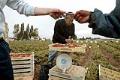
Steve Sakuma weighing strawberries during harvest at Sakuma Brothers Farms, Burlington, WA, June 27, 2002
Building on a long tradition of Indigenous berry picking in the Puget Sound region, European Americans brought their preferred varieties of berries to the area as they settled in the late nineteenth and early twentieth centuries. By the first decades of the twentieth century, Japanese Americans were setting up family farms, based on practices in fertilization, irrigation, and crop rotation…
ID Number:2000.107.20020627.CD02.01.001
Date:2002
Photograph
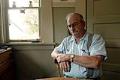
Jerry Mapes, Burlington, Washington, June 27, 2002
Building on a long tradition of Indigenous berry picking in the Puget Sound region, European Americans brought their preferred varieties of berries to the area as they settled in the late nineteenth and early twentieth centuries. By the first decades of the twentieth century, Japanese Americans were setting up family farms, based on practices in fertilization, irrigation, and crop rotation…
ID Number:2000.107.20020627.CD02.01.002
Date:2002
Photograph
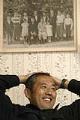
Steve Sakuma with portrait of his grandparents and their children, Burlington, Washington, June 27, 2002
Building on a long tradition of Indigenous berry picking in the Puget Sound region, European Americans brought their preferred varieties of berries to the area as they settled in the late nineteenth and early twentieth centuries. By the first decades of the twentieth century, Japanese Americans were setting up family farms, based on practices in fertilization, irrigation, and crop rotation…
ID Number:2000.107.20020627.CD02.01.003
Date:2002