121 results for: Japanese American Incarceration
Photograph
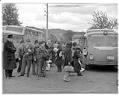
Incarcerees arriving on buses at the Puyallup Assembly Center, Puyallup, 1942
In the spring of 1942, persons of Japanese descent living on the West Coast were forcibly removed by the US Army into temporary "assembly centers" while permanent incarceration camps were built. The Puyallup Assembly Center, euphemistically named “Camp Harmony," was hastily constructed at the Washington State fairgrounds, and temporarily housed over 7,000 residents of Seattle, Tacoma, and Alaska.Buses transported incarcerees…
ID Number:1986.5.6682.4
Date:1942
Photograph
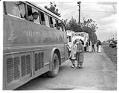
Busload of incarcerees arriving at the Puyallup Assembly Center, Puyallup, 1942
In the spring of 1942, persons of Japanese descent living on the West Coast were forcibly removed by the US Army to assembly centers while permanent incarceration camps were built. The Puyallup Assembly Center, euphemistically named "Camp Harmony," was hastily constructed at the Washington State fairgrounds in Puyallup and temporarily housed over 7,000 residents of Seattle, Tacoma and Alaska. Buses…
ID Number:1986.5.6682.5
Date:1942
Photograph
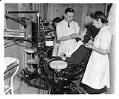
Woman receiving dental care at the Puyallup Assembly Center, Puyallup, 1942
In the spring of 1942, persons of Japanese descent living on the West Coast were forcibly removed by the US Army into "assembly centers" while permanent incarceration camps were built. The Puyallup Assembly Center, euphemistically named "Camp Harmony," was hastily constructed at the Washington State fairgrounds in Puyallup and temporarily housed over 7,000 residents of Seattle, Tacoma and Alaska. This…
ID Number:1986.5.6682.6
Date:1942
Photograph
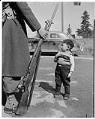
Japanese American boy standing near a soldier with a rifle, possibly in Seattle, 1942
On February 19, 1942, shortly after Japan's attack on Pearl Harbor and United States entry into WWII, President Franklin Roosevelt signed Executive Order 9066, calling for the exclusion of all civilians of Japanese descent from "designated military areas." More than 9,000 Japanese and Japanese American people living in the Pacific Northwest were forced into incarceration camps in Idaho and California…
ID Number:1986.5.41879.1
Date:1942
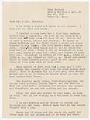
Ephemera
Letter from Mary Inouye at the Puyallup Assembly Center, May 14, 1942
President Franklin Roosevelt's Executive Order 9066 set into motion the expulsion of 110,000 Japanese Americans from West Coast cities. Some 7,500 people from the Seattle-Tacoma area were forced to move to the Puyallup Assembly Center, euphemistically named "Camp Harmony," beginning in March 1942. From this temporary facility, they were transferred to permanent "relocation centers" (inland incarceration camps).In this letter, a…
ID Number:1989.76.31
Date:1942
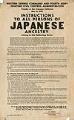
Poster
Civilian Exclusion Order No. 80 poster, King County, March 1942
On February 19, 1942, President Franklin Roosevelt signed Executive Order 9066, authorizing the incarceration of all people of Japanese descent, including American citizens, from "designated military areas." Just a few weeks later, the U. S. Army began posting notices detailing the Civilian Exclusion Orders issued in cities along the West Coast. As instructed on these signs, incarcerees could take with…
ID Number:1991.72.12
Date:1942
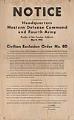
Poster
Civilian Exclusion Order No. 80 poster, King County, March 1942
On February 19, 1942, President Franklin Roosevelt signed Executive Order 9066, authorizing the incarceration of all people of Japanese descent, including American citizens, from "designated military areas." Just a few weeks later, the U. S. Army began posting notices detailing the Civilian Exclusion Orders issued in cities along the West Coast. As instructed on these signs, incarcerees could take with…
ID Number:1991.72.13
Date:1942
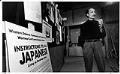
Photograph
Ron Chew at Wing Luke Museum, April 27, 1993
Ronald A. "Ron" Chew (b. 1953) was born in Settle, the son of Chinese immigrants who worked in the restaurant and garment industries in Seattle’s Chinatown International District (CID). Chew attended Franklin High School and University of Washington (UW), leaving UW in 1975 to pursue community-based journalism. Chew was a reporter for, then editor of, the CID newspaper International Examiner,…
ID Number:2000.107.035.07.02
Date:1993
Photograph
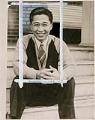
Portrait of Gordon K. Hirabayashi, Seattle, July 1, 1944
Gordon Hirabayashi (1918-2012) was a sociologist and religious pacifist best known for his principled resistance to the incarceration of Japanese Americans during World War II, and the Supreme Court case that resulted from his conviction for defying curfew, Hirabayashi v. United States.Gordon Hirabayashi was born in Seattle, attended high school in Auburn, and then the University of Washington. In 1942,…
ID Number:2000.107.089.13.01
Date:1944
Photograph
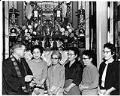
Rev. Kenryu Kumata with Buddhist Women's Federation officers, Seattle, April 20, 1963
The Seattle Buddhist Church (or Seattle Betsuin) at 1427 S Main Street was dedicated in October 1941, and replaced the original church building which was condemned for the development of the Yesler Terrace housing project. The disruption to the Japanese community from that project, and then the relocation of Japanese Americans into incarceration camps the following year destroyed the Japanese…
ID Number:2000.107.098.18.03
Date:1963