733 results for: Labor and Labor Unions
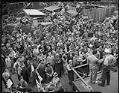
Photograph
Puget Sound Bridge & Dredge Co. employees on V-J Day, Seattle, August 14, 1945
Handwritten on negative: V-J day rally at Puget Sound Bridge & Dredge.Handwritten on sleeve: World War II - Seattle - V-J Day.Date photograph was filed at the Seattle Post-Intelligencer (date of photograph and file date may differ by a month or more): August 15, 1945.
ID Number:PI28310
Date:1945
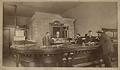
Photograph
Men inside Dexter Horton Bank, Seattle, 1882
In 1870 Seattle pioneer Dexter Horton (1825-1904) opened the first business in Seattle dedicated to serving as a bank. Dexter Horton Bank was one of the corporate ancestors of Seattle First National Bank, which eventually merged into the Bank of America.This image taken of the interior of the Dexter Horton Bank at the northwest corner of Commercial Street (First Avenue…
ID Number:SHS338
Date:1882
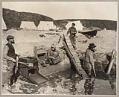
Photograph
Group of miners using conveyor and rockers, circa 1899
Around 1898, gold was found in inland creekbeds near what would become Nome. It wasn't until early 1899, when word leaked out that gold had been discovered in beach sand, that the Nome gold rush truly began. Extracting gold from beach sand called for different methods. Conveyors and rockers worked more efficiently than sluices and panning.This 1899 or 1900 photo…
ID Number:SHS414
Date:Circa 1899
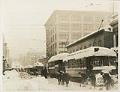
Photograph
Trolleys on Pike Street after snow, Seattle, January 31, 1916
January and February of 1916 were exceptionally cold. By the end of January, about 2 feet of snow had already accumulated, with more on the way. The heavy snow and ice trapped trolleys and halted businesses all over town. In this photo taken at the end of January 1916, workmen try to clear the ice near the trolleys stranded on…
ID Number:SHS622
Date:1916
Photograph
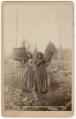
Indigenous women picking hops, Snoqualmie Hop Ranch, circa 1895
From the late 1860s to the early 1890s, hop farming was an important activity in the valleys of the Puget Sound region, including Puyallup, White River, and Snoqualmie. Indigenous workers came from throughout the Pacific Northwest, Canada, and Alaska (but especially from regional tribes like the Puyallup, Snoqualmie, Muckleshoot, Duwamish, Sammamish, Lummi, and Nisqually) as a seasonal labor force to…
ID Number:SHS1052
Date:Circa 1895
Photograph
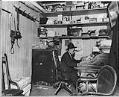
Chin Gee Hee, Chinese labor contractor, circa 1904
In the late 19th and early 20th centuries, Chinese labor contractors brought thousands of Chinese men to the Pacific Northwest to build railroads and to work in canneries, logging camps and coal mines. Companies depended on labor contractors to recruit workers, to move them where they were needed, to feed and house them, and to keep track of their pay.…
ID Number:SHS1152
Date:1901
Photograph
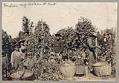
Indigenous men, women, and children working in hop field, Kent, circa 1895
From the late 1860s to the early 1890s, hop farming was an important activity in the valleys of the Puget Sound region, including Puyallup, White River, and Snoqualmie. Indigenous workers came from throughout the Pacific Northwest, Canada, and Alaska (but especially from regional tribes like the Puyallup, Snoqualmie, Muckleshoot, Duwamish, Sammamish, Lummi, and Nisqually) as a seasonal labor force to…
ID Number:SHS1975
Date:Circa 1895
Photograph
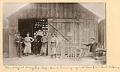
August Wenzel in front of his blacksmith shop at 7th and Pike, Seattle, 1889
August Joseph Wenzel (1856-1945) was born in Kingdom of Prussia, Germany, and moved to Seattle in 1888 with his wife Maria and their 8 children. He opened a blacksmith and cooper shop on Pike Street between Fourth Avenue and Fifth Avenue. Next door to the blacksmith shop he owned a wagon works shop and next to that a meat market.…
ID Number:SHS2303
Date:1889
Photograph
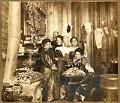
Theodore Wernecke and employees inside fur store, Seattle, circa 1898
An estimated 100,000 prospectors migrated to the Klondike region of the Yukon in north-western Canada between 1896 and 1899. Most of them stopped in Seattle to purchase supplies, greatly contributing to the city's economic success. Ohio-born Charles Theodore Wernecke (1852-1922) came to Seattle around 1897 and operated at least one store catering to miners headed to Alaska during the Klondike…
ID Number:SHS2508
Date:Circa 1898
Photograph
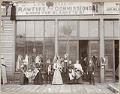
Exterior of C.T. Wernecke fur store, Seattle, circa 1897
Fur trading in the Pacific Northwest dates back to the 1700s. The first raw fur auction in the United States was organized in Seattle in 1898, coinciding with the Klondike Gold Rush, which had started in 1896. Ohio-born Charles Theodore Wernecke had come to Seattle in 1897 and ran a store that bought raw furs, manufactured fur clothing, and catered…
ID Number:SHS2525
Date:Circa 1897