733 results for: Labor and Labor Unions
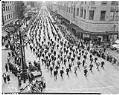
Photograph
Labor Day Parade on Fourth Avenue, September 2, 1940
On September 2, 1940, bands, floats and marching union members joined in Seattle's Labor Day parade. A 40-piece band and more than 1,000 members of the International Longshoremen & Warehousemen's Union Local 1-19 led the parade, followed by groups representing printers, airplane mechanics, fishermen, shingle weavers, post office clerks and many other workers.In this photo, taken during the 1940 Labor…
ID Number:PI23358
Date:1940
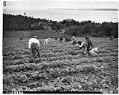
Photograph
Indigenous berry pickers on Vashon Island, June 1943
The United States' entry into World War II in December 1941 created labor shortages as many men left civilian jobs to join the military. On the West Coast, the shortage was exacerbated by the forced removal of Japanese Americans, many of whom were farmers. In the summer of 1943, the Vashon Island Packing Company hired 80 First Nations people from…
ID Number:PI23856
Date:1943
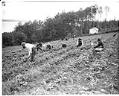
Photograph
Indigenous workers in a strawberry field, Vashon Island, June 1943
The United States' entry into World War II in December 1941 created labor shortages as many men left civilian jobs to join the military. On the West Coast, the shortage was exacerbated by the forced removal of Japanese Americans, many of whom were farmers.In the summer of 1943, the Vashon Island Packing Company hired 80 First Nations people from British…
ID Number:PI23857
Date:1943
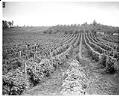
Photograph
Indigenous workers in berry field, Vashon Island, June 1943
The United States' entry into World War II in December 1941 created labor shortages as many men left civilian jobs to join the military. On the West Coast, the shortage was exacerbated by the forced removal of Japanese Americans, many of whom were farmers.In the summer of 1943, the Vashon Island Packing Company hired 80 First Nations people from British…
ID Number:PI23858
Date:1943
Photograph
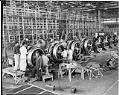
Men working on B-17 engines at the Boeing plant, November 1940
In 1940, some 7,500 Boeing Aircraft Company employees worked 24 hours per day to build B-17 Flying Fortress bombers for the British and American military. These long-range propeller-driven planes were capable of attacking an enemy fleet more than 1,000 miles offshore and conducting bombing raids on Germany from England. At this time, the United States had not yet entered World…
ID Number:PI23926
Date:1940
Photograph
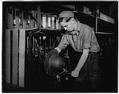
Man shaping a hat at the J.T. Hardeman Hat Company, Seattle, 1935
Polk's 1935 Seattle city directory lists the J.T. Hardeman Hat Company at 700 Republican Street, in what is now known as the South Lake Union neighborhood. The firm made men's fur felt hats. Handwritten on negative: Hats Candid.Handwritten on sleeve: Hats - men's.Date photograph was filed at the Seattle Post-Intelligencer (date of photograph and file date may differ by a…
ID Number:PI23969
Date:1935
Photograph
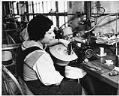
Woman sewing a hat at the J.T. Hardeman Hat Company, Seattle, 1935
Polk's 1935 Seattle city directory lists the J.T. Hardeman Hat Company at 700 Republican Street, in what is now known as the South Lake Union neighborhood. The firm made men's fur felt hats. Handwritten on negative: Hats candid.Handwritten on sleeve: Hats - men's.Date photograph was filed at the Seattle Post-Intelligencer (date of photograph and file date may differ by a…
ID Number:PI23970
Date:1935
Photograph
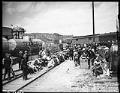
Striking longshoremen blocking train tracks at Pier 40, Smith Cove, Seattle, July 19, 1934
In the early 1930s, the International Longshoremen's Association, led by San Francisco-based Harry Bridges, tried to unionize all West Coast dockworkers to improve pay and working conditions. In 1934, after employers refused to recognize the union, West Coast longshoremen went out on strike for 98 days, seriously disrupting trade. At Seattle's Smith Cove, picketing strikers blocked access to the piers…
ID Number:PI23998
Date:1934
Photograph
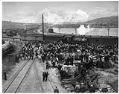
Policemen and striking longshoremen at Pier 40, Seattle, June 1934
In the early 1930s, the International Longshoremen's Association, led by San Francisco-based Harry Bridges, tried to unionize all West Coast dockworkers to improve pay and working conditions. In 1934, after employers refused to recognize the union, West Coast longshoremen went out on strike for 98 days, seriously disrupting trade. At Seattle's Smith Cove, picketing strikers blocked access to the piers…
ID Number:PI24001
Date:1934
Photograph
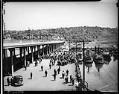
Waterfront strike at Smith Cove, July 19, 1934
In the early 1930s, the International Longshoremen's Association, led by San Francisco-based Harry Bridges, tried to unionize all West Coast dockworkers to improve pay and working conditions. In 1934, after employers refused to recognize the union, West Coast longshoremen went out on strike for 98 days, seriously disrupting trade. At Seattle's Smith Cove, picketing strikers blocked access to the piers…
ID Number:PI24004
Date:1934