733 results for: Labor and Labor Unions

Photograph
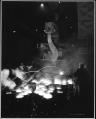
Welder at Todd Shipyards, Seattle, 1956
The Seattle Division of Todd Shipyard Corporation originated in 1916, when the William H. Todd Corporation purchased the Seattle Construction and Dry Dock Company (formerly Moran Brothers Shipyard). Originally located on the Seattle waterfront, the shipyard built cargo vessels for the U.S. Shipping Board during World War I. Todd moved the operation to a new plant on Harbor Island in…
ID Number:Lib1993.20.215
Date:1956
Photograph
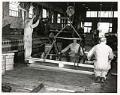
Bethlehem Steel Company factory, Seattle, 1957
New York City-born William Pigott (1860-1929) founded two of Seattle's major industrial enterprises, Seattle Steel Company and Seattle Car Manufacturing Company (later Pacific Car and Foundry Company, or PACCAR). Seattle Steel Company (later Bethlehem Steel Company and Birmingham Steel Company) began operations in 1905 on 55 acres of tide flats in Humphrey (later Youngstown and West Seattle). The steel and…
ID Number:Lib1993.20.313
Date:1957
Photograph
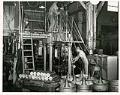
Employees working in lead manufacturing plant, Seattle circa 1950
Beginning about 1917, the Northwest Lead Company operated at 1744 Fourth Avenue South in Seattle. The plant manufactured lead products for the plumbing trade, mainly from lead produced by the Bunker Hill Mining Company of Kellogg, Idaho, which had acquired the plant in 1920. This image shows employees working with sheets of lead at the Seattle plant. Caption information source:…
ID Number:Lib1995.5.6
Date:Circa 1950
Photograph
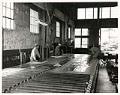
Employees working in lead manufacturing plant, Seattle circa 1950
Beginning about 1917, the Northwest Lead Company operated at 1744 Fourth Avenue South in Seattle. The plant manufactured lead products for the plumbing trade, mainly from lead produced by the Bunker Hill Mining Company of Kellogg, Idaho, which had acquired the plant in 1920. This image shows employees at work at the Seattle plant. Caption information source: The Seattle Sunday…
ID Number:Lib1995.5.8
Date:Circa 1950
Photograph
Employees working in lead manufacturing plant, Seattle circa 1950
Beginning about 1917, the Northwest Lead Company operated at 1744 Fourth Avenue South in Seattle. The plant manufactured lead products for the plumbing trade, mainly from lead produced by the Bunker Hill Mining Company of Kellogg, Idaho, which had acquired the plant in 1920. This image shows employees at work at the Seattle plant. Caption information source: The Seattle Sunday…
ID Number:Lib1995.5.9
Date:Circa 1950
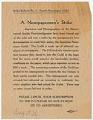
Ephemera
Seattle Newspaper Guild Strike Bulletin No. 1, August 1936
Spurred by "arbitrary" dismissals and assignment changes and other 'efficiency' moves" by the Seattle Post-Intelligencer, 35 newspaper writers went on strike from August 19 to November 29, 1936. This small group of strikers was able to force P-I owner William Randolph Hearst to recognize the union. Through the strike, the union was able to negotiate a 40-hour work week, originally…
ID Number:MS.COLL.1432
Date:1936
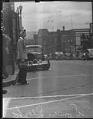
Photograph
Woman in work clothes waiting to cross street, Seattle, 1942
During World War II, many women were trained to fill the jobs left by men serving in the military. Women did auto repair, aircraft assembly and other jobs once considered men's work. Handwritten on image: Women slacks.Handwritten on sleeve: Fashions - slacks - women's.Date photograph was filed at the Seattle Post-Intelligencer (date of photograph and file date may differ by…
ID Number:PI21377
Date:1942
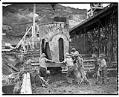
Photograph
Men emptying cement into form at dam construction site, circa 1937
After much research, the United States Bureau of Reclamation and its contractor, the MWAK Company, developed a very strong type of concrete for the Grand Coulee Dam. Two concrete mixing plants built at the dam site supplied 640 cubic yards of concrete per hour, breaking all earlier records. Traveling cranes moved the concrete to the building site in huge buckets.This…
ID Number:PI22043
Date:Circa 1937
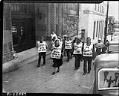
Photograph
Demonstrators with signs outside Seattle Chamber of Commerce during WPA strike, Seattle, 1937
In 1936, the federal Works Progress Administration hired some 9,000 unemployed King County residents on 271 different projects ranging from improving roads and parks to serving school lunches. Congress reduced funding for the WPA in 1937, causing nationwide layoffs. In Seattle, some workers stormed the WPA offices to protest the layoffs. Others staged sitdown strikes or picketed on downtown sidewalks.This…
ID Number:PI22387
Date:1937
Photograph
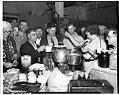
Woman serving soup to WPA strikers, Seattle, 1937
In 1936, the federal Works Progress Administration hired some 9,000 unemployed King County residents on 271 different projects ranging from improving roads and parks to serving school lunches. Congress reduced funding for the WPA in 1937, causing nationwide layoffs. In Seattle, some workers stormed the WPA offices to protest the layoffs. Others staged sitdown strikes or picketed on downtown sidewalks.…
ID Number:PI22389
Date:1937