134 results for: Lumber and Logging
Photograph
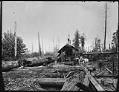
Yarding logs with a steam donkey, circa 1902
Yarding is the process of hauling logs to a central loading area or landing. Starting in the 1880s, steam engines began to replace animal teams for yarding logs. These steam donkeys or donkey engines were fueled with ever-plentiful wood. A long cable was attached to a log, and the donkey engine reeled it in. Many donkey engines were built on…
ID Number:1983.10.6910
Date:Circa 1902
Photograph
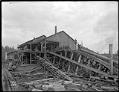
Lumber and shingle mill, circa 1905
Machias, a lumber town in Snohomish County, had a sawmill which cut both lumber and shingles.This photo was taken in Machias around 1905. Large logs (right) are being hauled up the chute to be cut into lumber. Smaller chunks of cedar (left) are riding up a chain belt to be sawed into shingles. Webster & Stevens number: 2471
ID Number:1983.10.6912
Date:Circa 1905
Photograph
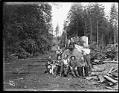
Children and logging crew with a big log, circa 1903
Sometime in the early 1900s, members of a logging crew and their children and dogs posed for a photographer from the Seattle firm of Webster & Stevens A big log provided a sign of the loggers' occupation as well as a convenient place for a little girl to sit. While the location of the photograph is unknown, it is probably…
ID Number:1983.10.6913
Date:Circa 1903
Photograph
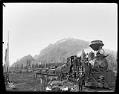
Logging train at Mt. Si, circa 1904
At first, logging companies cut trees along rivers and other bodies of water. They floated the logs downstream to the sawmill. After these areas were logged over, companies began using railroads to haul logs to a river or directly to the mill. The tracks could be moved as needed.This photo shows a Shay locomotive, the train crew, and flatcars full…
ID Number:1983.10.6916
Date:Circa 1904
Photograph
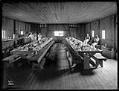
Logging camp cookhouse, circa 1904
Loggers ate their meals in the lumber camp's cookhouse. They needed three big meals to give them enough energy for ten hours of work in the woods. At a typical meal they might eat boiled corned beef, baked beans, potatoes, hash, pancakes, biscuits, butter, and coffee. Most lumber camp cooks were men.This photo shows the inside of a lumber camp…
ID Number:1983.10.6917
Date:Circa 1904
Photograph
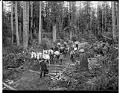
Horse team hauling logs on skid road, circa 1904
At first, loggers used oxen to haul logs out of the woods. Later, they used horses, which were more intelligent and easier to handle. The teams pulled the logs along skid roads to a river or railroad line. Skid roads were built of logs laid across or along the track. Greasing the skid road logs made it easier to pull…
ID Number:1983.10.6919
Date:Circa 1904
Photograph
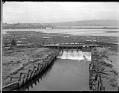
Lake Washington Ship Canal spillway near Fremont, circa 1915
During the building of the Lake Washington Ship Canal in Seattle, temporary dams were built at various places to control the water level. This photo, taken around 1915, shows the spillway of a temporary dam at the western end of Lake Union, near Fremont. Logs for a nearby lumber mill float behind the dam. The Stone Way Bridge and Capitol…
ID Number:1983.10.6935
Date:Circa 1915
Photograph
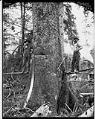
Fallers cutting a tree, circa 1905
The loggers who cut down trees were called fallers. Using their axes, they cut notches in the trunk for springboards. They then stood on the springboards and felled the tree with a crosscut saw. Cutting above ground level was easier because the trunk was narrower, and there was less pitch to gum up the saws. Even so, it might take…
ID Number:1983.10.7393
Date:Circa 1905
Photograph
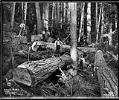
Bucking logs, circa 1905
Buckers got the logs ready to be hauled out of the woods. They cut off branches, and cut the trunks into proper lengths for the sawmill. They also beveled the ends of the logs to make them easier to move. Like all logging, bucking was very dangerous work, particularly on steep slopes. At any time, a log might roll over…
ID Number:1983.10.7394
Date:Circa 1905
Photograph
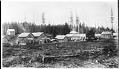
View of Enumclaw, Washington, circa 1905
Enumclaw, Washington, is located on the plateau between the Green and White Rivers. The town was platted in 1884, and the Columbia and Puget Sound Railroad came through in 1885. Enumclaw quickly became a boomtown of lumber mills and farms. Residents supplied timber and produce to the nearby mining towns of Black Diamond and Franklin.This photo shows a view of…
ID Number:1983.10.7423
Date:Circa 1905