134 results for: Lumber and Logging
Photograph
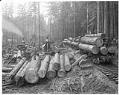
Loading logs, circa 1916
Loggers used steam engines called donkey engines or steam donkeys to load logs onto railroad cars. Loops of cable from a pair of donkey engines pulled the logs up an incline and onto the car. The car had stops on the far side to keep the logs from rolling off.This photo shows a pile of logs at an incline, ready…
ID Number:1983.10.10403
Date:Circa 1916
Photograph
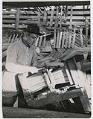
Man nailing a bundle of shingles, circa 1915
Washington state's important cedar shingle industry began in the 1870s and grew quickly. In the first six months of 1905 alone, over 18,000 railroad cars full of shingles left the state for building projects all over the United States.In this photo, taken at a Washington mill in about 1915, a worker finishes packing a bundle of shingles. The skilled workers…
ID Number:1983.10.PA18.73
Date:Circa 1915
Photograph
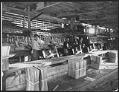
Men packing shingles, circa 1915
By 1893, Washington state had 150 mills which cut cedar shingles and sent them by rail to the rest of the United States. Cedar shingles make a good roof and wall covering because they are strong and light, and they shed rain and snow easily.In this photo, several millworkers pack the shingles into bundles. This photo was taken around 1915…
ID Number:1983.10.PA18.74
Date:1915
Photograph
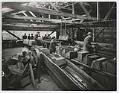
Shingle sawyers, circa 1915
Workers in the shingle mills took blocks of cedar, called bolts, and cut them to the right size with a series of saws. They then cut the wood into thin shingles. These skilled workers were called shingle weavers because of the way they moved the wood in the sharp saws. This was very dangerous work, and many millworkers had their…
ID Number:1983.10.PA18.75
Date:1915
Photograph
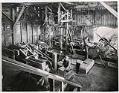
Workers in shingle mill, circa 1915
By 1893, Washington state had 150 mills which cut cedar shingles and sent them by rail to the rest of the United States. Cedar shingles make a good roof and wall covering because they are strong and light, and they shed rain and snow easily.In this photo, taken at a Washington mill in about 1915, workers are shown preparing shingle…
ID Number:1983.10.PA18.77
Date:Circa 1915
Photograph
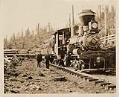
Logging train from the Preston Mill Company, circa 1925
By the 1920s, most of the forest near Puget Sound had been logged, and the mills had followed the loggers inland towards the Cascade Mountains. At that time, the Preston Mill Company, started in 1896 by Swedish immigrants, was one of the larger mills in King County.This 1920s photo, taken Clarke Kinsey, shows a railroad locomotive hauling logs through logged-off…
ID Number:1984.85.1
Date:Circa 1925
Photograph
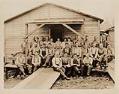
Preston Mill Company employees outside the mess hall, circa 1925
By the 1920s, most of the forest near Puget Sound had been logged, and the mills had followed the loggers inland towards the Cascade Mountains. The Preston Mill Company, in the Raging River Gorge between Issaquah and Snoqualmie, Washington, was one of the larger mills in King County. Swedish immigrants settled in the area in 1890 and opened the mill…
ID Number:1984.85.6
Date:Circa 1925
Photograph
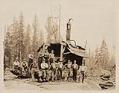
Preston Mill Company employees and donkey engine, circa 1925
By the 1920s, most of the forest near Puget Sound had been logged, and the mills had followed the loggers inland towards the Cascade Mountains. The Preston Mill Company, in the Raging River Gorge between Issaquah and Snoqualmie, Washington, was one of the larger mills in King County. Swedish immigrants settled in the area in 1890 and opened the mill…
ID Number:1984.85.9
Date:Circa 1925
Audio recording
Oral history interview with Tomo Shoji, April 10, 1985
Interview with Tomo Shoji about her experiences before and during World War II, conducted by Lorraine McConaghy for the Life on the Homefront Oral History Project, April 10, 1985. She discusses her parents' arrival in the U.S. and their work in a sawmill camp. Her mother later moved to Seattle and set up a midwifery practice for the Japanese community.…
ID Number:1985.134.22
Date:1985
Videorecording
Oral history interview with Norton Clapp, June 12, 1985
Norton Clapp (1906-1995) was a Seattle businessman and philanthropist. Clapp started working for the Weyerhaeuser Timber Company part-time in 1938, and returned to the company after serving in the Navy, replacing his father as director after his death. In 1960, he became president of Weyerhaeuser, serving in that position until 1966, and as Board member until 1970, before leaving to…
ID Number:1985.135.5
Date:1985