134 results for: Lumber and Logging
Photograph
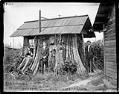
Stump House, circa 1905
The Stump House on the Lindstrom farm near Edgecomb, Washington was a great curiosity in the early 1900s. No one seems to know its original builder, but the house was widely photographed. It appeared on postcards and even souvenir china. Edgecomb was a logging area, between the Snohomish County towns of Marysville and Arlington.This photo, taken by Edmonds photographer Axtell,…
ID Number:1983.10.7565
Date:Circa 1905
Photograph
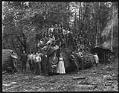
Loggers with large log, circa 1907
Handwritten on sleeve: Group of Loggers on large log.Photographer's Reference Number: 5366
ID Number:1983.10.7590
Date:Circa 1907
Photograph
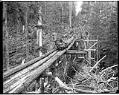
Moving a log down a trailing chute, circa 1910
Loggers often used wooden chutes to move cut logs to a central loading place. The chutes were temporary structures, built out of long straight logs called "chute sticks." In gravity chutes, logs slid downhill under their own weight. In trailing chutes, logs were pulled along by cables.This photo, taken around 1910, shows a trailing chute crossing a trestle near Cook's…
ID Number:1983.10.7663.2
Date:Circa 1910
Photograph
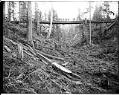
Skidding logs on a temporary bridge, circa 1910
In the northwest forests, wood was so plentiful that loggers used it to build many kinds of temporary structures. This photo, taken in about 1910, shows a temporary bridge used for skidding logs across a ravine at Cook's Camp, near Brennan, Washington. Notes: The photographer may be Axtell, a photographer based in Edmonds, Washington, who took other photographs at Cook's…
ID Number:1983.10.7664
Date:Circa 1910
Photograph
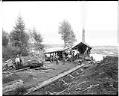
Yarding logs with a steam donkey, circa 1910
Yarding is the process of hauling logs to a central loading area or landing. Starting in the 1880s, steam engines began to replace animal teams for yarding logs. These steam donkeys or donkey engines were fueled with ever-plentiful wood. A long cable was attached to a log, and the donkey engine reeled it in. Many donkey engines were built on…
ID Number:1983.10.7666
Date:Circa 1910
Photograph
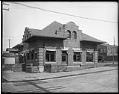
Stimson Mill office, Seattle, circa 1907
The Stimson Mill Company was one of the largest lumber mills in Ballard, and this building at Shilshole Avenue NW and NW Vernon Place was the headquarters. It is extant and used as a private residence. Handwritten on sleeve: Stimson Mill Office Bldg.Photographer's Reference Number: 6391
ID Number:1983.10.7757
Date:Circa 1907
Photograph
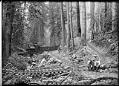
Men sitting near track in forest, circa 1913
Handwritten on sleeve: Timber Scene.Webster & Stevens number: 25383
ID Number:1983.10.9571
Date:Circa 1913
Photograph
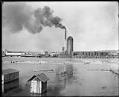
Seattle Cedar mill, circa 1916
The Seattle Cedar Lumber Manufacturing Company had a large mill in Ballard, just to the west of the Ballard Bridge. Logs were floated to the mill, and kept in the water until they were cut. The rough lumber was then stacked to dry before it was planed and sold.This photo, taken around 1916, shows the tall smokestack and piles of…
ID Number:1983.10.10353
Date:Circa 1916
Photograph
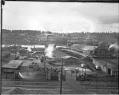
Stimson Mill in Ballard, Seattle, circa 1916
Handwritten on sleeve: Stimson Mill Pan.Webster & Stevens number: 52957
ID Number:1983.10.10386.2
Date:Circa 1916
Photograph
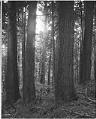
Loggers amidst large trees, circa 1917
The loggers who cut down trees were called fallers. Using their axes, they cut notches in the trunk for springboards. They then stood on the springboards and felled the tree with a crosscut saw. Cutting above ground level was easier because the trunk was narrower, and there was less pitch to gum up the saws. Even so, it might take…
ID Number:1983.10.10400.2
Date:Circa 1917