417 results for: Indigenous Peoples
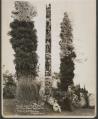
Postcard
J.E. Standley and young girl in front of a totem pole, Seattle, circa 1925
Ohio-born curio collector Joseph Edward "Daddy" Standley (1854-1940) came to Seattle in 1899 and opened Ye Olde Curiosity Shop on Second Avenue and Pike Street. He moved the shop to the Colman Dock on the waterfront in 1904, and since 1988 the shop has been located at Pier 54. Still a family-run business after five generations, the store attracts about…
ID Number:1980.6877.4.85
Date:Circa 1925
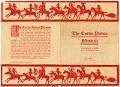
Program
The Curtis Picture Musicale program, circa 1912
From 1911 to 1913, photographer Edward S. Curtis toured the country with a multimedia production, The Curtis Picture Musicale, based on his photographs of Indigenous peoples. At this point, Curtis’s efforts to document Indigenous life had already taken 14 years, and he expected that it would take eight additional years to complete the project. The Musicale, a fund-raising effort, was…
ID Number:1980.7060.1
Date:Circa 1912
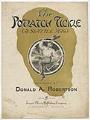
Music, notated
The Potlatch Tickle
The music for "The Potlatch Tickle (A Seattle Rag)" was composed by Donald A. Robertson, arranged by Carl A. Weber, and published by the Empire Music Publishing Company of Seattle. A native of Germany, Carl Alfred Weber (1863-1929) came to Seattle about 1910 and opened a music studio where he taught and arranged music. Donald Alexander Robertson (1888-1934) was a…
ID Number:1980.7097A.28
Date:1911
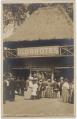
Postcard
Entrance to Igorrote Village, Pay Streak at Alaska-Yukon-Pacific Exposition, Seattle, 1909
The Alaska-Yukon-Pacific Exposition (AYPE) was a world's fair held in Seattle in 1909, publicizing the development of the Pacific Northwest. The fairgrounds became the campus of the University of Washington. One of the most popular attractions at the AYPE was the "Igorrote Village," a simulated village of the Igorot (previously spelled Igorrote), a diverse group of Indigenous Peoples living in…
ID Number:1980.7177.5.37
Date:1909
Postcard
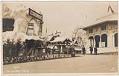
On the Pay Streak, Alaska-Yukon-Pacific Exposition, Seattle, 1909
The Alaska-Yukon-Pacific Exposition (AYPE) was a world's fair held in Seattle in 1909, publicizing the development of the Pacific Northwest. The fairgrounds became the campus of the University of Washington. The AYPE included a constructed "Eskimo Village," which exhibited Indigenous people as attractions for the fair's visitors. This postcard shows the "Eskimo Village" with the Ferris wheel visible in background.…
ID Number:1980.7177.5.38
Date:1909
Photograph
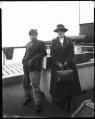
Red Cross nurse Elizabeth Brady and Indigenous man, Seattle, circa 1924
Born in Ireland, Elizabeth Brady was a member of the Providence School of Nursing's first graduating class. At the time this photo was taken, she was working as a Red Cross nurse for the city of Seattle. Her job was to follow up with patients originally seen by a doctor at the Seattle Health Department. She later worked as a…
ID Number:1983.10.202
Date:Circa 1924
Photograph
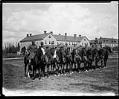
Cavalry at Fort Lawton, May 18, 1918
In 1897, the city of Seattle donated land on Magnolia Bluff to the US government to build a new Army post as part of a defense system for Puget Sound; this was designated as Fort Lawton in 1900. During most of its active service, the fort served as an embarkation station where troops gathered before being sent to duty in…
ID Number:1983.10.1017
Date:1918
Photograph
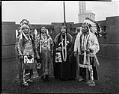
Two Yakama couples in traditional dress, Seattle, January 29, 1921
The Yakama (formerly spelled Yakima) people have lived in the Columbia River basin since time immemorial. During the winter, they lived in permanent villages built on the valley floor, where the climate was most temperate. Starting in spring, they traveled along the rivers and into the hills to gather food. Some gathered roots and berries, and others fished in rivers,…
ID Number:1983.10.2082.1
Date:1921
Photograph
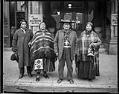
Two Yakama couples outside a Seattle hotel, January 29, 1921
The Yakama (formerly spelled Yakima) people have lived in the Columbia River basin since time immemorial. Historically, they lived in permanent winter villages built on the valley floor where the climate was most temperate. Starting in spring, they traveled along the rivers and into the hills to gather food. Some gathered roots and berries, and others fished in rivers, especially…
ID Number:1983.10.2082.2
Date:1921
Photograph
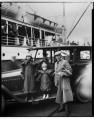
Roald Amundsen with Chukchi girls on waterfront, Seattle, 1921
Norwegian explorer Roald Amundsen was the first to reach the South Pole, but the Arctic was his first love. He designed his own ship, named it for Queen Maud of Norway, and christened it with a block of ice. The well-equipped expedition set off from Norway in June 1918 to explore the area near the North Pole. The ship spent…
ID Number:1983.10.2160
Date:1921