417 results for: Indigenous Peoples
Photograph
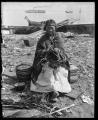
Makah woman making baskets at Neah Bay, circa 1905
The Makah people of the northwest tip of the Olympic Peninsula refer to themselves as Kwih-dich-chuh-ahtx, which translates roughly to "the people who live by the rocks and seagulls." The early Makah were skilled mariners, using several types of canoes which they carved from western red cedar for various purposes - war, whaling, fishing, sealing, carrying cargo, and long voyages.…
ID Number:1955.970.470.14
Date:Circa 1905
Photograph
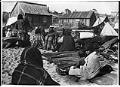
Group seated on the beach with trade items, Port Townsend, circa 1900
The people in this photograph are not identified, but the items they brought with them in their large sea-going canoes are visible-- bundles of dried cattails for weaving mats and a large, decorated Chinese trunk. The woman in the center appears to be holding a mirror. The buildings in the distant background indicate the location is probably Port Townsend, Washington.…
ID Number:1955.970.470.22
Date:Circa 1900
Photograph
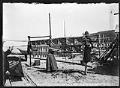
Makah woman drying fish on a rack, Neah Bay, circa 1900
The Makah people of the northwest tip of the Olympic Peninsula refer to themselves as Kwih-dich-chuh-ahtx, which translates roughly to "the people who live by the rocks and seagulls." The early Makah were skilled mariners, using several types of canoes which they carved from western red cedar for various purposes - war, whaling, fishing, sealing, carrying cargo, and long voyages.…
ID Number:1955.970.470.23
Date:Circa 1900
Photograph
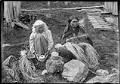
Two Makah basketmakers, Neah Bay, circa 1900
The Makah people of the northwest tip of the Olympic Peninsula refer to themselves as Kwih-dich-chuh-ahtx, which translates roughly to "the people who live by the rocks and seagulls." The early Makah were skilled mariners, using several types of canoes which they carved from western red cedar for various purposes - war, whaling, fishing, sealing, carrying cargo, and long voyages.…
ID Number:1955.970.470.25
Date:Circa 1900
Photograph
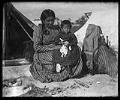
Makah woman and child with puppy, Port Townsend, circa 1900
The Makah people of the northwest tip of the Olympic Peninsula refer to themselves as Kwih-dich-chuh-ahtx, which translates roughly to "the people who live by the rocks and seagulls." The early Makah were skilled mariners, using several types of canoes which they carved from western red cedar for various purposes - war, whaling, fishing, sealing, carrying cargo, and long voyages.…
ID Number:1955.970.470.26
Date:Circa 1900
Photograph
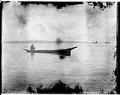
Coast Salish canoe in Port Townsend Bay, circa 1900
The Coast Salish style canoe was designed for use in the calm waters of Puget Sound and its many small bays and inlets. Both the prow and the stern curve upwards from a rounded bottom. Salish canoes were often painted black with brightly colored figures near the prow and stern. The Coast Salish style of canoe was more lightly constructed…
ID Number:1955.970.470.512
Date:Circa 1900
Photograph
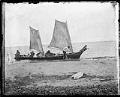
West Coast style canoe with two sails, circa 1900
By the turn of the 20th century, Indigenous seafarers adapted cloth sails, usually of the sprit-rig type seen in this image. Traditional sails of woven mats and wood slats had been used prior to the arrival of Europeans, but they were replaced by cloth once the Native peoples began trading with the settlers. This photograph was probably taken in Port…
ID Number:1955.970.470.513
Date:Circa 1900
Photograph
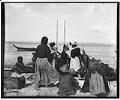
Women shopping for baskets on the beach, Port Townsend, circa 1895
The Makah people of the northwest tip of the Olympic Peninsula refer to themselves as Kwih-dich-chuh-ahtx, which translates roughly to "the people who live by the rocks and seagulls." The early Makah were skilled mariners, using several types of canoes which they carved from western red cedar for various purposes - war, whaling, fishing, sealing, carrying cargo, and long voyages.…
ID Number:1955.970.470.546
Date:Circa 1895
Ephemera
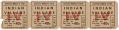
Strip of young adult admission tickets for the Indian Village exhibit, Seattle World's Fair, 1962
Tickets for children 15 years or under for the Indian village exhibit, printed with number 014511 through 014514. The Indian Village included a long house, teppes, and other displays, and hosted performers from various local Tribes as well as those from the Plains and eastern United States.
ID Number:1963.3119.52n
Date:1962
Photograph
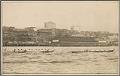
Indigenous boat races on Elliott Bay, Seattle, circa 1912
This image of Elliott Bay faces east with spectators lining the docks and streets of downtown Seattle visible in the background. Two Indigenous wooden dugout canoes with 11 men each are racing south along the shoreline in front of Belltown. The event likely took place during one of the Golden Potlatch celebrations staged in the summers of 1911, 1912, and…
ID Number:1971.5202.73
Date:Circa 1912