417 results for: Indigenous Peoples
Photograph
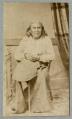
Chief Si'ahl (Chief Seattle), 1864
Chief Si'ahl, known to settlers as Chief Seattle, became the leader of the Suquamish and Duwamish peoples sometime around 1810. When settlers started moving to the Elliott Bay area in the 1850s, Chief Si'ahl stayed friendly to the newcomers and urged his people to do the same. The city of Seattle was named for him.This 1864 portrait of Chief Si'ahl…
ID Number:SHS67
Date:1864
Photograph
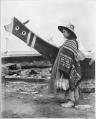
Indigenous woman and canoe at the Seattle waterfront, 1898
Indigenous people from many parts of the Pacific Northwest came to Seattle to trade and buy supplies. In this photo, a woman holding a basket stands by a large canoe at the Seattle waterfront. The design of the canoe and her hat suggest that she is from one of the First Nations in Vancouver Island or another part of coastal…
ID Number:SHS321
Date:1898
Photograph
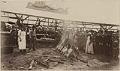
Puget Sound tribal members at the Railroad Jubilee barbecue, Seattle, September 1883
Northern Pacific Railroad Company President Henry Villard (1835-1900) visited Seattle shortly after he and U. S. President Ulysses S. Grant (1822-1885) drove the "golden spike" on September 8, 1883, near Independence Creek, Montana, symbolizing the completion of the of Northern Pacific Railroad. A celebration honoring the transcontinental railroad was held on the grounds of the Territorial University (now University of…
ID Number:SHS468
Date:1883
Photograph
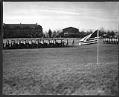
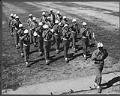
Signal Corps troops marching at Fort Lawton, January 29, 1944
In 1897, the city of Seattle donated land on Magnolia Bluff to the US government to build a new Army post as part of a defense system for Puget Sound; this was designated as Fort Lawton in 1900. During most of its active service, the fort served as an embarkation station where troops gathered before being sent to duty in…
ID Number:SHS822
Date:1944
Photograph
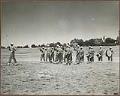
Signal Corp marching band at Fort Lawton, August 6, 1946
In 1897, the city of Seattle donated land on Magnolia Bluff to the US government to build a new Army post as part of a defense system for Puget Sound; this was designated as Fort Lawton in 1900. During most of its active service, the fort served as an embarkation station where troops gathered before being sent to duty in…
ID Number:SHS827
Date:1946
Photograph
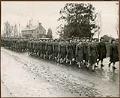
Military band parading at Fort Lawton, Seattle, August 9, 1946
In 1897, the city of Seattle donated land on Magnolia Bluff to the US government to build a new Army post as part of a defense system for Puget Sound; this was designated as Fort Lawton in 1900. During most of its active service, the fort served as an embarkation station where troops gathered before being sent to duty in…
ID Number:SHS873
Date:1946
Photograph
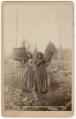
WACs parading at Fort Lawton, Seattle, February 3, 1944
In 1897, the city of Seattle donated land on Magnolia Bluff to the US government to build a new Army post as part of a defense system for Puget Sound; this was designated as Fort Lawton in 1900. During most of its active service, the fort served as an embarkation station where troops gathered before being sent to duty in…
ID Number:SHS876
Date:1944
Photograph
Indigenous women picking hops, Snoqualmie Hop Ranch, circa 1895
From the late 1860s to the early 1890s, hop farming was an important activity in the valleys of the Puget Sound region, including Puyallup, White River, and Snoqualmie. Indigenous workers came from throughout the Pacific Northwest, Canada, and Alaska (but especially from regional tribes like the Puyallup, Snoqualmie, Muckleshoot, Duwamish, Sammamish, Lummi, and Nisqually) as a seasonal labor force to…
ID Number:SHS1052
Date:Circa 1895
Photograph
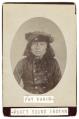
Pat Kanim, Snoqualmie Chief, circa 1855
The Snoqualmie people are a Coast Salish group who have lived in the Snoqualmie River Valley since time immemorial. They made dugout canoes which they used to navigate the river and reach Puget Sound. Traditionally the Snoqualmie burned off the bottom lands of the Snoqualmie Valley to create open areas that ensured an abundance of edible plants for foraging as…
ID Number:SHS1679
Date:Circa 1855
Photograph
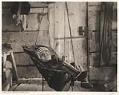
Infant asleep in a sling, Alaska, circa 1905
In this image, an infant wearing a cap covered with buttons sleeps in a birchbark sling rigged with a rocking mechanism. The style of the cap appears Tlingit, but the infant's moccasins and the sling are probably of Alaskan Athabaskan origin. Around the beginning of the 20th century, white photographers used photographs of Indigenous babies on commercial products, and this…
ID Number:SHS1765
Date:Circa 1905