3246 results for: Seattle Post-Intelligencer
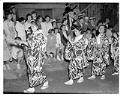
Photograph
Children dancing at Bon Odori festival, Seattle, 1936
During the summer of 1932, the Seattle Buddhist Church (Seattle Betsuin Buddhist Temple) held the city's first Bon Odori festival. Bon Odori is a Japanese dance which is part of the observance of Obon, a Buddhist memorial service. The joyful dance, which celebrates the Buddhist tradition of selfless giving, expresses gratitude to departed family members and ancestors. Over the years,…
ID Number:PI22451
Date:1936
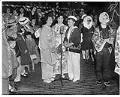
Photograph
Three women singing at Bon Odori festival, Seattle, 1937
During the summer of 1932, Seattle's first Bon Odori festival was held by the Seattle Buddhist Church (Seattle Betsuin Buddhist Temple). Bon Odori is a traditional Japanese style of dancing performed during Obon, a Buddhist memorial service. The joyful dance celebrates selfless giving and expresses gratitude to departed family members and ancestors. Over the years, the annual open-to-all event has…
ID Number:PI22454
Date:1937
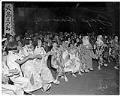
Photograph
Dancers at Bon Odori festival, Seattle, circa 1935
During the summer of 1932, Seattle's first Bon Odori festival was held by the Seattle Buddhist Church (Seattle Betsuin Buddhist Temple). Bon Odori is a traditional Japanese style of dancing performed during Obon, a Buddhist memorial service. The joyful dance celebrates selfless giving and expresses gratitude to departed family members and ancestors. Over the years, the annual open-to-all event has…
ID Number:PI22458
Date:Circa 1935
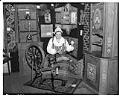
Photograph
Woman spinning in Swedish Folk Art exhibition, February 1937
In mid-February 1937, various Swedish groups sponsored a Swedish Folk Art Exhibit at Seattle's Frederick and Nelson department store. Exhibits included handicrafts, utensils, furniture and weaving and spinning demonstrations. During the exhibit, Mrs. Ingeborg Soderlund demonstrated how to spin thread on an early 19th century wheel brought to Seattle from Gamtland in northern Sweden.This photo, taken in Seattle in February…
ID Number:PI22473
Date:1937
Photograph
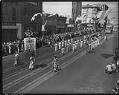
Chinese community marchers in Potlatch parade on Second Avenue, Seattle, 1938
Seattle's Potlatch of Progress opened July 28, 1938. During its four sunny days of events, Seattleites and visitors enjoyed several parades, a Native American canoe race, a swim carnival, horseracing, fishing contests, fireworks at Green Lake and the dedication of Alaskan Way.This photo shows a group from Seattle's Chinese community marching in a parade on Second Avenue. Note the streetcar…
ID Number:PI22612
Date:1938
Photograph
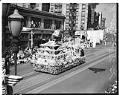
Japanese Chamber of Commerce float in Potlatch parade on Second Avenue, Seattle, 1939
Seattle's 1939 Potlatch Festival opened July 25 and ran for five days. Its Golden Jubilee theme celebrated Washington's 50 years of statehood. Events included a Western horse show, an original play on the history of Seattle, visiting warships, a beauty contest and three parades. On the last day of the festival, an estimated 300,000 people lined the streets and watched…
ID Number:PI22619
Date:1939
Photograph
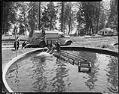
Trout rearing ponds at Seward Park, Seattle, 1948
In 1935, during the Great Depression, a Washington Emergency Relief Act work crew built fish rearing ponds at Seattle's Seward Park. The Washington State Department of Game supervised the fish hatchery and, in May 1948, delivered 250,000 young rainbow trout to the Cedar River and other area streams. Handwritten on image: Seward Park Rearing ponds.Handwritten on sleeve: Fish - Trout…
ID Number:PI23041
Date:1948
Photograph
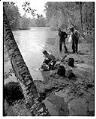
Man dumping fish into stream, May 1948
In 1935, during the Great Depression, a Washington Emergency Relief Act work crew built fish rearing ponds at Seattle's Seward Park. The Washington State Department of Game supervised the fish hatchery and, in May 1948, delivered 250,000 young rainbow trout to the Cedar River and other area streams.In this photo, taken around May 21, 1948, Washington State Department of Game…
ID Number:PI23045
Date:1948
Photograph
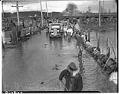
Men sandbagging during Green River flood, Kent, April 1938
In mid-April 1938, heavy rains caused flooding throughout western Washington state. Near Kent and Auburn, and throughout the Green River Valley, road crews worked hard to pile sandbags in the worst trouble spots. These road crews included workers from the Works Progress Administration (WPA), a federal relief agency set up to hire the unemployed during the Great Depression.In this photo,…
ID Number:PI23107
Date:1938
Photograph
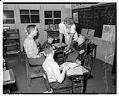
Students with disabilities in classroom, December, 1946
As early as 1911, the Seattle Public Schools had special education classes for students with disabilities and those with other special needs. In 1943, the district started classes for students with cerebral palsy at Warren Avenue School. The program moved to Lowell School in the 1960s.This 1946 photo shows a teacher, identified by the photographer's notes as Elizabeth Boxeth, and…
ID Number:PI23202
Date:1946