165 results for: Klondike-Alaska Gold Rush
Photograph
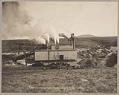
Dredge at Solomon River, Alaska, circa 1900
By 1901, many of Alaska's small scale mining operations had been replaced by large industrial mining companies. Many of these companies used large steam-powered dredges to scoop up the gravel from creekbeds. This photo, taken around 1900, shows a dredge belonging to the Three Friends Mining Co. working the Solomon River, Alaska. Original title: Three Friends Mining Co. dredge Solomon…
ID Number:SHS9546
Date:Circa 1900
Photograph
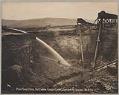
Hydraulic mining at Glacier Creek, near Nome, Alaska, circa 1904
By 1904, many of the gold mining claims around Nome, Alaska, were owned and operated by large mining companies. That year, the Miocene Ditch Company used hydraulic mining techniques at Price Bros. claim No. 2 below the original strike on Glacier Creek.This photo shows the Miocene Ditch Company's hydraulic mining operations at Glacier Creek, near Nome. A high powered stream…
ID Number:SHS9547
Date:Circa 1904
Photograph
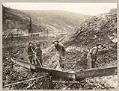
Manning a sluice at Bonanza Creek, circa 1898
Miners used water running through sluice boxes to wash the gold out of the pay dirt. Lumber for the sluice boxes was cut from nearby hills and finished in a nearby sawmill. As the hills were cleared, lumber became even more expensive. A typical two-man sluice was fifty feet long, ten inches tall, and twelve to fourteen inches across, with…
ID Number:SHS9548
Date:Circa 1898
Photograph
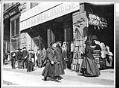
Second Avenue sidewalk during the gold rush, 1899
After news of gold strikes in the Klondike region reached Seattle in 1897, many local businesses boomed by selling specialty goods to the miners.This 1899 photo shows Seattle pedestrians walking by several outfitters on Second Avenue. Sleds lean against the outside walls of the buildings. Striped woolen blankets are stacked below a sign directing people upstairs to the Mosquito-Proof Tent…
ID Number:SHS9551
Date:1899
Photograph
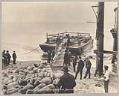
Landing sheep at Nome for Carstens Brothers & Dashley, circa 1900
There is no harbor at Nome, Alaska, and when the Nome gold rush started in 1899, there wasn't even a city. It was a challenge for ships to bring in passengers and supply the new town with food and fuel. Vessels anchored in deep water and barges brought freight and passengers to the shore through the shallows. Each year, supplies…
ID Number:SHS9552
Date:1900
Photograph
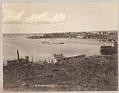
St. Michael, Alaska, circa 1900
The town of St. Michael, Alaska, is 124 miles southeast of Nome and around 85 miles from the mouth of the Yukon River. It was settled by Russian fur traders in 1835. In 1898 and 1899, Klondike gold seekers who could afford it sailed to St. Michael and rode a steamboat over 400 miles up the Yukon to the gold…
ID Number:SHS9554
Date:Circa 1900
Photograph
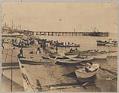
Nome wharf from Barrack Square, 1905
Around 1905, the city of Nome built a wharf for loading and unloading passengers and freight. In this 1905 photo by B.B. Dobbs, the wharf (background) appears to be under construction. The beach is filled with small boats which ferry freight and passengers between the city and ships anchored offshore. SHS category: Alaska - Waterfront
ID Number:SHS9562
Date:1905
Photograph
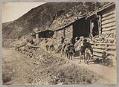
Mule train moving by the side of the Klondike River, circa 1904
Even after the opening of railroad and steamboat routes along the Yukon River and its tributaries, mules and other pack animals still carried some of the supplies to the Klondike gold fields. This was hard work, and good packtrain owners knew to pack their animals carefully and feed them well.In this photo, taken by Larss & Duclos around 1904, a…
ID Number:SHS9581
Date:Circa 1904
Photograph
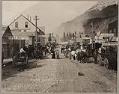
Skagway street scene, 1898
By 1898, Skagway, Alaska, had a busy business district which sold goods and services to people leaving for the Klondike gold fields.This photo shows downtown Skagway in 1898. Businesses which can be seen in the photo include drugstores, outfitters, an agency for hiring packers to carry one's supplies along the trail, a hardware store and tinsmith, and several saloons. Two…
ID Number:SHS9768
Date:1898
Photograph
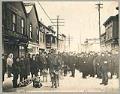
Ned Darling posing with dog sled team before departure for Seattle, Nome, Alaska, February 2, 1906
The world's record for the fastest time of a midwinter "mush" from Nome to Seattle via Valdez was set by Charles Edward "Ned" Darling (1871-1923) at 42 days, beating the previous record by four days. Born in Ireland, at the time of this image Ned was a hardware merchant in Nome, Alaska. He moved to Berkeley, California, before 1920 with…
ID Number:SHS9888
Date:1906