165 results for: Klondike-Alaska Gold Rush
Photograph
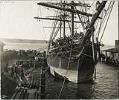
Sailing ship "Lucile" loading at Seattle pier, 1898
In 1897 and 1898 so many people wanted to go north to the Klondike gold fields that all kinds of ships were pressed into service. Some were sailing ships which had carried passengers, coal, lumber, or salmon up and down the west coast of the United States.This 1898 photo shows the wooden sailing ship "Lucile" loaded with gold miners and…
ID Number:SHS2551
Date:1898
Photograph
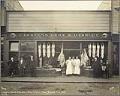
Carstens Bros & Dashley Meat Market employees outside store, Nome, October 1908
In 1890 German emigrant Julius August Carstens (1873-1949) arrived in Seattle with his brothers, Thomas and William. Together they founded the Carstens Brothers Meat Markets, later expanding the business into meat packing. In this image employees of the Carstens Brothers and Dashley Meat Market pose outside the shop in Nome, Alaska. In 1899 the brothers had expanded their business north…
ID Number:SHS3098
Date:1908
Photograph
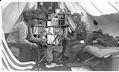
Two gold seekers in their tent, circa 1902
Many of the gold seekers and others who poured into the Yukon and Alaska lived in tents, at least for a short time. Photos of tent interiors are relatively unusual, however.In this photo, two men sit on cots in a tent while they enjoy a conversation. Two rifles hang below the makeshift shelf which is crowded with tools and other…
ID Number:SHS5280
Date:Circa 1902
Photograph
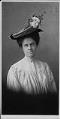
Mrs. Clara Goddard, Seattle, circa 1890
Clara Goddard lived at Kilbourne Avenue near Aurora in 1890 with her husband Albert, who, along with his brother Charles, ran a machinery business in Fremont. The handwritten note on the verso of the original photo provides us with a tantalizing bit of information about Mrs. Goddard's life a few years later during the Klondike gold rush.According to Mrs. Goddard's…
ID Number:SHS6108
Date:Circa 1890
Photograph
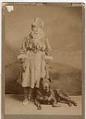
Mrs. Minerva Hose, governess in Skagway, circa 1900
In 1896, Tagish Indian Skookum Jim Mason and two other men made the first big gold strike on Rabbit (Bonanza) Creek, setting off the Klondike gold rush. Mason later employed Mrs. Minerva Hose to teach and take care of his daughter Daisy. Mrs. Hose was an early shopkeeper in Dyea, Alaska.This photo of Mrs. Minerva Hose was taken at the…
ID Number:SHS6370
Date:Circa 1900
Photograph
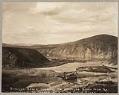
Dredging operation at Bonanza, Yukon Territory, circa 1903
Even as people poured into Dawson and the Yukon Territory during the summer of 1898, the day of the individual gold miner had begun to pass. Soon, large scale industrial mining companies were dredging the creekbeds with heavy equipment.This photo shows the Bonanza Basin, near where the Klondike River (foreground) meets the Yukon River (background). A dredge is working in…
ID Number:SHS7258
Date:Circa 1903
Photograph
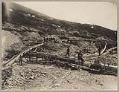
Miners and sluices on Bonanza Creek, circa 1898
Miners used water running through sluice boxes to wash the gold out of the pay dirt. Lumber for the sluice boxes was cut from the surrounding hills and finished in a nearby sawmill. As the hills were cleared, lumber became even more expensive. By the time this photo was taken, large mining companies had begun to replace small scale mining…
ID Number:SHS7300
Date:Circa 1898
Photograph
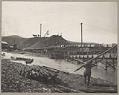
View of sluices and piles of gravel at Ophir, circa 1905
Gold strikes were made on Ophir Creek, near Nome, Alaska, in 1897. By 1905, the day of the individual miner had passed, giving way to larger scale industrial mining at Ophir and elsewhere.This photo, taken by Albert Kinne around 1905, shows the hoisting works at claim 14 at Ophir Creek. The hoists, possibly pulled by the horses (center left), lift…
ID Number:SHS7301
Date:Circa 1905
Photograph
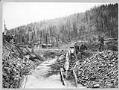
Men and sluice at Hunker Creek, circa 1898
Like Bonanza Creek, Hunker Creek flows into the Klondike River, Yukon Territory. During the season of 1898-99, $1.5 million of gold was mined at Hunker Creek. By 1899, the day of small scale mining had passed, and industrial mining had already begun.This photo of a group of miners working on a sluice at Hunker Creek was taken by Hegg &…
ID Number:SHS7302
Date:Circa 1898
Photograph
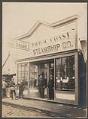
Steamship office and drug store in Nome, Alaska, circa 1903
By late fall 1899, reports of gold strikes at Nome gained enough credibility to draw gold seekers from Dawson. Some 2,500 people left Dawson for Nome, traveling by river or trail. Once the word was out in Seattle and elsewhere, the small settlement grew quickly.This photo shows a commercial building in Nome sometime between 1900 and 1905. A drugstore and…
ID Number:SHS7900
Date:Circa 1903