130 results for: Indigenous Peoples
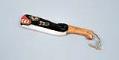
Fish club, 1900-1920
This fish club was carved and painted by an unknown local tribe, possibly for trade or other commercial use.
ID Number:1958.1581.2
Date:1900-1920
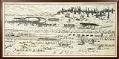
Drawing on animal hide by George Twok Aden Ahgupuk, ca. 1930-1950
George Twok Aden Ahgupuk (1911-2001) was an Inupiat native artist from Shishmaref, Alaska, whose work depicted village life, hunting of seals, walrus, whale, and polar bears, and Alaska wildlife and scenery, similar to what is featured in this piece. Twok developed his own technique for bleaching caribou, reindeer, and moose hides, and he shared this technique with no one. This…
ID Number:1959.1655.634
Date:Circa 1930-1950
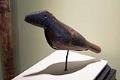
Wooden rattle in the shape of a bird, Lummi, ca. 1900
In the early 1900s a Lummi man carved this bird shape from wood, then filled it with stones to make a rattle. He painted it red and black: ceremonial colors. Then he—or his wife—would shake it during a spiritual dance ceremony.
ID Number:1959.1694.1
Date:Circa 1900
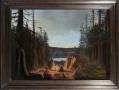
Oil painting of an Indigenous camp on Lake Union by Emily Inez Denny, 1886
The daughter of one of Seattle’s founding families, Emily Inez Denny (1853 – 1918) was both a painter and writer. Greatly influenced by seeing the drawings of Sarah Willoughby as a student at the Washington Territorial University, she took on painting as a life-long pursuit. In her 1909 book, “Blazing the Way,” Denny writes of an imagined scene from 1851:…
ID Number:1959.1791.2
Date:1886
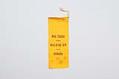
Ribbon with Chinook Jargon text, "Nika Chahko Kopa Washington Hyas Ahnkuttie," ca. 1910
Chinook Jargon was the trade language used by European American settlers to the Pacific Coast (originally fur traders) and Northwest Pacific Coast tribes. Many early settlers in Seattle were able to speak and understand it. As the language fell out of use, knowledge of Chinook Jargon became a point of pride and proof of longevity in the region. This ribbon…
ID Number:1960.1818.11
Date:Circa 1893-1911
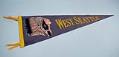
High school pennant, "West Seattle," ca. 1920-1960
This West Seattle High School pennant (date unknown) displays the controversial former "mascot" of an Indian chief. The symbol of the school has since been changed to Wildcats.The appropriation of Indigenous culture as mascots, or to market products or events, are some common examples of discrimination and marginalization faced by Native peoples in the United States.
ID Number:1961.2427.1
Date:Circa 1920-1960
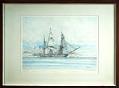
Drawing of USS Decatur, "Seattle-1855," by Hewitt Jackson, ca. 1961
Hewitt Jackson (1914-2007) was a seaman, marine draftsman, and artist. He is best known for his maritime drawings of ships that sailed the Puget Sound and Pacific Northwest. The MOHAI collection contains seven of Hewitt's works. This particular drawing features the USS Decatur which was an armed vessel anchored in Elliott Bay during the "Battle of Seattle" that took place…
ID Number:1961.2441.1
Date:1961
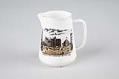
Souvenir pitcher with image of "Pioneer Place and Totem Pole," ca. 1905
This Seattle souvenir from around 1905 shows “Pioneer Place” (now called Pioneer Square) “and Totem Pole.” While difficult to spot in the illustration this refers to a Tlingit totem pole that was a tourist attraction in Seattle for decades. The totem was carved around 1870 to honor a high-ranking tribal woman named Aanséet. The pole was named Naas-shagee-yéil and it…
ID Number:1962.2550.3
Date:Circa 1905
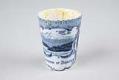
Blue and white souvenir tumbler, ca. 1909
This tumbler is a Seattle souvenir, likely from the time of the Alaska-Yukon-Pacific Exposition (AYPE) of 1909. The AYPE publicized the development of the Pacific Northwest and positioned Seattle as a gateway to Alaska and the Pacific Rim. This tumbler includes three important sites and views from around Seattle: Mount Rainier, Snoqualmie Falls, and the Totem pole at Pioneer Square.…
ID Number:1962.2652.3
Date:Circa 1909
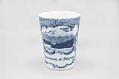
Blue and white souvenir tumbler, ca. 1909
This tumbler is a Seattle souvenir, likely from the time of the Alaska-Yukon-Pacific Exposition (AYPE) of 1909. The AYPE publicized the development of the Pacific Northwest and positioned Seattle as a gateway to Alaska and the Pacific Rim. This tumbler includes three important sites and views from around Seattle: Mount Rainier, Snoqualmie Falls, and the Totem pole at Pioneer Square.…
ID Number:1962.2652.4
Date:Circa 1909