101 results for: Great Depression
Photograph
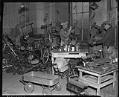
Men working in Salvation Army toy repair shop, 1937
In 1887, Salvation Army Captains Alfred and Lizzie Harris arrived in Seattle. Starting with only $20.00 in their pockets, the couple opened a hall in the basement of a saloon and started their ministry to the homeless and hungry. Over a century later, the Salvation Army continues its work in Seattle and King County, providing food, shelter, health services, counseling…
ID Number:PI21337
Date:1937
Photograph
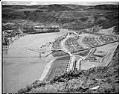
Engineers Town near site of Grand Coulee dam, circa 1937
Thousands of workers from all over the United States poured into the central Washington to work on the Grand Coulee Dam. Whether they were engineers, office workers or unskilled labor, all of these people and their families needed places to live. In December 1933, at the start of the dam project, workers graded the land for Engineers Town. Six months…
ID Number:PI22025
Date:Circa 1937
Photograph
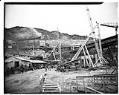
Change of shift at dam construction site, circa 1937
Work started on the Grand Coulee Dam in the fall of 1933 and was finished ten years later. Workers used a system of cranes, trestles, and conveyor belts to move the concrete and other construction materials into place. The men labored in shifts around the clock in winter and summer to build the dam on the Columbia River.This photo, taken…
ID Number:PI22031
Date:Circa 1937
Photograph
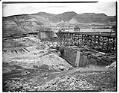
Trestles and traveling cranes at dam construction site, circa 1937
Large concrete dams, like Grand Coulee Dam, are actually built as a series of immense blocks, not as one solid structure. At Grand Coulee, workers poured concrete five feet at a time into wooden forms at the top of each column. A system of trestles and traveling cranes moved the workers and building materials to where they were needed.This photo,…
ID Number:PI22037
Date:Circa 1937
Photograph
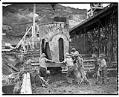
Men emptying cement into form at dam construction site, circa 1937
After much research, the United States Bureau of Reclamation and its contractor, the MWAK Company, developed a very strong type of concrete for the Grand Coulee Dam. Two concrete mixing plants built at the dam site supplied 640 cubic yards of concrete per hour, breaking all earlier records. Traveling cranes moved the concrete to the building site in huge buckets.This…
ID Number:PI22043
Date:Circa 1937
Photograph
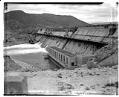
West side of Grand Coulee Dam showing powerhouse, March 1941
The Columbia Basin Project, including Grand Coulee Dam, was designed to supply irrigation water from the Columbia River to the dry lands of eastern Washington state. The dam also harnessed the power of the river to supply electricity to the Pacific Northwest. Irrigation and cheap hydroelectric power stimulated the growth of both agriculture and industry throughout the region.This photo, taken…
ID Number:PI22057
Date:1941
Photograph
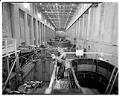
Inside a powerhouse at Grand Coulee Dam, August 1941
When Grand Coulee Dam was completed in 1943, its huge generators were the largest in the world, and the dam itself was one of the world's largest power plants. During World War II, the cheap electric power from Grand Coulee and Bonneville Dams stimulated the growth of the Pacific Northwest's aluminum, aircraft and shipbuilding industries and lit the homes of…
ID Number:PI22065
Date:1941
Photograph
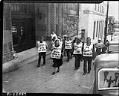
Demonstrators with signs outside Seattle Chamber of Commerce during WPA strike, Seattle, 1937
In 1936, the federal Works Progress Administration hired some 9,000 unemployed King County residents on 271 different projects ranging from improving roads and parks to serving school lunches. Congress reduced funding for the WPA in 1937, causing nationwide layoffs. In Seattle, some workers stormed the WPA offices to protest the layoffs. Others staged sitdown strikes or picketed on downtown sidewalks.This…
ID Number:PI22387
Date:1937
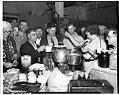
Photograph
Woman serving soup to WPA strikers, Seattle, 1937
In 1936, the federal Works Progress Administration hired some 9,000 unemployed King County residents on 271 different projects ranging from improving roads and parks to serving school lunches. Congress reduced funding for the WPA in 1937, causing nationwide layoffs. In Seattle, some workers stormed the WPA offices to protest the layoffs. Others staged sitdown strikes or picketed on downtown sidewalks.…
ID Number:PI22389
Date:1937
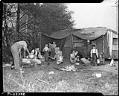
Photograph
Migrant family in makeshift housing, September 22, 1940
On September 22, 1940, a King County deputy sheriff found a family camped by the side of West Marginal Way. Harry Cooper had left North Dakota with his seven children, hoping to find a job in the Pacific Northwest. When found, the family had had nothing to eat for three days but some vegetables brought by neighbors.This photo shows the…
ID Number:PI22392
Date:1940