101 results for: Great Depression
Photograph
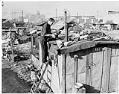
Edwin Hill repairing roof of shack in Hooverville, Seattle, November 1939
During the Depression of the 1930s, over 600 unemployed and homeless people lived in shacks on vacant land just south of downtown Seattle. They built their homes from scrap lumber and other materials which they found along the waterfront. This area, and similar places throughout the United States, were called Hoovervilles after President Herbert Hoover whom many people blamed for…
ID Number:PI22393
Date:1939
Photograph
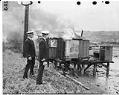
Naval officers watching Hooverville shack burn, June 6, 1942
During the Great Depression of the 1930s, many unemployed and homeless people throughout the United States built shantytowns on vacant lots. The settlements were called Hoovervilles, after President Herbert Hoover whom many blamed for the depression. In Seattle, shantytowns grew in the waterfront areas south of downtown Seattle and north near Smith Cove. When the United States entered World War…
ID Number:PI22395
Date:1942
Photograph
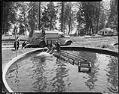
Trout rearing ponds at Seward Park, Seattle, 1948
In 1935, during the Great Depression, a Washington Emergency Relief Act work crew built fish rearing ponds at Seattle's Seward Park. The Washington State Department of Game supervised the fish hatchery and, in May 1948, delivered 250,000 young rainbow trout to the Cedar River and other area streams. Handwritten on image: Seward Park Rearing ponds.Handwritten on sleeve: Fish - Trout…
ID Number:PI23041
Date:1948
Photograph
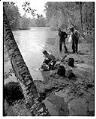
Man dumping fish into stream, May 1948
In 1935, during the Great Depression, a Washington Emergency Relief Act work crew built fish rearing ponds at Seattle's Seward Park. The Washington State Department of Game supervised the fish hatchery and, in May 1948, delivered 250,000 young rainbow trout to the Cedar River and other area streams.In this photo, taken around May 21, 1948, Washington State Department of Game…
ID Number:PI23045
Date:1948
Photograph
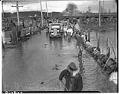
Men sandbagging during Green River flood, Kent, April 1938
In mid-April 1938, heavy rains caused flooding throughout western Washington state. Near Kent and Auburn, and throughout the Green River Valley, road crews worked hard to pile sandbags in the worst trouble spots. These road crews included workers from the Works Progress Administration (WPA), a federal relief agency set up to hire the unemployed during the Great Depression.In this photo,…
ID Number:PI23107
Date:1938
Photograph
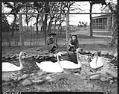
Girls with swans at Woodland Park Zoo, Seattle, 1937
In 1899, Seattle bought Woodland Park and its small zoo from the Phinney family. Most of the animals were kept in cages with bars and concrete floors. Visitors could go right up to the cages and feed the animals. During the economic depression of the 1930s, workers with the federal government's Works Projects Administration (WPA) built several animal habitats at…
ID Number:PI24721
Date:1937
Photograph
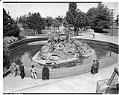
Monkey Island at Woodland Park Zoo, May 13, 1946
During the economic depression of the 1930s, workers with the federal government's Works Projects Administration (WPA) built Monkey Island and several other animal habitats at Seattle's Woodland Park Zoo. This photo, taken on a sunny day in May 1946, shows people watching the antics of the monkey colony on Monkey Island at Woodland Park. Written on original envelope: Seattle-parks-Woodland ZooDate…
ID Number:PI24732
Date:1946
Photograph
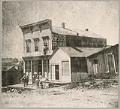
Intelligencer building at 1st and Cherry, circa 1876
Seattle's oldest newspaper, The Seattle Post-Intelligencer, was founded in 1863 as the weekly Seattle Gazette, when Seattle was little more than a sawmill, a few dozen wooden buildings, and a couple of hundred people. This image shows the paper's new building, constructed in 1874 by Henry Yesler at Front Street (now First Avenue) and Cherry Street. The name on the…
ID Number:SHS252
Date:Circa 1876
Photograph
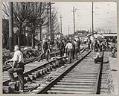
Relief project crew working on streetcar tracks, March 12, 1934
During the Great Depression of the 1930s, the United States government started a number of programs to help the unemployed. The Civil Works Administration (CWA) provided money for short-term public works projects during the winter months of 1933-1934. Thanks to funding from the CWA, King County was able to hire tens of thousands of workers for local projects.This photo, taken…
ID Number:SHS8525
Date:1934
Photograph
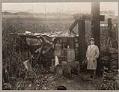
Mayor Robert Harlan standing by a shack at Hooverville, October 27, 1931
During the Depression of the 1930s, over 600 unemployed people lived in Hooverville, just south of downtown Seattle. There were several other such settlements in the city, and many others around the nation. The average Hooverville resident was a white, unmarried male, about 45 years old. During the booming 1910s and 1920s, he had been a logger, fisherman, miner, or…
ID Number:SHS8661
Date:1931