417 results for: Indigenous Peoples
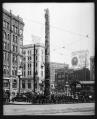
Photograph
Totem pole at Pioneer Square, 1915
This Tlingit totem was carved around 1790 to honor a tribal woman named Chief-of-All-Women and it was placed in the village of Tongass on the Alaska coast. In 1899, a group of leading Seattle businessmen on a goodwill tour of southeastern Alaska stole the totem and brought it back to Pioneer Square. The businessmen were indicted for the theft, but…
ID Number:1983.10.10030.1
Date:1915
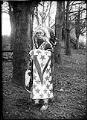
Photograph
William Shelton posing in traditional garments, circa 1925
William Shelton (1868-1938) was a well-known leader of the Snohomish Tribe who lived on the Tulalip Reservation. Chief Shelton carved a number of story poles, with animals and creatures prevalent in the Coast Salish oral tradition. Among the many examples of his carving that survive today is a story pole on the State Capitol campus in Olympia.In this image Mr.…
ID Number:1983.10.10923.1
Date:Circa 1925
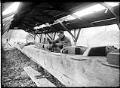
Photograph
William Shelton carving a story pole, circa 1920
William Shelton (1868-1938), named Wha-ceh-dub or Whah-kay-dub in his native language of Lushootseed, was a cultural leader of the Snohomish and expert woodworker. During his lifetime, Indigenous people were confined to live on reservations and their children were taken to boarding schools. These schools prohibited Indigenous customs or languages in an attempt to “civilize” Indigenous children and eradicate their culture.…
ID Number:1983.10.10923.2
Date:Circa 1920
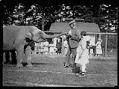
Photograph
Roald Amundsen and Chukchi girls with elephant at Woodland Park, Seattle, 1921
Norwegian explorer Roald Amundsen was the first to reach the South Pole, but the Arctic was his first love. He designed his own ship, named it for Queen Maud of Norway, and christened it with a block of ice. The well-equipped expedition set off from Norway in June 1918 to explore the area near the North Pole. The ship spent…
ID Number:1983.10.10978.2
Date:1921
Photograph
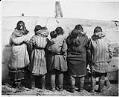
Native Alaskan women and children, 1905
In the early years of the 20th century, Frank H. Nowell, a Seattle photographer, spent several years in the area around Nome, Alaska. He took many photographs of the region and its native inhabitants and sold the photos to tourists and residents alike.In this photo, taken on a summer day in 1905, a group of Alaska Native, likely Inupiat, women…
ID Number:1983.10.13110
Date:1905
Photograph
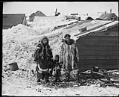
Angokwakzhuk and family, Nome, Alaska, 1905
In this 1905 photo, the Inupiat carver Angokwakzhuk (known as Happy Jack) stands next to his wife, Assongoyi, and daughter, Rose Ann Omelak, near a wooden building in Nome, Alaska. All three wear traditional fur parkas with fur-rimmed hoods.During the Nome gold rush, in the early years of the 20th century, Frank H. Nowell, a Seattle photographer, spent several years…
ID Number:1983.10.13161
Date:1905
Photograph
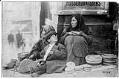
Indigenous family selling baskets in downtown Seattle, circa 1912
At the turn of 19th to 20th centuries, Indigenous artists in the Pacific Northwest were making baskets and carvings specifically for the tourist trade and were experimenting with form and design. Making baskets for sale became an important income source for many Indigenous families. In this photo, two women and a boy sit by their baskets on Second Avenue, outside…
ID Number:1983.10.PA2.1
Date:Circa 1912
Photograph
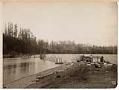
Salmon trap, circa 1911
For many years, Native Americans and others trapped migrating salmon by building wire mesh and net barriers across waterways. The fish were funneled into a trap and couldn't escape. Canneries ran traps too. Their boats regularly emptied the salmon traps and delivered the fish to the cannery. This method caught so many fish that salmon runs began to disappear. Salmon…
ID Number:1983.10.PA11.79
Date:Circa 1911
Photograph
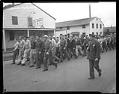
German prisoners at Fort Lawton, Seattle, 1945
In 1897, the city of Seattle donated land on Magnolia Bluff to the US government to build a new Army post as part of a defense system for Puget Sound; this was designated as Fort Lawton in 1900. During most of its active service, the fort served as an embarkation station where troops gathered before being sent to duty in…
ID Number:1986.5.3533.1
Date:1945
Photograph
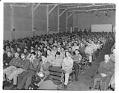
German prisoners viewing atrocity newsreels at Fort Lawton, Seattle, 1945
In 1897, the city of Seattle donated land on Magnolia Bluff to the US government to build a new Army post as part of a defense system for Puget Sound; this was designated as Fort Lawton in 1900. During most of its active service, the fort served as an embarkation station where troops gathered before being sent to duty in…
ID Number:1986.5.3533.2
Date:1945