185 results for: Coast Salish Peoples
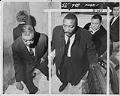
Photograph
Dick Gregory at Thurston County Superior Court, Olympia, November 20, 1966
Richard Claxton "Dick" Gregory (1932-) is an American comedian and civil rights activist, who helped call attention to Washington State laws restricting Native American rights. The "fish wars," as they were known at the time, led to the Boldt Decision, a federal ruling guaranteeing Washington tribes half the state's salmon and catch.In this image Dick Gregory, left, followed by Mad…
ID Number:2000.107.079.07.01
Date:1966
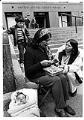
Photograph
Jean Halliday sitting outside federal courthouse, Seattle, April 6, 1970
Fort Lawton was a United States Army post located in the Magnolia neighborhood of Seattle, overlooking Puget Sound. In 1968 the site was rejected for proposed defense upgrades, and the Army began downsizing the property. In 1970 the United Indians of All Tribes Foundation (UIATF) presented a claim to all lands that might be declared surplus by the Army. Led…
ID Number:2000.107.095.26.01
Date:1970
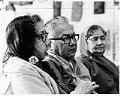
Photograph
Lottie J. Fenton, Charles James, and Ione H. Knox in Seattle, May 2, 1971
This image shows Lottie J. Fenton, left, Charles James, and Ione H. Knox, all members of the Duwamish Tribe, at the Indian Center on Boren Avenue and Stewart Street. They are listening to a description as to how local Native peoples might obtain permission from the State Department of Fisheries to harvest some of the expected heavy salmon run into…
ID Number:2000.107.095.26.02
Date:1971
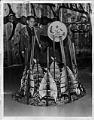
Photograph
Hyacinth David with drum at Tillicum Village, July 31, 1970
Tillicum Village was a Puget Sound area visitor attraction from 1962-2021 that was designed to showcase the arts, culture, and food of various Northwest Coast Salish Indigenous peoples. Blake Island Marine State Park is located in Puget Sound directly west of West Seattle.In this image Hyacinth David, a member of the Tla-o-qui-aht First Nation of Vancouver Island, Canada, holds a…
ID Number:2000.107.095.27.03
Date:1970
Photograph
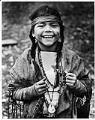
Ervina McCloud taking a break from dancing, Seattle, November 7, 1968
In this image, Ervina McCloud, 7, a member of the Tulalip Tribes from northwest Washington, smiles for the camera at the University of Washington HUB Auditorium. McCloud was one of a group of Northwest Native American dancers at a folk concert to benefit the Hopi Tribe in northeastern Arizona. Caption information source: The Seattle Times, November 8, 1968, page 31Caption…
ID Number:2000.107.095.28.02
Date:1968
Photograph
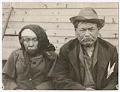
Sbeebayoo (Billy) and Ellen Phillips, Seattle, January 8, 1910
In 1910 Chief Si'ahl's (Chief Seattle) nephew, Sbeebayoo (known as "Indian Billy" Phillips) and his wife Ellen (1812-1910), members of the Duwamish Tribe, were struggling to survive in their home at the foot of Stacy Street, just south of the Pioneer Square neighborhood. Seattle Post-Intelligencer reporters seized the story, describing how Sbeebayoo's camping places along the Puget Sound shoreline had…
ID Number:2000.107.095.28.04
Date:1910
Photograph
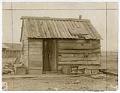
Ellen Phillips in doorway of her home, Seattle, May 10, 1910
In 1910 Chief Si'ahl's (Chief Seattle) nephew, Sbeebayoo (known as "Indian Billy" Phillips) and his wife Ellen (1812-1910), members of the Duwamish Tribe, were struggling to survive in their home at the foot of Stacy Street, just south of the Pioneer Square neighborhood. Seattle Post-Intelligencer reporters seized the story, describing how Sbeebayoo's camping places along the Puget Sound shoreline had…
ID Number:2000.107.095.28.05
Date:1910
Photograph
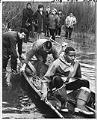
Dick Gregory on Nisqually River, March 1, 1966
Richard Claxton "Dick" Gregory (1932-2017) was an American comedian and civil rights activist who helped call attention to Washington State laws restricting Native American rights. The "fish wars" as they were known at the time, led to the Boldt Decision, a federal ruling guaranteeing Washington tribes half the state's salmon and steelhead trout catch.In this image Dick Gregory, foreground, sits…
ID Number:2000.107.095.30.02
Date:1966
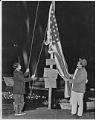
Photograph
Herman K. Johns Jr. and Billy Frank Jr. lower U.S. flag at protest fishing site, Frank's Landing, Nisqually River, January 21, 1964
In the 1960s, Native Americans and their supporters began protesting Washington State laws restricting Native American fishing rights that had been granted in a series of treaties with the United States between 1854 and 1855. The Survival of the American Indian Society (SAIA), the NAACP, and the National Indian Youth Council (NIYC), coordinated a series of protests and demonstrations over…
ID Number:2000.107.096.01.01
Date:1964
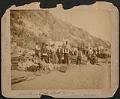
Photograph
Coast Salish group on beach, circa 1885
By the late 19th century, most Seattle-area Coast Salish peoples had been moved to reservations and were excluded from living in the city. Sometime before 1895, visiting Native peoples started camping on Ballast Island, at the foot of Washington Street. After 1895, waterfront development forced the encampment further from the central waterfront.In this photo, taken during the 1880s, a Coast…
ID Number:2000.107.096.06.01
Date:Circa 1885