185 results for: Coast Salish Peoples
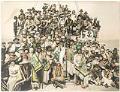
Photograph
Sourdough Club on ship "Portland" during Golden Potlatch, Seattle, July 17, 1912
The Tilikums of Elttaes were a fraternal civic organization composed primarily of influential white Seattle area businessmen, who used Native American imagery to promote tourism and the economic development of the city. The appropriation of culture in order to market products or events is a common example of discrimination and marginalization faced by Indigenous peoples in the United States. In…
ID Number:1954.776.1
Date:1912
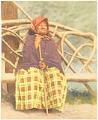
Photograph
Kikisoblu (Princess Angeline) seated at Madrona Park, Seattle, circa 1892
Kick-is-on-lo Cud, or Kikisoblu (circa 1816-1896), was the eldest daughter of Chief Seattle (Si'ahl), the leader of the Suquamish and Duwamish tribes. During her lifetime, she saw the coming of white settlers, the exile of her people from their traditional lands, and the growth of the new city named for her father. She didn't move to the Port Madison Reservation…
ID Number:1954.812.1
Date:Circa 1892
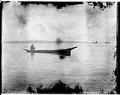
Photograph
Coast Salish canoe in Port Townsend Bay, circa 1900
The Coast Salish style canoe was designed for use in the calm waters of Puget Sound and its many small bays and inlets. Both the prow and the stern curve upwards from a rounded bottom. Salish canoes were often painted black with brightly colored figures near the prow and stern. The Coast Salish style of canoe was more lightly constructed…
ID Number:1955.970.470.512
Date:Circa 1900
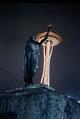
Photograph
Chief Si'ahl (Chief Seattle) statue and Space Needle, Seattle World's Fair, 1962
Amateur photographer Elmer Hike shot this unusual study in contrasts from just south of Denny Way. James Wehn's sculpture of Chief Si'ahl (Chief Seattle) stands in the foreground, reaching upwards towards the light at the top of the Space Needle. This was a slide sent to the World's Fair by an amateur photographer.Handwritten on slide: Chief Seattle appears holding light…
ID Number:1965.3598.27.1
Date:1962
Photograph
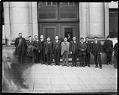
Group of Native American men at courthouse, circa 1920
Sometime between 1915 and 1923, Jerry Kanim, chief of the Snoqualmie Tribe, and a group of other men visited the King County Courthouse in Seattle. A photographer from the firm of Webster & Stevens snapped a photograph of the group but left no notes on the occasion. Kanim, chief since 1914, was active in pursuing land claims and fishing rights,…
ID Number:1983.10.2545
Date:Circa 1920
Photograph
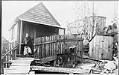
Kikisoblu (Princess Angeline) at her house, circa 1893
Kikisoblu was the eldest daughter of Chief Si'ahl (Chief Seattle). By the time this photo was taken, probably in the 1890s, her Suquamish and Duwamish people had been exiled to the Port Madison Reservation. White settlers renamed her Princess or Queen Angeline and built her a new home. Her house was located on Western Avenue near what is now Pike…
ID Number:1983.10.6086
Date:Circa 1893
Photograph
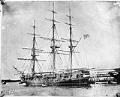
U.S.S. Decatur, circa 1850
During the early 1850s, hostility grew between the Native peoples and the new settlers in the Puget Sound region. The "Decatur" and several other government ships were moved to the area to protect the settlers. On January 26, 1856, following word of a planned attack on Seattle, troops on the "Decatur" fired howitzers into the forest beyond Third Avenue where…
ID Number:1983.10.6182
Date:Circa 1850
Photograph
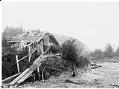
Hwehlchtid's house at low tide, Shilshole, circa 1903
Hwehlchtid (called Salmon Bay Charlie by the settlers) of the Shilshole people lived on the southern shore of Salmon Bay, near present-day Ballard, which was then outside of Seattle. Hwehlchtid and his wife Chilohleet'sa (Madeline) remained in their traditional homeland long after others of their tribe had moved away. This photograph showing Hwehlchtid and Chilohleet’sa’s home, later made into a…
ID Number:1983.10.6567
Date:Circa 1903
Photograph
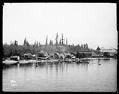
View of fishing camp at Eagle Harbor on Bainbridge Island, circa 1905
Bainbridge Island had been inhabited by the Suquamish people before the 1855 Treaty of Point Elliott. In the early 20th century, a group of Indigenous people from British Columbia set up a camp on Eagle Harbor, near what is now Waterfront Park in Winslow. They harvested clams and fish from Eagle Harbor and other nearby waters to sell to Seattle…
ID Number:1983.10.6948
Date:Circa 1905
Photograph
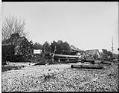
Fishing camp at Eagle Harbor on Bainbridge Island, circa 1905
Bainbridge Island had been inhabited by the Suquamish people before the 1855 Treaty of Point Elliott. In the early 20th century, a group of Indigenous people from British Columbia set up a camp on Eagle Harbor, near what is now Waterfront Park in Winslow. They harvested clams and fish from Eagle Harbor and other nearby waters to sell to Seattle…
ID Number:1983.10.6949
Date:Circa 1905