185 results for: Coast Salish Peoples
Photograph
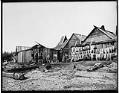
Fishing camp at Eagle Harbor on Bainbridge Island, circa 1905
Bainbridge Island had been inhabited by the Suquamish people before the 1855 Treaty of Point Elliott. In the early 20th century, a group of Indigenous people from British Columbia set up a camp on Eagle Harbor, near what is now Waterfront Park in Winslow. They harvested clams and fish from Eagle Harbor and other nearby waters to sell to Seattle…
ID Number:1983.10.6950
Date:Circa 1905
Photograph
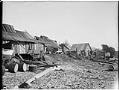
Fishing camp at Eagle Harbor on Bainbridge Island, circa 1905
Bainbridge Island had been inhabited by the Suquamish people before the 1855 Treaty of Point Elliott. In the early 20th century, a group of Indigenous people from British Columbia set up a camp on Eagle Harbor, near what is now Waterfront Park in Winslow. They harvested clams and fish from Eagle Harbor and other nearby waters to sell to Seattle…
ID Number:1983.10.6951
Date:Circa 1905
Photograph
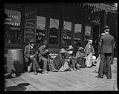
Group of Suquamish people waiting at Colman Dock, Seattle, circa 1911
The Suquamish tribe lived on Bainbridge Island and fished in the waters of Puget Sound long before Seattle was founded. The Suquamish carved dugout canoes and used them to travel to fishing and hunting grounds across Puget Sound. Fishing, especially for salmon, was of central importance to the Suquamish for both subsistence and culture. Suquamish fishers used subtle environmental clues…
ID Number:1983.10.7723
Date:1911
Photograph
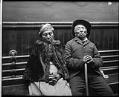
Man and woman, possibly Suquamish, seated inside a Seattle building, circa 1910
Although the photographers did not identify this couple or the location, it is possible that they are Suquamish, waiting in Seattle's federal courthouse. At approximately the same time, a group of Suquamish were photographed at Seattle's Colman Dock returning to the Port Madison Reservation, on Bainbridge Island, after trying to collect payments for land sold to the government. Webster &…
ID Number:1983.10.7792
Date:Circa 1910
Photograph
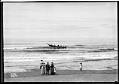
Quinault canoe and sightseers, Moclips, Washington, 1914
The Quinault are a Coast Salish people whose historic territory was the southwestern Olympic Peninsula. The current Quinault Indian Nation (QIN) has a reservation covering part of their historic lands. In addition to Quinault people, the QIN includes people from several neighboring tribes: Queets, Quileutes, Hohs, Chehalis, Chinook, and Cowlitz. Fishing, especially for salmon, is an important part of Quinault…
ID Number:1983.10.8687
Date:1914
Photograph
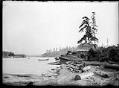
Hwehlchtid's house at Shilshole with canoe anchored offshore, circa 1905
In 1855, representatives of the Indigenous peoples of the area now known as Seattle, including the Duwamish and Suquamish, signed the Treaty of Point Elliott. As part of this treaty, many Indigenous people agreed to move in their tribal groups to reservations outside of the Seattle area, but some remained. In 1865 the Board of Trustees of Seattle passed Ordinance…
ID Number:1983.10.9067
Date:Circa 1905
Photograph
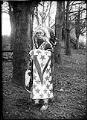
William Shelton posing in traditional garments, circa 1925
William Shelton (1868-1938) was a well-known leader of the Snohomish Tribe who lived on the Tulalip Reservation. Chief Shelton carved a number of story poles, with animals and creatures prevalent in the Coast Salish oral tradition. Among the many examples of his carving that survive today is a story pole on the State Capitol campus in Olympia.In this image Mr.…
ID Number:1983.10.10923.1
Date:Circa 1925
Photograph
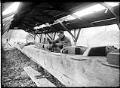
William Shelton carving a story pole, circa 1920
William Shelton (1868-1938), named Wha-ceh-dub or Whah-kay-dub in his native language of Lushootseed, was a cultural leader of the Snohomish and expert woodworker. During his lifetime, Indigenous people were confined to live on reservations and their children were taken to boarding schools. These schools prohibited Indigenous customs or languages in an attempt to “civilize” Indigenous children and eradicate their culture.…
ID Number:1983.10.10923.2
Date:Circa 1920
Photograph
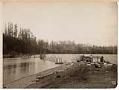
Salmon trap, circa 1911
For many years, Native Americans and others trapped migrating salmon by building wire mesh and net barriers across waterways. The fish were funneled into a trap and couldn't escape. Canneries ran traps too. Their boats regularly emptied the salmon traps and delivered the fish to the cannery. This method caught so many fish that salmon runs began to disappear. Salmon…
ID Number:1983.10.PA11.79
Date:Circa 1911
Photograph
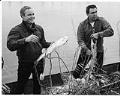
Marlon Brando and Bob Satiacum on Puyallup River, March 2, 1964
In the 1960s, Native Americans and their supporters began protesting Washington State laws restricting Native American fishing rights that had been granted in a series of treaties with the United States between 1854 and 1855. The Survival of the American Indian Society (SAIA), the NAACP, and the National Indian Youth Council (NIYC), coordinated a series of protests and peaceful demonstrations…
ID Number:1986.5.4414.1
Date:1964