584 results for: Alaska
Photograph
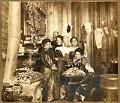
Theodore Wernecke and employees inside fur store, Seattle, circa 1898
An estimated 100,000 prospectors migrated to the Klondike region of the Yukon in north-western Canada between 1896 and 1899. Most of them stopped in Seattle to purchase supplies, greatly contributing to the city's economic success. Ohio-born Charles Theodore Wernecke (1852-1922) came to Seattle around 1897 and operated at least one store catering to miners headed to Alaska during the Klondike…
ID Number:SHS2508
Date:Circa 1898
Photograph
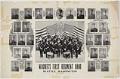
Wagner's First Regiment Band, Seattle, 1889
Cornetist Theodore H. “Dad” Wagner arrived in Seattle in the mid-1880s. As leader of the Second Regiment National Guard Band, Wagner’s band gained community fame by providing free concerts at Pioneer Square after Seattle’s Great Fire of 1889. That same year, he led the First Regiment Washington National Guard Band in celebration of Washington’s statehood. His own band, Dad Wagner’s…
ID Number:SHS2514
Date:1889
Photograph
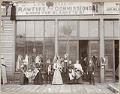
Exterior of C.T. Wernecke fur store, Seattle, circa 1897
Fur trading in the Pacific Northwest dates back to the 1700s. The first raw fur auction in the United States was organized in Seattle in 1898, coinciding with the Klondike Gold Rush, which had started in 1896. Ohio-born Charles Theodore Wernecke had come to Seattle in 1897 and ran a store that bought raw furs, manufactured fur clothing, and catered…
ID Number:SHS2525
Date:Circa 1897
Photograph
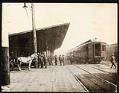
Northern Pacific depot, Seattle, circa 1899
Between 1892 and 1906, the Northern Pacific Railroad had a depot on Railroad Avenue at Columbia Street. Many people who were headed to the northern gold fields arrived by train at this Seattle railroad station. In 1906, the railroad moved its operations to the new King Street Station. Typed on sleeve: Railroad station on Railroad Ave. and Columbia St.
ID Number:SHS2546
Date:Circa 1899
Photograph
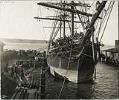
Sailing ship "Lucile" loading at Seattle pier, 1898
In 1897 and 1898 so many people wanted to go north to the Klondike gold fields that all kinds of ships were pressed into service. Some were sailing ships which had carried passengers, coal, lumber, or salmon up and down the west coast of the United States.This 1898 photo shows the wooden sailing ship "Lucile" loaded with gold miners and…
ID Number:SHS2551
Date:1898
Photograph
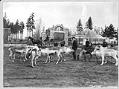
Reindeer and Sami at Woodland Park, 1898
In 1892, the United States government started bringing reindeer from Siberia into Alaska as a new food source for the native peoples. In 1898, the government brought in Norwegian reindeer, along with Sami herdsmen and their families. They stopped in Seattle to wait for a ship to Alaska. Some Sami remained in Alaska, while others eventually returned to Seattle or…
ID Number:SHS2899
Date:1898
Photograph
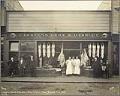
Carstens Bros & Dashley Meat Market employees outside store, Nome, October 1908
In 1890 German emigrant Julius August Carstens (1873-1949) arrived in Seattle with his brothers, Thomas and William. Together they founded the Carstens Brothers Meat Markets, later expanding the business into meat packing. In this image employees of the Carstens Brothers and Dashley Meat Market pose outside the shop in Nome, Alaska. In 1899 the brothers had expanded their business north…
ID Number:SHS3098
Date:1908
Photograph
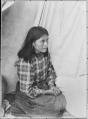
Young Indigenous woman named Tasha seated by a tent, circa 1900
From the late 1860s to the early 1890s, hop farming was an important activity in the valleys of the Puget Sound region, including Puyallup, White River, and Snoqualmie. Indigenous workers came from throughout the Pacific Northwest, Canada, and Alaska (but especially from regional tribes like the Puyallup, Snoqualmie, Muckleshoot, Duwamish, Sammamish, Lummi, and Nisqually) as a seasonal labor force to…
ID Number:SHS4880
Date:Circa 1900
Photograph
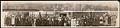
Seattle skyline and suffragists, 1915
The print pictured here features two panoramic images, one of the Seattle skyline, with many landmarks identified, and the other of a large group of people posing together on a city sidewalk. Most of the individuals are women, and several are proudly displaying copies of The Suffragist, a weekly newspaper published by the Congressional Union for Woman Suffrage. Handwritten on…
ID Number:SHS5211
Date:1915
Photograph
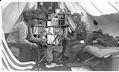
Two gold seekers in their tent, circa 1902
Many of the gold seekers and others who poured into the Yukon and Alaska lived in tents, at least for a short time. Photos of tent interiors are relatively unusual, however.In this photo, two men sit on cots in a tent while they enjoy a conversation. Two rifles hang below the makeshift shelf which is crowded with tools and other…
ID Number:SHS5280
Date:Circa 1902