417 results for: Indigenous Peoples
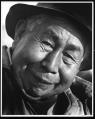
Photograph
Sherman Dominick, 1970
In the 1960s, Native Americans and their supporters began protesting Washington State laws restricting Native American fishing rights that had been granted in a series of treaties with the United States between 1854 and 1855. The Survival of the American Indian Society (SAIA), the NAACP, and the National Indian Youth Council (NIYC), coordinated a series of protests and peaceful demonstrations…
ID Number:Lib1993.20.240
Date:1970
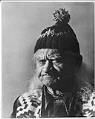
Photograph
William Frank, Sr., 1980
William Frank, Sr. (1879-1983) was a Nisqually elder, early tribal government official, and leader in the struggle for Indigenous fishing rights. His name at birth was Qu Lash Qud, and he was renamed Frank while at boarding school, after a white homesteader for whom his father worked. In 1917, the US Army took most of the Nisqually Reservation to expand…
ID Number:Lib1993.20.249
Date:1980
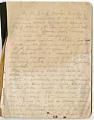
Manuscript
Henry A. Smith's recollection of 1856 "Battle of Seattle," circa 1900
On the morning of January 26, 1856, the "Battle of Seattle" began when Native Americans raided the settlement of Seattle. Previously warned of the attack, most settlers had barricaded themselves in a blockhouse. The attackers were driven off by artillery fire and by Marines from the U.S. Navy sloop-of-war Decatur, anchored in Elliott Bay. Although there were relatively few casualties…
ID Number:MS.COLL.204
Date:Circa 1900
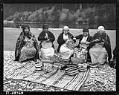
Photograph
Indigenous women making baskets, Olympic Peninsula, 1926
The women from coastal Washington's Indigenous tribes are known for their basketry. They made twined, coiled, and plaited baskets for gathering clams and berries, storing and serving food, and many other purposes. Basketry techniques were also used for hats and other clothing. At the start of the 20th century, Indigenous artists in the Pacific Northwest were making baskets specifically for…
ID Number:PI23768
Date:1926
Photograph
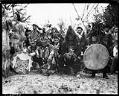
Indigenous group in ceremonial dress, Seattle, 1931
This image shows a group of Indigenous people dressed in elaborate ceremonial dress in the summer of 1931. It is possibly in connection with a display of Northwest Indigenous culture at the Seattle Exposition and Outdoor Show, which included a war dance demonstration every evening. The two men on the right wear feather headgear typical of Coast Salish spirit dancers.…
ID Number:PI23790
Date:1931
Photograph
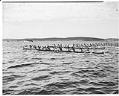
Canoe race at Coupeville festival, August 9, 1936
In 1936, the Coupeville Indian Water Festival culminated in a race of traditional canoes crewed by Indigenous people from Washington and British Columbia. Eleven canoes started the three-mile race in Penn's Cove on August 9, 1936, but only eight managed to finish. High winds caused three canoes to sink; the Lone Eagle from the Lummi Reservation sank only a few…
ID Number:PI23809
Date:1936
Photograph
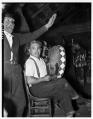
Swinomish drummer and singer at the Treaty Day observance, January 22, 1939
The Swinomish are a Coast Salish group whose historic lands were in the Skagit and Samish River valleys as well as Whidbey, Camano, Fidalgo Islands, and the San Juan Islands. They lived in large permanent villages during the winter, then spread out in spring and summer to gather resources – salmon from the rivers, shellfish from the coastline, cedar wood…
ID Number:PI23822
Date:1939
Photograph
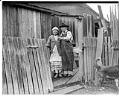
George and Mary Adams standing outside their home, Port Gamble Reservation, February 1939
In February 1939, the representatives of the Port Gamble band of the Clallam (now S’Klallam) people invited a Seattle Post-Intelligencer reporter and photographer to come to their village south of Hansville on the Olympic Peninsula. Chairman of the tribe’s governing committee Benny George, along with his aid Jackson and Rev. Karl Leonard of Bremerton, had been in contact with the…
ID Number:PI23825
Date:1939
Photograph
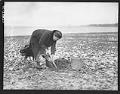
Josie Anderson digging clams, Port Gamble Reservation, February 1939
In February 1939, the representatives of the Port Gamble band of the Clallam (now S’Klallam) people invited a Seattle Post-Intelligencer reporter and photographer to come to their village south of Hansville on the Olympic Peninsula. Chairman of the tribe’s governing committee Benny George, along with his aid Jackson and Rev. Karl Leonard of Bremerton, had been in contact with the…
ID Number:PI23827
Date:1939
Photograph
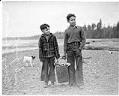
Skip George and Benny Anderson carrying clams at Point Julia, February 1939
In February 1939, the representatives of the Port Gamble band of the Clallam (now S’Klallam) people invited a Seattle Post-Intelligencer reporter and photographer to come to their village south of Hansville on the Olympic Peninsula. Chairman of the tribe’s governing committee Benny George, along with his aid Jackson and Rev. Karl Leonard of Bremerton, had been in contact with the…
ID Number:PI23828
Date:1939