3246 results for: Seattle Post-Intelligencer, The
Photograph
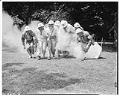
Madrona air raid wardens drilling with gas masks, August 1942
On August 2, 1942, Seattle staged a city-wide air raid drill to test its wartime emergency preparedness. Sirens wailed and army and navy planes roared low over the city as 58,000 civil defense workers handled traffic, dealt with imaginary fires, gave first aid and evacuated people from areas where bombs had supposedly landed. During the drill one theoretical bomb landed…
ID Number:PI27965
Date:1942
Photograph
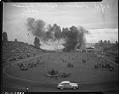
Army guns at civil defense demonstration in Husky Stadium, Seattle, 1943
Handwritten on negative: U of W stadium civilian defense show.Handwritten on sleeve: U.S. Army - Seattle - show (U of W stadium).Date photograph was filed at the Seattle Post-Intelligencer (date of photograph and file date may differ by a month or more): June 20, 1943.
ID Number:PI27983
Date:1943
Photograph
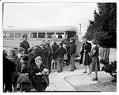
Civil defense workers in first aid drill, March 1942
During World War II, Seattle-area communities set up volunteer civil defense groups to help in case they were attacked. Men, women and even children joined up to help with such things as fighting fires, running air raid shelters, driving ambulances, and caring for the injured. Each community held periodic drills to make sure that everything would run smoothly in an…
ID Number:PI27990
Date:1942
Photograph
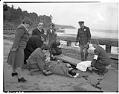
Civil defense workers in first aid drill, Vashon Island, 1942
During World War II, Seattle-area communities set up volunteer civil defense groups to help in case they were attacked. Men, women and even children joined up to help with such things as fighting fires, running air raid shelters, driving ambulances, and caring for the injured. Each community held periodic drills to make sure that everything would run smoothly in an…
ID Number:PI27991
Date:1942
Photograph
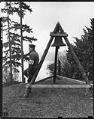
Paul Billingsley at civil defense lookout, Vashon Island, 1942
During World War II, Seattle-area communities set up volunteer civil defense groups to help in case they were attacked. Men, women and even children joined up to help with such things as fighting fires, running air raid shelters, driving ambulances, and caring for the injured. Each community held periodic drills to make sure that everything would run smoothly in an…
ID Number:PI27993
Date:1942
Photograph
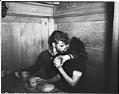
Sailor kissing girl during blackout, Seattle, 1941
In December 1941 an unidentified but creative photographer was assigned to cover what might happen in Seattle if wartime authorities declared a blackout. With all the lights turned off, a kiss stolen over coffee in a downtown cafe was oneof the results. Written on negative: Seattle blackoutHandwritten on sleeve: World War II - Seattle - blackoutDate photograph was filed at…
ID Number:PI28004
Date:1941
Photograph
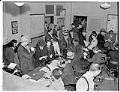
Japanese Americans surrendering equipment to police, Seattle, December 29, 1941
On February 19, 1942, shortly after Japan's attack on Pearl Harbor and United States entry into WWII, President Franklin Roosevelt signed Executive Order 9066, calling for the exclusion of all civilians of Japanese descent from "designated military areas." More than 9,000 Japanese and Japanese American people living in the Pacific Northwest were forced into incarceration at camps in Idaho and…
ID Number:PI28030
Date:1941
Photograph
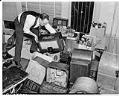
Man stacking radios surrendered by Japanese Americans, Seattle, December 29, 1941
On February 19, 1942, shortly after Japan's attack on Pearl Harbor and United States entry into WWII, President Franklin Roosevelt signed Executive Order 9066, calling for the exclusion of all civilians of Japanese descent from "designated military areas." More than 9,000 Japanese and Japanese American people living in the Pacific Northwest were forced into incarceration at camps in Idaho and…
ID Number:PI28032
Date:1942
Photograph
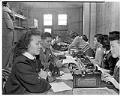
Japanese Americans registering for exclusion, Seattle, 1942
Shortly after the Japanese attacked Pearl Harbor, President Franklin Roosevelt signed Executive Order 9066, calling for the exclusion of all Japanese and Japanese Americans from "designated military areas." Although the United States was at war with Germany and Italy, few Italian and German Americans were placed in incarceration camps.This March 1942 photo shows Japanese Americans registering at the Seattle chapter…
ID Number:PI28033
Date:1942
Photograph
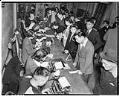
Japanese Americans registering for exclusion, Seattle, 1942
Shortly after the Japanese attacked Pearl Harbor, President Franklin Roosevelt signed Executive Order 9066, calling for the exclusion of all Japanese and Japanese Americans from "designated military areas." Although the United States was at war with Germany and Italy, few Italian and German Americans were placed in incarceration camps.This March 1942 photo shows Japanese Americans registering at the Seattle chapter…
ID Number:PI28034
Date:1942