587 results for: Asian American
Photograph
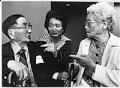
Incarceration camp survivors at reparations hearing, Seattle, September 11, 1981
The Commission on Wartime Relocation and Internment of Civilians (CWRIC) was appointed by Congress in 1980 to conduct an official study into Executive Order 9066 and the forced removal and incarceration of Japanese Americans during World War II. The CWRIC held public hearings in several U.S. cities, including Seattle, and the testimonies were recorded. In 1983, the Commission issued a…
ID Number:2000.107.098.19.08
Date:1981
Photograph
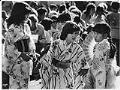
Dancers at Bon Odori festival, Seattle, July 24, 1982
During the summer of 1932, Seattle's first Bon Odori festival was held by the Seattle Buddhist Church (Seattle Betsuin Buddhist Temple). Bon Odori is a traditional Japanese style of dancing performed during Obon, a Buddhist memorial service. The joyful dance celebrates selfless giving and expresses gratitude to departed family members and ancestors. Over the years, the annual open-to-all event has…
ID Number:2000.107.098.19.09
Date:1982
Photograph
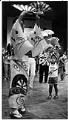
Kiki Hagimori instructs Corey Ojima for Bon Odori, Seattle, July 19, 1983
During the summer of 1932, Seattle's first Bon Odori festival was held by the Seattle Buddhist Church (Seattle Betsuin Buddhist Temple). Bon Odori is a traditional Japanese style of dancing performed during Obon, a Buddhist memorial service. The joyful dance celebrates selfless giving and expresses gratitude to departed family members and ancestors. Over the years, the annual open-to-all event has…
ID Number:2000.107.098.19.10
Date:1983
Photograph
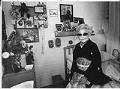
Midori Sugawara in her room at Keiro Nursing Home, Seattle, April 16, 1985
Seattle Keiro nursing home, designed to care for Issei (first generation Japanese immigrants), opened on September 30, 1976 at 24th Avenue South and South Massachusetts Street. Designed by Japanese Americans, the home sought to care for Japanese elders in a respectful and culturally familiar manner. In 1987, the nursing home moved to a larger facility at 16th Avenue and East…
ID Number:2000.107.098.19.11
Date:1985
Photograph
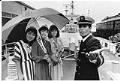
Seafair royalty touring Japanese training ship, Seattle, June 7, 1985
Seafair Royalty have been a part of Seattle's annual summer celebration since the festival's beginnings in 1950. Young women are chosen for the court to represent their neighborhood and/or ethnic community and are awarded academic scholarships.In this photo, the Seafair queen and princesses of Seattle's Japanese community stand under an umbrella while taking a tour of the Japanese Maritime Safety…
ID Number:2000.107.098.19.12
Date:1985
Photograph
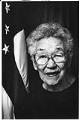
Kotaka Uomoto at Nisei Veterans Hall, Seattle, September 21, 1988
This photo shows Kotaka Uomoto posing in front of an American flag at the Nisei Veterans Hall in Seattle, where she participated in a twice-weekly nutrition program for Japanese senior citizens. Kotaka (1896-1993) and her husband Hyokichi Uomoto (1883-1965) arrived in Washington from Japan in 1916 and settled in Seattle. The couple had four sons: Yoshinori George (1919-2004), Kiyoshi Robert…
ID Number:2000.107.098.20.01
Date:1988
Photograph
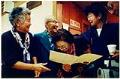
Kichisaburo Ishimitsu and friends at redress ceremony, Seattle, October 14, 1990
The Japanese American Redress Movement refers to the efforts, from the 1940s through the 1990s, to obtain the restitution of civil rights, monetary compensation, and an apology from the U.S. government for the forced removal and incarceration of Japanese Americans during World War II. Japanese Americans protested their mass incarceration with defiance and protests while living at the camps, and…
ID Number:2000.107.098.20.02
Date:1990
Photograph
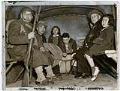
Japanese Americans from Bainbridge Island in back of military truck, March 31, 1942
In this image Seijiro Nakamura, second from left, and his children are shown seated in an army truck with Private Tony Bova. The elderly man on the right is Kihachi Hirakawa, pastor of the Japanese church at Winslow. The minister had held his final services three days before in the church he built with is own labor more than forty…
ID Number:2000.107.098.21.01
Date:1942
Photograph
Bob and Yoshi Hosokawa waiting for bus during forced removal, 1942
This image shows Bob and Yoshi Hosokawa, who had been married three months, awaiting their turn to board the bus for the train that will carry them to the Minidoka War Relocation Center in southern Idaho, where they would be incarcerated until 1945.On February 19, 1942, shortly after Japan's attack on Pearl Harbor and United States entry into WWII, President…
ID Number:2000.107.098.22.01
Date:1942
Photograph
Child waiting to be taken to an incarceration camp during WWII, November 30, 1942
On February 19, 1942, shortly after Japan's attack on Pearl Harbor and United States entry into WWII, President Franklin Roosevelt signed Executive Order 9066, calling for the exclusion of all civilians of Japanese descent from "designated military areas." More than 9,000 Japanese and Japanese American people living in the Pacific Northwest were forced into incarceration at camps in Idaho and…
ID Number:2000.107.098.22.02
Date:1942