587 results for: Asian American
Photograph
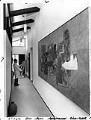
Paul Horiuchi at home, Seattle, August 12, 1967
Painter and collagist Paul Horiuchi (1906-1999) was one of the artists of the "Northwest School," an art movement which combined natural elements of the Puget Sound area with traditional Asian aesthetics to create a novel and distinct regional style.The Horiuchi family's Rainier Beach home, designed by T. Gregory Saito, was filled with natural light and provided ample space to hang…
ID Number:2000.107.091.28.04
Date:1967
Photograph
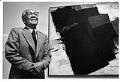
Paul Horiuchi and his painted collage, "Monolithic Impasse", Seattle, August 7, 1990
Painter and collagist Paul Horiuchi (1906-1999) was one of the artists of the "Northwest School," an art movement which combined natural elements of the Puget Sound area with traditional Asian aesthetics to create a novel and distinct regional style.Here, Horiuchi stands next to his 1964 work "Monolithic Impasse," in the Seattle Art Museum's 1990 exhibition "Views and Visions in the…
ID Number:2000.107.091.28.05
Date:1990
Photograph
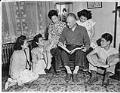
Kihara family at home after repatriation from Hiroshima, June 1947
In 1932, Tsueko Kihara and her five children left their home in Seattle for an extended visit to Japan. Her husband, Ichimatsu Kihara, remained in Seattle working as a fish wholesaler. When Japan invaded China in 1937, the Kiharas were unable to leave the country and were stuck in Japan during the entire Pacific War. On August 6th, 1945, the…
ID Number:2000.107.098.17.01
Date:1947
Photograph
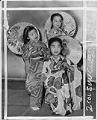
Three girls in costume at Hina Matsuri festival, Seattle, February 25, 1948
Hina Matsuri, also "Doll's Day," "Girls' Day," and "Momo no Sekku," is a Japanese religious holiday celebrated on March 3 to pray for the health and good future of young girls. Traditionally, parents or grandparents of a newborn girl buy a set of hina ningyo ("hina dolls") for the baby, unless they have special dolls that are inherited from generation…
ID Number:2000.107.098.17.02
Date:1948
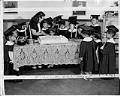
Photograph
Sallie Onishi cutting cake for her young students, Japanese Baptist Church, Seattle, July 1, 1948
Here, teacher Sallie Onishi cuts a huge cake to celebrate the end of classes for her 4-, 5- and 6- year old students at the Japanese Baptist Church in Seattle. The children had staged a pageant in Japanese costumes before donning caps and gowns for their "commencement" ceremony. Caption information source: Seattle Post Intelligencer photo caption, July 3, 1948, p.3
ID Number:2000.107.098.17.03
Date:1948
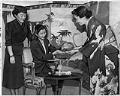
Photograph
Women practicing Japanese tea ceremony, Seattle, July 24, 1953
The Aiiku Guild was the first Japanese-American Orthopedic Guild in Seattle, supporting the Children's Orthopedic Hospital (now Seattle Children's Hospital) through its fundraising activities. Here, members of the Guild practice a Japanese tea ceremony, in preparation for a public demonstration in the exhibition hall at Frederick & Nelson later that summer. The event would also include a demonstration of flower…
ID Number:2000.107.098.17.04
Date:1953
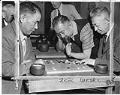
Photograph
Clarence Arai watching a game of Go at the Japanese Ki-in clubroom, Seattle March 6, 1957
Clarence T. Arai (1901-1963) was a Seattle lawyer and photographer, also known for his role in the founding of the Japanese American Citizen's League (JACL). He founded the first Japanese American Boy Scout troop in 1920, an became the first Japanese American graduate from University of Washington Law School in 1924. Arai was active in local politics and served as…
ID Number:2000.107.098.17.05
Date:1957
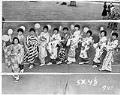
Photograph
Ten girls performing Bon Odori dance at Children's International Play Fair, Seattle, August 27, 1958
In 1944, the first annual national meeting of the Children’s Theatre Conference was organized with the objectives of promoting the establishment of children’s theatre activities in all communities by educational, community, and private groups, and to provide a meeting ground for children’s theatre workers and educators from all levels. Over the next decades the group grew to include operations in…
ID Number:2000.107.098.17.06
Date:1958
Photograph
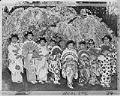
Dancers posing at Cherry Blossom Festival at UW Arboretum, Seattle, April 12, 1959
The Japanese tradition of holding events or festivals surrounding the short-lived blooming of ornamental cherry blossom trees (sakura) is thought to be centuries old and is maintained in many parts of the world. Cherry blossom festivals (hanami) are a reminder to celebrate life and to enjoy the transient beauty of flowers. They are held outside and often include a variety…
ID Number:2000.107.098.17.07
Date:1959
Photograph
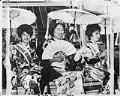
Japanese community "royalty" at Japan Week opening ceremony, Seattle World's Fair, July 23, 1962
Japan Week at the Seattle World's Fair (Century 21 Exposition) opened on July 23, 1962, with a celebration at the Plaza of States including music, dancing, speeches, and the national anthems of Japan and the U.S. played by Jackie Souder's World's Fair band. The "Royalty" of the Japanese community also participated in the festivities. Seafair Royalty have been a part…
ID Number:2000.107.098.18.01
Date:1962