587 results for: Asian American
Photograph
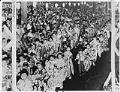
Dancers at Bon Odori festival, Seattle, July 14, 1963
During the summer of 1932, Seattle's first Bon Odori festival was held by the Seattle Buddhist Church (Seattle Betsuin Buddhist Temple). Bon Odori is a traditional Japanese style of dancing performed during Obon, a Buddhist memorial service. The joyful dance celebrates selfless giving and expresses gratitude to departed family members and ancestors. Over the years, the annual open-to-all event has…
ID Number:2000.107.098.18.02
Date:1963
Photograph
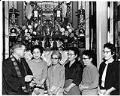
Rev. Kenryu Kumata with Buddhist Women's Federation officers, Seattle, April 20, 1963
The Seattle Buddhist Church (or Seattle Betsuin) at 1427 S Main Street was dedicated in October 1941, and replaced the original church building which was condemned for the development of the Yesler Terrace housing project. The disruption to the Japanese community from that project, and then the relocation of Japanese Americans into incarceration camps the following year destroyed the Japanese…
ID Number:2000.107.098.18.03
Date:1963
Photograph
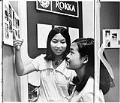
Young women looking at photos at "Pride and Shame" exhibit, Seattle, July 19, 1970
In the summer of 1970, the Seattle Japanese American Citizens League (JACL) organized an exhibit titled "Pride and Shame" that chronicled the experience of Japanese and Japanese Americans in the Pacific Northwest from the late 1880s to 1970. First shown at the Museum of History & Industy (MOHAI), the exhibit was in part a community celebration, with displays about Japanese…
ID Number:2000.107.098.18.04
Date:1970
Photograph
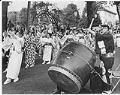
Drummer and dancers at Bon Odori festival, Seattle, July 1977
During the summer of 1932, the Seattle Buddhist Church held the city's first Bon Odori festival. Bon Odori is a Japanese dance which is part of the observance of Obon, a Buddhist memorial service. The joyful dance, which celebrates the Buddhist tradition of selfless giving, expresses gratitude to departed family members. Over the years, the festival grew to include flower…
ID Number:2000.107.098.19.01
Date:1977
Photograph
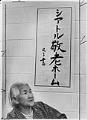
Mrs. Kin Hayashi at tour of Seattle Keiro nursing home, September 19, 1976
Seattle Keiro nursing home, designed to care for Issei (first generation Japanese immigrants) opened on September 30, 1976 at 24th Avenue South and South Massachusetts Street. Designed by Japanese Americans, the home sought to care for Japanese elders in a respectful and culturally familiar manner. In 1987, the nursing home moved to a larger facility with more than twice the…
ID Number:2000.107.098.19.02
Date:1976
Photograph
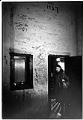
Yoshiko Mita at stage door of old Nippon Kan Theater, Seattle, February 14, 1979
In this photo, Japanese actress Yoshiko Mita stands in the stage door of the old Nippon Kan (Japanese Hall) Theater on S. Washington Street in Seattle's Chinatown International District. The graffitied walls are covered with names and dates that predate WWII. Built with funds from the community, the theater opened in 1909, and served as the cultural center of Seattle's…
ID Number:2000.107.098.19.03
Date:1979
Photograph
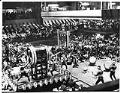
Drummers performing at Cherry Blossom Festival at Seattle Center, May 5, 1979
The Japanese tradition of holding events or festivals surrounding the short-lived blooming of ornamental cherry blossom trees (sakura) is thought to be centuries old and is maintained in many parts of the world. Cherry blossom festivals (hanami) are a reminder to celebrate life and to enjoy the transient beauty of flowers. They are held outside and often include a variety…
ID Number:2000.107.098.19.04
Date:1979
Photograph
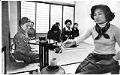
Student practicing Japanese tea ceremony, Seattle, November 20, 1980
Here, tea ceremony teacher Yoshiko Kubota watches student Atsuko Murao pour water from a kettle to make a frothy green tea. Ms. Kubota's school at 525 S. Main Street in Seattle's Chinatown International District was based on the principles of tea articulated by Grand Master Shoshitsu Sen and the Urasenke Foundation of Kyoto. In a simple room designed specifically for…
ID Number:2000.107.098.19.05
Date:1980
Photograph
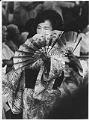
Dancers at Bon Odori festival, Seattle, July 27, 1981
During the summer of 1932, Seattle's first Bon Odori festival was held by the Seattle Buddhist Church (Seattle Betsuin Buddhist Temple). Bon Odori is a traditional Japanese style of dancing performed during Obon, a Buddhist memorial service. The joyful dance celebrates selfless giving and expresses gratitude to departed family members and ancestors. Over the years, the annual event open to…
ID Number:2000.107.098.19.06
Date:1981
Photograph
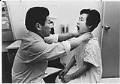
Rikuko Tanaka being examined by Dr. Michio Yamakido, Seattle, May 23, 1981
In this image, Rikuko Tanaka is examined by Dr. Michio Yamakido at the Public Health Service Hospital in Seattle. Tanaka was a survivor of the US nuclear bombing of Hiroshima in 1945. This exam was part of a study conducted by the Japanese government which aimed to keep track of the health of atom bomb survivors living in the US…
ID Number:2000.107.098.19.07
Date:1981