179 results for: Red
Photograph
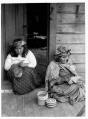
Two Makah basketmakers at Neah Bay, 1900
The Makah people of the northwest tip of the Olympic Peninsula refer to themselves as Kwih-dich-chuh-ahtx, which translates roughly to "the people who live by the rocks and seagulls." The early Makah were skilled mariners, using several types of canoes which they carved from western red cedar for various purposes - war, whaling, fishing, sealing, carrying cargo, and long voyages.…
ID Number:Lib1988.33.52
Date:1900
Photograph
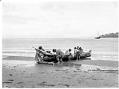
Makah group pulling a canoe on shore at Neah Bay, circa 1900
The Makah people of the northwest tip of the Olympic Peninsula refer to themselves as Kwih-dich-chuh-ahtx, which translates roughly to "the people who live by the rocks and seagulls." The early Makah were skilled mariners, using several types of canoes which they carved from western red cedar for various purposes - war, whaling, fishing, sealing, carrying cargo, and long voyages.…
ID Number:Lib1988.33.113
Date:Circa 1900
Photograph
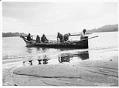
Makah whale hunters landing their canoe at Neah Bay, 1900
The Makah people of the northwest tip of the Olympic Peninsula refer to themselves as Kwih-dich-chuh-ahtx, which translates roughly to "the people who live by the rocks and seagulls." The early Makah were skilled mariners, using several types of canoes which they carved from western red cedar for various purposes - war, whaling, fishing, sealing, carrying cargo, and long voyages.…
ID Number:Lib1988.33.122
Date:1900
Photograph
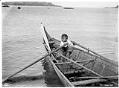
Makah boy rowing a canoe at Neah Bay, 1900
The Makah people of the northwest tip of the Olympic Peninsula refer to themselves as Kwih-dich-chuh-ahtx, which translates roughly to "the people who live by the rocks and seagulls." The early Makah were skilled mariners, using several types of canoes which they carved from western red cedar for various purposes - war, whaling, fishing, sealing, carrying cargo, and long voyages.…
ID Number:Lib1988.33.136
Date:1900
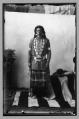
Photograph
Plateau man with a dentalium necklace, circa 1900
The Indigenous peoples of the Columbia Plateau include many different tribal groups. The Plateau peoples' historic lands are in what is now British Columbia, Washington, Idaho, Montana, and Oregon. In Washington, the Yakama, Nez Perce, Spokane, Colville, and other Plateau tribes live east of the Cascade Range in the Columbia River watershed. In this portrait, part of a series taken…
ID Number:Lib1992.9.67
Date:Circa 1900
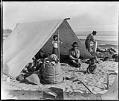
Photograph
Group of Makah people under a fly tent at Port Townsend, August 30, 1899
The Makah people of the northwest tip of the Olympic Peninsula refer to themselves as Kwih-dich-chuh-ahtx, which translates roughly to "the people who live by the rocks and seagulls." The early Makah were skilled mariners, using several types of canoes which they carved from western red cedar for various purposes - war, whaling, fishing, sealing, carrying cargo, and long voyages.…
ID Number:Lib1993.1.724
Date:1899
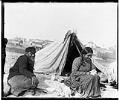
Photograph
Two Makah people at Port Townsend, September 2, 1899
The Makah people of the northwest tip of the Olympic Peninsula refer to themselves as Kwih-dich-chuh-ahtx, which translates roughly to "the people who live by the rocks and seagulls." The early Makah were skilled mariners, using several types of canoes which they carved from western red cedar for various purposes - war, whaling, fishing, sealing, carrying cargo, and long voyages.…
ID Number:Lib1993.1.728
Date:1899
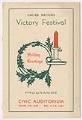
Program
Program for the United Nations Victory Festival, Seattle, December1945
The Seventh Annual United Nations Christmas Festival, known in 1945 as the Victory Festival, was held at Seattle's Civic Auditorium, with costumed representatives from fourteen countries participating in the "Pageant of the Nations Going Home," a celebration of courage and hope after the devastations of war. United Nations representatives from twenty nations attended, and the entertainment also included performances by…
ID Number:Lib1996.28.22
Date:1945
Ephemera
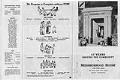
Community Chest brochure "Neighborhood House," 1953
Neighborhood House, founded in 1906, was originally created to serve as a settlement house for new Jewish immigrants in order to help them "integrate into American life." It later expanded its services to include "people of all ages, all faiths, all races." Operating under the Red Feather Agency, the Neighborhood House was a "pioneer member of Community Chest" as well…
ID Number:MS.COLL.1444
Date:1953
Photograph
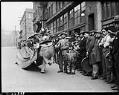
Chinese Lion Dance, circa 1930
Chinese American communities often hold a Lion Dance at the time of the lunar new year or when a new business opens. In Seattle during Chinese New Year, the lion dances through the Chinatown - International District and stops in front of businesses to wish them a prosperous year. The businesses offer the lion red envelopes of money, wrapped in…
ID Number:PI22398
Date:Circa 1930