417 results for: Indigenous Peoples
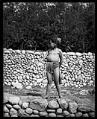
Photograph
Igorot child at Alaska-Yukon-Pacific Exposition, Seattle, 1909
The Alaska-Yukon-Pacific Exposition (AYPE) was a world's fair held in Seattle in 1909, publicizing the development of the Pacific Northwest. The fairgrounds became the campus of the University of Washington. One of the most popular attractions at the AYPE was the "Igorrote Village," a simulated village of the Igorot (previously spelled Igorrote), a diverse group of Indigenous peoples living in…
ID Number:1990.73.18
Date:1909
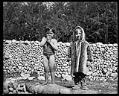
Photograph
Igorot child and Inuit child at Alaska-Yukon-Pacific Exposition, Seattle, 1909
The Alaska-Yukon-Pacific Exposition (AYPE) was a world's fair held in Seattle in 1909, publicizing the development of the Pacific Northwest. The fairgrounds became the campus of the University of Washington. One of the most popular attractions at the AYPE was the "Igorrote Village," a simulated village of the Igorot (previously spelled Igorrote), a diverse group of Indigenous peoples living in…
ID Number:1990.73.19
Date:1909
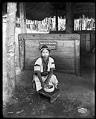
Photograph
Young woman making clay pot in Igorrote Village, Alaska-Yukon-Pacific Exposition, Seattle, 1909
The Alaska-Yukon-Pacific Exposition (AYPE) was a world's fair held in Seattle in 1909, publicizing the development of the Pacific Northwest. The fairgrounds became the campus of the University of Washington. One of the most popular attractions at the AYPE was the "Igorrote Village," a simulated village of the Igorot (previously spelled Igorrote), a diverse group of Indigenous peoples living in…
ID Number:1990.73.78
Date:1909
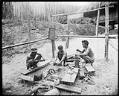
Photograph
Igorot pipe makers in exhibit at Alaska-Yukon-Pacific Exposition, Seattle, 1909
The Alaska-Yukon-Pacific Exposition (AYPE) was a world's fair held in Seattle in 1909, publicizing the development of the Pacific Northwest. The fairgrounds became the campus of the University of Washington. One of the most popular attractions at the AYPE was the "Igorrote Village," a simulated village of the Igorot (previously spelled Igorrote), a diverse group of Indigenous peoples living in…
ID Number:1990.73.94
Date:1909
Photograph
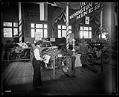
Two white men and and Igorot man in car exhibit, Alaska-Yukon-Pacific Exposition, Seattle, 1909
The vehicles pictured here participated in the first transcontinental auto race, beginning in New York on June 1, 1909, and ending at the AYPE on June 23, 1909. A model T Ford arrived first, but was disqualified because the drivers changed the engine during the race. The winner (the second to arrive) was a Shawmut. Six vehicles participated in the…
ID Number:1990.73.110
Date:1909
Photograph
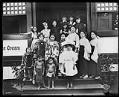
Group of children of different ethnicities, Alaska-Yukon-Pacific Exposition, Seattle, 1909
The Alaska-Yukon-Pacific Exposition (AYPE) was a world's fair held in Seattle in 1909, publicizing the development of the Pacific Northwest. The fairgrounds became the campus of the University of Washington. The children pictured may be assembled for "Children of All Nations Day," which was an event held at the AYPE. The event included children from Japan, China, Assyria, Egypt, Morocco,…
ID Number:1990.73.120
Date:1909
Photograph
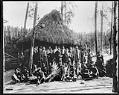
Igorot men and children with Masonic Lodge Members in front of Igorot hut, Alaska-Yukon-Pacific Exposition, Seattle, 1909
The Alaska-Yukon-Pacific Exposition (AYPE) was a world's fair held in Seattle in 1909, publicizing the development of the Pacific Northwest. The fairgrounds became the campus of the University of Washington. One of the most popular attractions at the AYPE was the "Igorrote Village," a simulated village of the Igorot (previously spelled Igorrote), a diverse group of Indigenous peoples living in…
ID Number:1990.73.144
Date:1909
Photograph
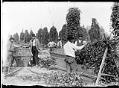
Indigenous men at work picking hops, circa 1890
From the late 1860s to the early 1890s, hop farming was an important activity in the valleys of the Puget Sound region, including Puyallup, White River, and Snoqualmie. Indigenous workers came from throughout the Pacific Northwest, Canada, and Alaska (but especially from regional tribes like the Puyallup, Snoqualmie, Muckleshoot, Duwamish, Sammamish, Lummi, and Nisqually) as a seasonal labor force to…
ID Number:1991.79.36
Date:Circa 1890
Photograph
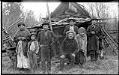
Cheholtz family in front of fishing shack, near Castle Rock, Washington, circa 1885
The Cowlitz People are a Coast Salish group whose historic lands are along the Cowlitz and Lewis Rivers, in what is now southwestern Washington. Traditionally, the annual cycle of resource gathering determined where the Cowlitz People traveled and at what time of year – from river fishing in the spring, gathering roots and berries in summer and fall, and making…
ID Number:1991.79.49
Date:Circa 1885
Photograph
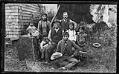
Group of Nooksacks near Lynden, Washington, circa 1900
The Nooksack are a Coast Salish people whose historic lands centered on the Nooksack River drainage basin, from the shore to around Mount Baker in the east. They have their own language, also named Nooksack. On the edges of Nooksack land and in offshore waters, resources were shared with neighboring peoples, to whom the Nooksack were linked by shared descent…
ID Number:1991.79.72
Date:Circa 1900