360 results for: Visual Arts
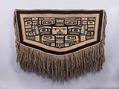
Chilkat blanket, ca. 1890-1910
The term "Chilkat Blanket" was created by European traders in the late 19th century. The Tlingit, Haida, and Tsmishian tribes had been making these blankets since the early 1800s and the Tlingit traditionally referred to the blanket as Naaxiin (or “fringe about the body”) and the Tsimshian as Gwis-halait (or “dancing blanket”).
ID Number:1964.3230.2
Date:Circa 1890-1910
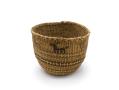
Coast Salish twined basket, ca. 1900-1940
This basket with its dog or wolf design is thought to be made by the Twana people who lived in the region around Hood Canal in the south Puget Sound.
ID Number:1964.3334.13
Date:Circa 1900-1940
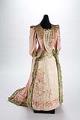
Silk ball gown worn by Alsora Hayner Fry, with rhododendron design handpainted by Jessie Elliot, 1893
This dress was worn by Mrs. Alsora Hayner (Minerva) Fry at the 1893 state ball in Olympia, where Mrs. Fry was the guest of honor. Fry was the chief promoter of the rhododendron as the Washington state flower. She came to Seattle in 1888 and was the charter member of the Woman's Century Club and its first president. The dress…
ID Number:1964.3359.C1083
Date:1893
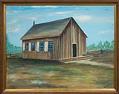
Painting of Maple School, the first schoolhouse in King County, 1862-1895, by Beulah Maple Norman, ca. 1960
The first schoolhouse in King County stood on the site of present Boeing Field, land that was once owned by the Maple family. The artist's grandfather, Jacob Maple, was already clearing land for settlement along the Duwamish River a few months before the Denny party landed at Alki Point. Beulah Maple Norman (1893-1992) took up amateur painting in order to…
ID Number:1965.3696
Date:Circa 1960
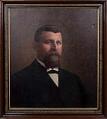
Oil portrait of Moritz Thomsen by Roman Fekonja, 1895
Moritz Thomsen (1850-1932), a former Dutch sea captain, arrived in Seattle in 1896 and co-founded the Centennial Mill Company (now Krusteaz brand). A tireless industrialist, Thomsen at one time was president of fourteen corporations, including the Centennial Mill Company, and the Denny-Renton Clay & Coal Company. Little is known about the artist, Roman Fekonja (1868-1910), except he was born in…
ID Number:1965.3758.4
Date:1895
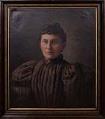
Oil portrait of Marie Thomsen by Roman Fekonja, 1895
This portrait of Marie Thomsen, born Marie Nissen, was painted when she was 44 years old. She arrived in Seattle with her husband, Moritz Thomsen (1850-1932), in 1896. Moritz co-founded the Centennial Mill Company (now Krusteaz brand), and he was, at one time, president of fourteen corporations, including the Centennial Mill Company, and the Denny-Renton Clay & Coal Company. Little…
ID Number:1965.3758.5
Date:1895
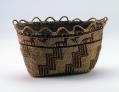
Skokomish twined basket, ca. 1900
The Skokomish Tribe was originally primarily composed of Twana Indians, a Salishan people from the Hood Canal drainage basin in western Washington State. The Twana subsisted on hunting, fishing and gathering activities, moving around in warmer weather and settling on more permanent sites during colder climes. Twana descendants live on the Skokomish Reservation, and all have become known as the…
ID Number:1965.3775.8
Date:Circa 1900
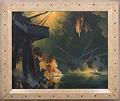
Painting of a nighttime naval battle off Saipan by Edward Grigware, 1944
The artist, Edward Grigware (1889-1960), lived in Seattle and Spokane and was an accomplished mural artist. During World War II, he was a War Record painter for the US Navy, working from the carrier Enterprise in the midst of the Pacific campaigns. Some of his works appeared in Life magazine.
ID Number:1966.3803
Date:Circa 1944-1950
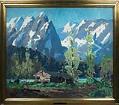
Painting of Mt. Index, by Eustace Ziegler, ca. 1934, with unfinished painting of Mt. McKinley and packhorses on verso
By the beginning of Great Depression, Eustace Ziegler (1881-1969) was an established and successful artist. In 1933, the US government launched an ambitious program of cultural aid including direct aid for artist hard hit by the depression. Ziegler had long advocated government funding for the arts and, in a show of support for the program, he donated this painting to…
ID Number:1966.3848.1
Date:1934
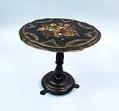
Papier-mâché tilt top table made in Great Britain, 1840-1855
Papier-mâché, or paperware, is a form of paper pulp, glue, chalk and fine sand which is molded, baked, then lacquered. The process was first patented in Britain in 1772. Only a few pieces survive in museum collections, and MOHAI is fortunate to have this table in excellent condition. Early papier-mâché furniture pieces were decorated with gilding and mother of pearl.…
ID Number:1966.4005.1
Date:1840-1855