360 results for: Visual Arts
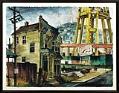
Painting by Thomas Wells of the Space Needle and surrounding neighborhood during the construction of the Seattle World's Fair, 1962
The artist Thomas Wells (1916 – 2003) was born in Chicago, Illinois. He was a member of the Marine Historical Societies of Seattle, San Diego, San Francisco, and New York, and a life member of the Puget Sound Group of Northwest Painters. The theme of the Seattle World's Fair, Century 21, was inspired by the promise of a new age.…
ID Number:1963.3119.6
Date:1962
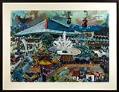
Painting by Jess Cauthorn of a bird's-eye panoramic view of the Seattle World's Fair, 1962
Artist Jess Cauthorn (1923-2005), born in Seattle was originally a student, and then became the owner and taught at the Burnley School of Professional Art in Seattle. He was a member of the American Watercolor Society, Puget Sound Group of Northwest Painters, and the Northwest Watercolor Society. This brightly colored piece charmingly illustrates the Seattle World's Fair grounds.
ID Number:1963.3119.7
Date:1962
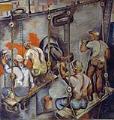
Oil painting, "Scraping and Painting" or "Chipping Rust," part of "Men Who Work the Ships" mural by Kenneth Callahan, 1936
Kenneth Callahan (1905-1986) was born in Spokane and lived in Seattle, becoming a nationally known artist, most celebrated for his murals. Self-taught as a painter and sculptor, he is best known as a leading figure in the Northwest School along with Mark Tobey, Morris Graves, and Guy Anderson. Commissioned in 1936 under the Treasury Relief Art Project (TRAP), Callahan painted…
ID Number:1963.3128.1
Date:1936
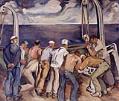
Oil painting, "Life Boat Drill," part of "Men Who Work the Ships" mural by Kenneth Callahan, 1936
Kenneth Callahan (1905-1986) was born in Spokane and lived in Seattle, becoming a nationally known artist, most celebrated for his murals. Self-taught as a painter and sculptor, he is best known as a leading figure in the Northwest School along with Mark Tobey, Morris Graves, and Guy Anderson. Commissioned in 1936 under the Treasury Relief Art Project (TRAP), Callahan painted…
ID Number:1963.3128.2
Date:1936
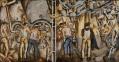
Oil painting, "Engine Room," part of "Men Who Work the Ships" mural by Kenneth Callahan, 1936
Kenneth Callahan (1905-1986) was born in Spokane and lived in Seattle, becoming a nationally known artist, most celebrated for his murals. Self-taught as a painter and sculptor, he is best known as a leading figure in the Northwest School along with Mark Tobey, Morris Graves, and Guy Anderson. Commissioned in 1936 under the Treasury Relief Art Project (TRAP), Callahan painted…
ID Number:1963.3128.3
Date:1936
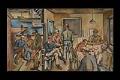
Oil painting, "Hiring Hall," part of "Men Who Work the Ships" mural by Kenneth Callahan, 1936
Kenneth Callahan (1905-1986) was born in Spokane and lived in Seattle, becoming a nationally known artist, most celebrated for his murals. Self-taught as a painter and sculptor, he is best known as a leading figure in the Northwest School along with Mark Tobey, Morris Graves, and Guy Anderson. Commissioned in 1936 under the Treasury Relief Art Project (TRAP), Callahan painted…
ID Number:1963.3128.4
Date:1936
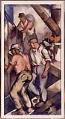
Oil painting, "Dock Scene," part of "Men Who Work the Ships" mural by Kenneth Callahan, 1936
Kenneth Callahan (1905-1986) was born in Spokane and lived in Seattle, becoming a nationally known artist, most celebrated for his murals. Self-taught as a painter and sculptor, he is best known as a leading figure in the Northwest School along with Mark Tobey, Morris Graves, and Guy Anderson. Commissioned in 1936 under the Treasury Relief Art Project (TRAP), Callahan painted…
ID Number:1963.3128.9
Date:1936
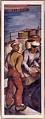
Oil painting, "Unloading," part of "Men Who Work the Ships" mural by Kenneth Callahan, 1936
Kenneth Callahan (1905-1986) was born in Spokane and lived in Seattle, becoming a nationally known artist, most celebrated for his murals. Self-taught as a painter and sculptor, he is best known as a leading figure in the Northwest School along with Mark Tobey, Morris Graves, and Guy Anderson. Commissioned in 1936 under the Treasury Relief Art Project (TRAP), Callahan painted…
ID Number:1963.3128.10
Date:1936
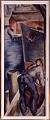
Oil painting, "Unloading 2," part of "Men Who Work the Ships" mural by Kenneth Callahan, 1936
Kenneth Callahan (1905-1986) was born in Spokane and lived in Seattle, becoming a nationally known artist, most celebrated for his murals. Self-taught as a painter and sculptor, he is best known as a leading figure in the Northwest School along with Mark Tobey, Morris Graves, and Guy Anderson. Commissioned in 1936 under the Treasury Relief Art Project (TRAP), Callahan painted…
ID Number:1963.3128.11
Date:1936
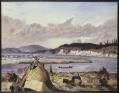
Oil painting of an Indigenous basket weaver in front of a tent, 1891
The daughter of one of Seattle’s founding families, Emily Inez Denny (1853 – 1918) was both a painter and writer. Greatly influenced by seeing the drawings of Sarah Willoughby as a student at the Washington Territorial University, she took on painting as a life-long pursuit. A woman who thrived on the creation of art, she constantly traveled with a notebook…
ID Number:1963.3178.1
Date:1891