Celebrate the Lunar New Year with a look into performances of the Chinese lion dance here in Seattle.

The Chinese lion dance has been performed for hundreds of years, traditionally intended to chase away bad spirits and welcome in good luck and prosperity. With intricate steps often danced by kung fu practitioners, the lion dance is a staple of Lunar New Year celebrations in the Chinatown International District, as well as celebrations and business events across the community.
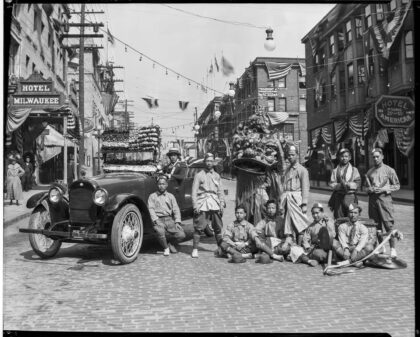
Chinese dance group with decorated car on King Street, 1921

Black and white photograph of a group of dancers posing with a Lion Dance costume and musical instruments next to a car.

MOHAI, PEMCO Webster & Stevens Collection, 1983.10.2187.2

In May 1921, Seattle’s Chinese residents held a week-long carnival to raise money for the Chinese Famine Fund, which was raising money for the those impacted by famine in northern China.

The event was called Go-Hing and was sponsored by the China Club, Chinese consul Goon Dip, and an advisory committee of Seattle and Washington state civic leaders. Seattle Mayor Hugh Caldwell opened the six-day festival, which featured various themed events like Commerce Day, University and High School Night, and Union Labor Day. Tickets were sold to all in the city and raised $5,000 for the national China Famine Relief Fund.

Here, a Chinese dance group poses on King Street during the carnival. One group member wears the head of a Lion Dance costume, and others hold their musical instruments.

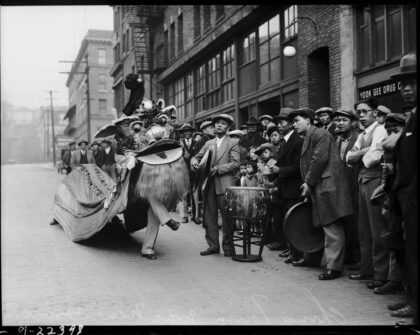
Chinese Lion Dance, circa 1930

Black and white photograph of a crowd of people standing on a sidewalk watching a Chinese Lion Dance in the street

MOHAI, Seattle Post-Intelligencer Collection, PI22398

During Chinese New Year celebrations in Seattle, the lion dancers make their way through Chinatown and historically stop in front of businesses to wish them a prosperous year. The businesses offer the lion red envelopes of money wrapped in lettuce leaves. The noise of the accompanying drums, gongs, cymbals and fireworks are believed to drive away evil spirits and bring good luck.

In this photo, probably taken around 1930, a lion dances along Seventh Avenue South, between King and Weller Streets, accompanied by cymbals and drums. The lion costume covers two dancers, one inside the head and one in the back.

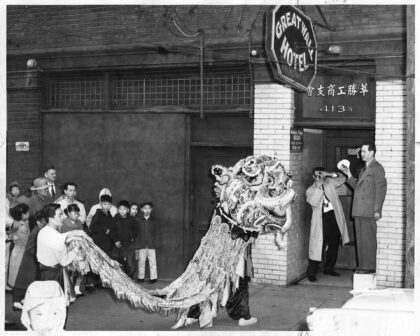
Youth performing Chinese lion dance, 1959

Black and white photograph of a group of children next to a lion dance costume.

MOHAI, Seattle Post-Intelligencer Collection, 2000.107.176.19.21, photo by John Vallentyne

Later in the twentieth century, the International District’s annual Lunar New Year celebrations expanded to feature Japanese Taiko Drumming, martial arts demonstrations, and other Asian cultural performances, as well as the lion dances.

In this image, a member of the Seattle Chinese Young Men’s Club dancing in a lion costume, while the man next to him holds out an offering for the lion. Next to the lion, a photographer stands in the doorway of the Great Wall Hotel, and extension of the Fujii Hotel, located near the corner of South King Street and Maynard Avenue South where Hing Hay Park is today. This lion dance was performed on for the Gregorian or western New Year on January 1, 1959.

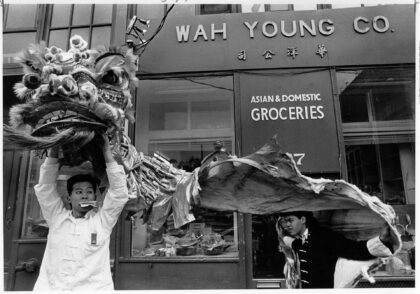
Lion dancers lifting costume on S. King Street, 1989

Black and white photograph of two dancers lifting a lion dance costume over their heads in front of Wah Young Co grocery store.

MOHAI, Seattle Post-Intelligencer Collection, 2000.107.036.11.01, photo by John H. Herndon

This photo of a lion dance from the 1989 Lunar New Year celebration features dancer Sonny Kwan (left) and Kay Chinn lifting their lion costume during dance to bestow good luck on businesses. Kwan holds this “lucky money” in his mouth, some of which was donated to a Chinese American nursing home. The photo was taken in front of the Wah Young Co. Asian Grocery, at a location that would become part of the Wing Luke Museum in 2008.

Categories:
Art, Civics

Related Blog Posts

Round wall clock that once hung in the window of Ding Ho Laundry and Cleaners, a Seattle business founded by Chinese immigrants York and Arlene Luke in 1956.
March 4, 2026

Spring Forward with Seattle History: Timeless Clocks from the MOHAI Collection

It’s almost time to spring forward! Celebrate the season with a look at four historic clocks from the MOHAI collection,…
Read More
A-side of a 12-inch vinyl record in golden yellow.
December 18, 2025

New Additions to MOHAI’s Collection: Artifacts Reflecting Seattle’s Diverse Stories in 2025

The MOHAI collections team has had a full and fascinating year! Every year, staff carefully review hundreds of potential donations,…
Read More