It’s almost time to spring forward! Celebrate the season with a look at four historic clocks from the MOHAI collection, from a hand-laundry clock trusted by Seattle’s elite to a pioneer family’s treasured timepiece. Each clock marks a moment in the city’s rich history.
/ March 4, 2026
Ding Ho Laundry and Cleaners Round Wall Clock
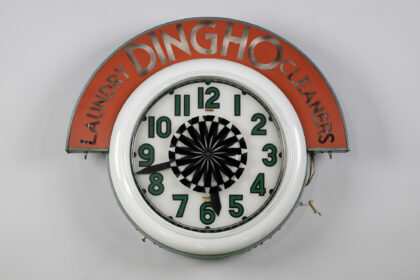
MOHAI, 2020.39.1. Donated in memory of York and Arlene Luke by their children
This clock hung in the window of the Ding Ho Laundry and Cleaners which was started by Chinese immigrants York and Arlene Luke and located at 905 James Street in Seattle.
York and Arlene opened Ding Ho Laundry and Cleaners (Ding Ho roughly translates to “the best” in English) in 1956, and their clients were the “who’s who” of the city including top executives, doctors, lawyers, and politicians. People would often set their watches to this clock. Ding Ho Laundry and Cleaners was one of the last businesses to provide hand-laundry service along with semiautomatic operations. York and Arlene would work ten to twelve hours a day, six days a week, and their children helped out in the shop too. York sold the cleaners in 1991 and retired after 35 years of running the business.
Martin and Mary Anne Cavanaugh's 19th-century Wooden Mantel Clock
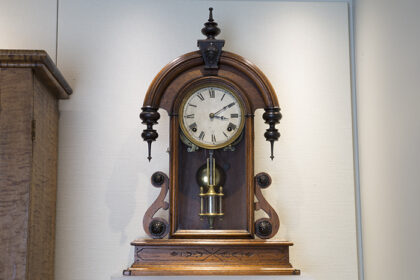
Clock brought with Cavanaugh family across plains in 1861
MOHAI, 1964.3312.1
Martin Cavanaugh and his wife Mary Anne Maple, early settlers in the Puget Sound region, brought this clock all the way from Missouri. A clock this ornate probably held a place of honor in their farmhouse which was built on land that became Boeing Field. This clock is on view in MOHAI’s exhibit True Northwest: The Seattle Journey.
Streamlined Art Deco-style Electric Mantel Clock
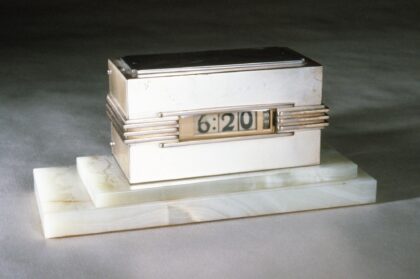
MOHAI, 1980.6912
Today we typically think of two clock types: analog clocks with hands and a clock face, and digital clocks which show numbers. But prior to digital technology, there were also mechanical clocks which displayed numbers, like this one. Internally, these clocks typically had plastic wheels with numbers which would rotate. This clock was an award to the Seattle Chamber of Commerce as an Outside Participant at the 48th Annual Tournament of Roses Parade held in Pasadena, California. It was presented on January 1, 1937. Sadly, the Washington Huskies, who made it to the Rose Bowl that year, were summarily trounced 21-0 by the Pittsburgh Panthers.
Carroll's Fine Jewelry Street Clock
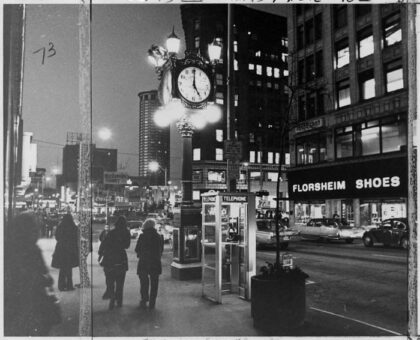
MOHAI, Seattle Post-Intelligencer Collection, 2000.107.189.13.01, photo by Tom Brownell
This street clock was commissioned by Thomas J. Carroll, the founder of Carroll’s Fine Jewelry, established in 1895 in Seattle. The clock was made by Seattle clockmakers Joseph Mayer and Sons and stood for decades at the jewelry store’s entrance at Fourth Avenue and Pike Street. Carroll’s Fine Jewelry closed in 2008, and that same year the clock was donated to MOHAI and moved to MOHAI’s old location in the Montlake neighborhood. In 2012, it was installed outside MOHAI’s new location in Lake Union Park. You can visit it today, although currently it is not operational.