MOHAI’s newest Community Spotlight display, Tadaima: I’m Home, features some of the most exquisite and emotionally complex objects in the museum’s collection.

In February 1942, Japanese American students at Bailey Gatzert Elementary were preparing to be incarcerated under Executive Order 9066. Many had beautiful, elaborate dolls for the celebration of Girls’ Day (Hinamatsuri) and Boys’ Day (Tango no Sekku). Since they could take so little with them to the camps, many students chose to leave their dolls with the school’s principal, Ada Mahon, for safekeeping.

It is possible that some of the dolls were retrieved after the war, but many remained at the school until 1973 when they were donated to MOHAI. Below, explore the story of lost dolls and lost memories, which highlight the deep experience of cultural and physical loss of the Japanese American community during the WWII incarceration.
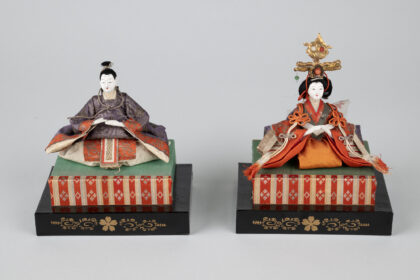
Emperor and Empress from Girls' Day set

Emperor and Empress dolls from a Japanese Girls' Day set, dressed in ornate purple and red court garments and displayed on tiered platforms; part of MOHAI's Japanese American doll collection.

MOHAI, 1973.5711.37

In Japan, Girls’ Day is celebrated with a display of dolls representing the Japanese Imperial court. A girl will typically be gifted the Emperor and Empress dolls before her first birthday, with other items added to the set over time. Much of the racism directed at people of Japanese decent was based on the idea that they were loyal to the emperor of Japan rather than the United States. So, while packing constraints were a main reason that students left their dolls at Bailey Gatzert, another major factor was that these items were considered risky or even dangerous to keep, lest their loyalty to the United States be called into question.

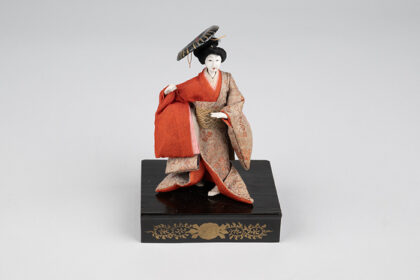
Dancer, possibly Fuji Musume from Girls' Day Set

Court doll from a Girls' Day set, ca. 1930-1940

MOHAI, 1973.5711.9b

Girls’ Day dolls were originally meant for play, but over time, they became more elaborate and intended primarily for display. The dolls in MOHAI’s collection are meant for display and are miniature works of art, which is evident in their detailed features.

The Girls’ Day dolls are typically dressed in the style of court dress from the Heian Period (794 to 1185). During this time, women at court wore a series of kimono-like robes, layered on top of one another. That effect is recreated with small layers around the neckline of this and many other dolls in the collection. This figure may be Fuji Musume or “The Wisteria Girl,” a famous character in the Kabuki dance tradition.

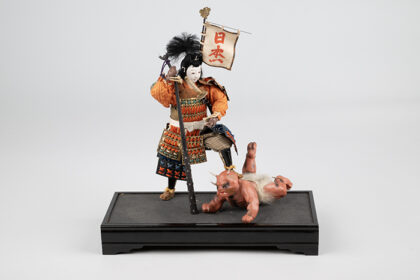
Figure from Boys' Day set, possibly Momotarō defeating an ogre

Boys' Day doll figure of Momotarō, the Peach Boy hero from Japanese folklore, in samurai armor standing over a red ogre; part of MOHAI's collection representing Japanese cultural heritage during WWII.

MOHAI, 1973.5711.16

The Boys’ Day dolls typically portray samurai or other heroic figures from Japanese folklore. This figure is likely Momotarō, a character who was born from a peach as a gift from the gods to a childless woman. As an adolescent he left home on a quest to defeat a powerful group of oni (demons or ogres).

Categories:
History, Immigration, People & Culture

Related Blog Posts

Photograph of several kinds of cassette and VHS tapes stored in the MOHAI collection.
March 19, 2026

Inside MOHAI’s Archives: Preserving Seattle’s Historic Digital and Audiovisual Collections

At MOHAI, our library and archives are full of millions of stories. As a proud Smithsonian Affiliate, we were excited…
Read More
Round wall clock that once hung in the window of Ding Ho Laundry and Cleaners, a Seattle business founded by Chinese immigrants York and Arlene Luke in 1956.
March 4, 2026

Spring Forward with Seattle History: Timeless Clocks from the MOHAI Collection

It’s almost time to spring forward! Celebrate the season with a look at four historic clocks from the MOHAI collection,…
Read More