101 results for: Winter
Photograph
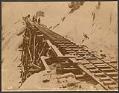
Icy tracks on the White Pass & Yukon Route, circa 1899
Winter snow in the coastal mountains was a constant problem for the White Pass and Yukon Route railway. Subzero temperatures, icy conditions, and snowfalls of several feet were common. The railroad's snowplows couldn't always get through, and sometimes passengers had to help clear the tracks.This photo by Eric Hegg shows workers clearing ice from the tracks of the White Pass…
ID Number:SHS42
Date:Circa 1899
Photograph
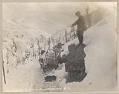
Man with two loaded sleds on Dyea trail above Lindeman, April 10, 1899
The trail from Dyea led across Chilkoot Pass to Lake Lindeman (sometimes spelled Linderman) and Lake Bennett in British Columbia. Many of the gold seekers who crossed Chilkoot Pass in the winter from 1897 to 1899 camped by Lake Lindeman waiting for the ice to thaw. Others hiked further to Lake Bennett.This photo, taken by Eric Hegg in April 1899,…
ID Number:SHS50
Date:1899
Photograph
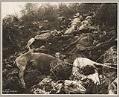
Dead horses on White Pass Trail, 1898
In 1897 and 1898, many of the Klondike stampeders used pack horses and mules to carry supplies along the White Pass Trail. Smart pack train owners took good care of their animals, but the trail was rough and the work was extremely hard. There was no feed in the mountain canyons and no water in winter. Animals who were too…
ID Number:SHS411
Date:1897
Photograph
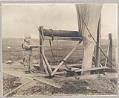
Child near mining equipment, Nome, August 30, 1906
Whole families traveled to the Yukon and Alaskan gold fields. Some couples met there and raised families. Many children worked with their parents on mining claims. It was a rough environment for children. Temperatures in Nome during the winter of 1899-1900 ranged from -35 to +35 degrees Fahrenheit with strong chilly winds.This photo of a child in Nome was taken…
ID Number:SHS565
Date:1906
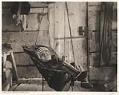
Photograph
Infant asleep in a sling, Alaska, circa 1905
In this image, an infant wearing a cap covered with buttons sleeps in a birchbark sling rigged with a rocking mechanism. The style of the cap appears Tlingit, but the infant's moccasins and the sling are probably of Alaskan Athabaskan origin. Around the beginning of the 20th century, white photographers used photographs of Indigenous babies on commercial products, and this…
ID Number:SHS1765
Date:Circa 1905
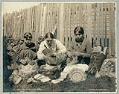
Photograph
Tlingit women weaving baskets, Alaska, circa 1897
The Tlingit people have lived on the coast and islands of what is now southeastern Alaska since time immemorial. Tlingit society is organized into clans, which follow maternal descent. Fishing, gathering, and hunting were central to historic Tlingit lifeways - they used salmon, shellfish, seals, berries, deer, and other food sources. They used every part for different purposes, not wasting…
ID Number:SHS1766
Date:Circa 1897
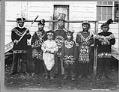
Photograph
Chilkat people in dance costumes, Klukwan, Alaska, circa 1895
The Chilkat are a Tlingit tribe who have lived in and around their village of Klukwan on the Chilkat River, in southeastern Alaska since time immemorial. They lived on foods available on their lands as well as trading with other tribes on the Pacific coast and inland. Settlers came to Chilkat lands in large numbers in the early 20th century,…
ID Number:SHS1769
Date:Circa 1895
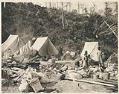
Photograph
Camp of Auke Natives, Alaska, circa 1896
The Tlingit people have lived on the coast and islands of what is now southeastern Alaska since time immemorial. Tlingit society is organized into clans, which follow maternal descent. Fishing, gathering, and hunting were central to historic Tlingit lifeways - they used salmon, shellfish, seals, berries, deer, and other food sources. They used every part for different purposes, not wasting…
ID Number:SHS1772
Date:Circa 1896
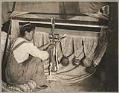
Photograph
Woman weaving a Chilkat blanket, Alaska, circa 1904
The Chilkat are a Tlingit tribe who have lived in and around their village of Klukwan on the Chilkat River, in southeastern Alaska since time immemorial. They lived on foods available on their lands as well as trading with other tribes on the Pacific coast and inland. Settlers came to Chilkat lands in large numbers in the early 20th century,…
ID Number:SHS1773
Date:Circa 1904
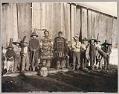
Photograph
Group of Chilkat people in traditional dance costumes, Klukwan, Alaska, circa 1895
The Chilkat are a Tlingit tribe who have lived in and around their village of Klukwan on the Chilkat River, in southeastern Alaska since time immemorial. They lived on foods available on their lands as well as trading with other tribes on the Pacific coast and inland. Settlers came to Chilkat lands in large numbers in the early 20th century,…
ID Number:SHS1785
Date:Circa 1895