101 results for: Winter
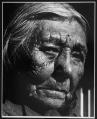
Photograph
Mattie Wheeler Howeattle, Taholah, 1965
Mattie Wheeler Howeattle (1861-1967) was an enrolled member of the Quinault Indian Nation. She married Washington Howeattle, a Quileute tribal member and representative of the Quinault Council. The couple lived in Taholah and were well-known for their knowledge of Quilieute and Quinault traditions, and Mattie was an accomplished basket and doll maker.Mattie Howeattle lived to be 106, and photographer Josef…
ID Number:Lib1993.20.198
Date:1965
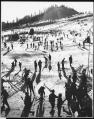
Photograph
Skiers at Snoqualmie Summit, 1954
In the winter of 1934, Seattle made national news by opening one of the first municipal ski areas in the country at Snoqualmie summit, championed by Mayor John F. Dore, a skier who envisioned the project as one that could lift his city's spirits during the midst of the Great Depression. The Ski Park grew, installing a rope tow in…
ID Number:Lib1993.20.262
Date:1954
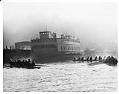
Photograph
University of Washington crew team rowing on Lake Washington, Kirkland, 1977
Photographer Josef Scaylea (1913-2004) worked for 35 years as chief photographer for the Seattle Times, winning over 1000 awards for his photographs highlighting the scenery and people in the Pacific Northwest. He donated a collection of his photographs and photography equipment to MOHAI in 1993.Scaylea often photographed the UW crew team, and took this picture of a foggy winter practice…
ID Number:Lib1993.20.267
Date:1977
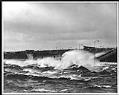
Photograph
Waves crashing against Evergreen Point Bridge during a storm, Medina, 1970
Photographer Josef Scaylea (1913-2004) worked for 35 years as chief photographer for the Seattle Times, winning over 1000 awards for his photographs highlighting the scenery and people in the Pacific Northwest. He donated a collection of his photographs and photography equipment to MOHAI in 1993.Scaylea often photographed scenes of Lake Washington, including this view of a winter storm on the…
ID Number:Lib1993.20.280
Date:1970

Ephemera
Seattle's Automobile Show advertisement, April 1916
In 1916 the third annual Seattle Automobile Show was held downtown, hosted by the Seattle Auditorium Company, and featured thirty-three passenger models of twenty different makes, and eight motor trucks produced by six different manufacturers. Some of the standouts included a white six-cylinder Paige, a maroon eight-cylinder Oakland, and a Marmon with an aluminum engine. Also on display were the…
ID Number:MS.COLL.872
Date:1916
Photograph
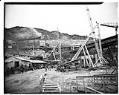
Change of shift at dam construction site, circa 1937
Work started on the Grand Coulee Dam in the fall of 1933 and was finished ten years later. Workers used a system of cranes, trestles, and conveyor belts to move the concrete and other construction materials into place. The men labored in shifts around the clock in winter and summer to build the dam on the Columbia River.This photo, taken…
ID Number:PI22031
Date:Circa 1937
Photograph
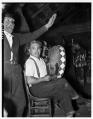
Swinomish drummer and singer at the Treaty Day observance, January 22, 1939
The Swinomish are a Coast Salish group whose historic lands were in the Skagit and Samish River valleys as well as Whidbey, Camano, Fidalgo Islands, and the San Juan Islands. They lived in large permanent villages during the winter, then spread out in spring and summer to gather resources – salmon from the rivers, shellfish from the coastline, cedar wood…
ID Number:PI23822
Date:1939
Photograph
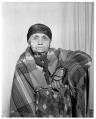
siastenu at the Seattle Post-Intelligencer office, Seattle, November 16, 1940
siastenu (1857-1958), also named Ruth Sehome Shelton, was born in 1857 on Guemes Island, in one of the last remaining Samish longhouses. She was descended from the Dungeness Klallam, the Lummi, and the Samish peoples. siastenu spread the oral histories of the Coast Salish peoples and carried knowledge of that history into the 20th century. In 1889, siastenu married Wheakadim…
ID Number:PI23839
Date:1940
Photograph
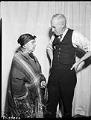
siastenu and Ed Dalby at the Seattle Post-Intelligencer offices, November 16, 1940
siastenu (1857-1958), also named Ruth Sehome Shelton, was born in 1857 on Guemes Island, in one of the last remaining Samish longhouses. She was descended from the Dungeness Klallam, the Lummi, and the Samish peoples. siastenu spread the oral histories of the Coast Salish peoples and carried knowledge of that history into the 20th century. In 1889, siastenu married Wheakadim…
ID Number:PI23840
Date:1940
Photograph
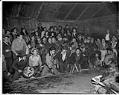
Slahal game at the Swinomish smokehouse, January 22, 1946
The Swinomish are a Coast Salish group whose historic lands were in the Skagit and Samish River valleys as well as Whidbey, Camano, Fidalgo Islands and the San Juan Islands. They lived in large permanent villages during the winter, then spread out in spring and summer to gather resources – salmon from the rivers, shellfish from the coastline, cedar wood…
ID Number:PI23871
Date:1946