217 results for: Railroads
Photograph
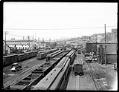
Railroad Avenue at Seattle's waterfront, circa 1911
Good railroad service was vital to growth of Seattle as a seaport. Eight tracks were built in a 120-foot right-of-way along the waterfront. This made it easier to transfer freight between the railroad cars and waiting ships.This photo shows the trains, piers, and warehouses along Railroad Avenue, looking north from the foot of University Street. Railroad Avenue is now called…
ID Number:1983.10.6713
Date:Circa 1911
Photograph
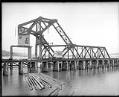
Northern Pacific railroad bridge, circa 1910
In about 1910, the Northern Pacific Railroad built a bascule bridge in one of its railroad trestles. In this kind of bridge, a large weight is used as a counterbalance. When the weight is pulled downwards, the span of the bridge tilts upwards so that boats can pass underneath.In this photo, scaffolding supports the large weight while the railroad bridge…
ID Number:1983.10.6724
Date:Circa 1910
Photograph
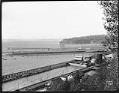
Great Northern Dock, Seattle, circa 1911
Railroad magnate James J. Hill formed the Great Northern Steamship Co. in 1900 and began building two ocean-going steamers, the "Minnesota" and the "Dakota", to carry trade goods between Seattle and Japan. The Great Northern Docks at Smith's Cove was the bustling center of this Pacific trade. The trains traveled over the bay on trestles, then continued on their way…
ID Number:1983.10.6764
Date:Circa 1911
Photograph
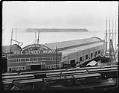
Ainsworth & Dunn Pike Street Wharf, Seattle, 1912
Handwritten on sleeve: Pike St. dock 1912.Photographer's Reference Number: 1258
ID Number:1983.10.6785
Date:1912
Photograph
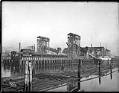
Bunkers and wharves at the Pacific Coast Coal Company, 1911
Railroad cars carried coal from the mines east of Lake Washington to the Seattle waterfront. The coal was offloaded and stored in bunkers. Then it was loaded onto ships bound for ports in Alaska or California.In this photo, taken in 1911, a railroad car filled with coal sits at the end of the dock at the Pacific Coast Coal Company…
ID Number:1983.10.6872.1
Date:1911
Photograph
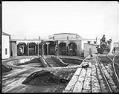
Turntable and roundhouse at the Pacific Coast Coal Company bunkers , 1911
When a train gets to the end of its track, the engine has to be turned around. This is done by driving the engine onto a turn-table, and then turning it in the right direction. When not in use, locomotives were housed in roundhouses.This photo shows the turn-table and roundhouse at the Pacific Coast Coal Company's waterfront storage bunkers on…
ID Number:1983.10.6872.2
Date:1911
Photograph
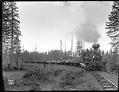
Train hauling logs, circa 1902
At first, logging companies cut trees along rivers and other bodies of water. They floated the logs downstream to the sawmill. After these areas were logged over, companies began using railroads to haul logs to a river or directly to the mill. The tracks could be moved as needed. Handwritten on sleeve: Log train.Webster & Stevens number: 2444
ID Number:1983.10.6893
Date:Circa 1902
Photograph
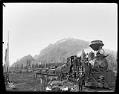
Logging train at Mt. Si, circa 1904
At first, logging companies cut trees along rivers and other bodies of water. They floated the logs downstream to the sawmill. After these areas were logged over, companies began using railroads to haul logs to a river or directly to the mill. The tracks could be moved as needed.This photo shows a Shay locomotive, the train crew, and flatcars full…
ID Number:1983.10.6916
Date:Circa 1904
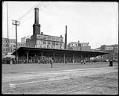
Photograph
Northern Pacific Railroad depot, circa 1905
Between 1892 and 1906, the Northern Pacific Railroad had a depot on Railroad Avenue at Columbia Street. Many people who were headed to the northern gold fields arrived by train at this Seattle railroad station. In 1906, the railroad moved its operations to the new King Street Station.This photo, probably taken sometime between 1904 and 1906, shows the low Northern…
ID Number:1983.10.6939
Date:Circa 1905
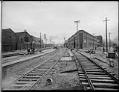
Photograph
Railroad Avenue under construction, Seattle, circa 1905
Good railroad service was vital to growth of Seattle as a seaport. Eight tracks were built in a 120-foot right-of-way along the waterfront. This made it easier to transfer freight between the railroad cars and waiting ships. This photo shows construction of a road alongside the railroad tracks. Railroad Avenue is now called Alaskan Way. Handwritten on sleeve: R.R. Ave…
ID Number:1983.10.7325
Date:Circa 1905