217 results for: Railroads
Photograph
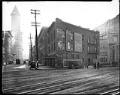
View of Yesler Way from Railroad Ave., Seattle, circa 1915
This image of Yesler Way was taken facing east, looking towards the Smith Tower at Second Avenue and Yesler Way. The tracks in the foreground are part of what was Railroad Avenue (now Alaskan Way), which ran along Seattle's waterfront. The brick building in the center of the frame holds several businesses, the Bedford Hotel, listed at 73 1/2 Yesler…
ID Number:1983.10.1413.2
Date:Circa 1915
Photograph
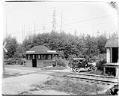
Interurban station, Echo Lake, circa 1919
Echo Lake is located in Shoreline, just north of Seattle. The lake was a popular bathing beach starting in 1916, and this photo shows the Interurban station at the site. Sign on station: Echo LakeHandwritten on sleeve: Woodman Ave. Co., [Echo] Lake ParkWebster & Stevens number: 74530Caption information source: "Shoreline — Thumbnail History," by Alan J. Stein, HistoryLink.org Essay 958
ID Number:1983.10.1553.1
Date:Circa 1919
Photograph
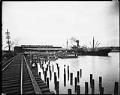
Exterior of Lake Union Dock Co., Seattle, circa 1920
This image of Seattle's Lake Union was taken from the west side of the lake, facing north towards Fremont. Prominent in the frame is a large steamship, likely docked for repairs at the Lake Union Dock Company, which was located at 2700 Westlake Avenue N. from at least 1920-1930. There are also several other small boats and houseboats moored here,…
ID Number:1983.10.1948.1
Date:Circa 1920
Photograph
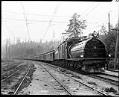
Chicago, Milwaukee, and St. Paul Railroad silk train, circa 1921
By the end of the 1920s, the single most valuable import coming through Seattle was Japanese silk. This luxury material came to Seattle on fast steamships and was sent by express train to eastern markets. Because it was both expensive and perishable, silk needed to be handled very carefully. One train carried a cargo of silk valued at $5 million.…
ID Number:1983.10.2199.1
Date:Circa 1921
Photograph
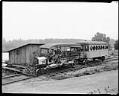
Train at Skagit River power site, circa 1921
Harsh terrain made the development of Seattle City Light's three Skagit River dams very difficult. Once they got permission to proceed on the Gorge Creek Diversion Dam in 1918, workers built access roads and a railway line, the Skagit River Railway, to haul supplies and workers to the construction site.This photo, taken around 1921, shows what is probably an excursion…
ID Number:1983.10.2251.6
Date:Circa 1921
Photograph
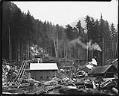
Skagit Dam construction site, circa 1921
Harsh terrain made the development of Seattle City Light's three dams on the Skagit River very difficult. Once they got permission to proceed on the Gorge Creek Diversion Dam in 1918, workers had to build access roads through the mountainous wilderness and railway lines to haul supplies and workers to and from the construction site.This photo, taken around 1921, shows…
ID Number:1983.10.2251.25
Date:Circa 1921
Photograph
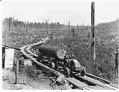
Kelly-Springfield truck hauling logs, circa 1925
Logging companies sometimes built railroads to haul logs out of the forest. Later, they used trucks. This photo was taken in the mid-1920s, somewhere in western Washington. A Kelly-Springfield logging truck hauls a large fir log along a track-like wooden logging road. Behind the truck are acres of cutover land. Wood was used for roads because it was cheap and…
ID Number:1983.10.3675.10
Date:Circa 1925
Photograph
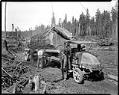
Kelly-Springfield logging truck, circa 1925
Logging companies sometimes built railroads to haul logs out of the forest. Later, they used trucks. This photo was taken in the mid-1920s, somewhere in western Washington. A Kelly-Springfield logging truck prepares to haul a large log along out of the forest. Original photo copied by Webster & Stevens. Handwritten on sleeve: Kelly Truck Co.Photographer's Reference Number: 131173
ID Number:1983.10.3675.16
Date:Circa 1925
Photograph
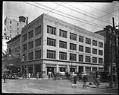
Great Northern Railway Building, Seattle, circa 1929
Shown here is the downtown Seattle office building for the Great Northern Railway on Fourth Avenue at Union Street, which was constructed in 1928 and 1929. The Great Northern Railway ran from Saint Paul, Minnesota, to Seattle, Washington, and was developed from the Saint Paul & Pacific Railroad. It was the northernmost transcontinental railroad route in the United States. Signs…
ID Number:1983.10.4050
Date:Circa 1929
Photograph
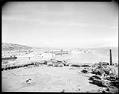
Finnish community at Smith Cove, August 2, 1935
Until the late 1930s or 1940s, a small community made up mainly of Finns lived near Smith Cove, north of downtown Seattle. They owned their one and two story homes, but the Great Northern Railway owned the land. Many residents worked in the logging, fishing, and railroad industries. A former resident remembers swimming with other children in the waves made…
ID Number:1983.10.4536.3
Date:1935