172 results for: Agriculture and Farms
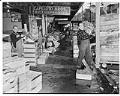
Photograph
Capeloto brothers unloading fruit at market, Seattle, November 4, 1948
Louis, Joseph, and Salvo Capeloto were three of the nine children of Moisin "Morris" and Behora "Dora" Capeloto. The Jewish family immigrated together from Rhodes to Washington State in 1912, around the time that Italy seized Rhodes from Turkey during the Italo-Turkish War, a significant precursor of the First World War.In this image the three Capeloto brothers pose in the…
ID Number:1986.5.9812.1
Date:1948
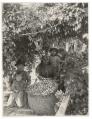
Photograph
Indigenous family working in a hop field in western Washington, circa 1900
From the late 1860s to the early 1890s, hop farming was an important activity in the valleys of the Puget Sound region, including Puyallup, White River, and Snoqualmie. Indigenous workers came from throughout the Pacific Northwest, Canada, and Alaska (but especially from regional tribes like the Puyallup, Snoqualmie, Muckleshoot, Duwamish, Sammamish, Lummi, and Nisqually) as a seasonal labor force to…
ID Number:1990.45.11
Date:Circa 1900
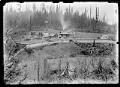
Photograph
View of farm and fields, circa 1900
Joseph Swartz was a shingle mill owner in Granite Falls, Washington, in the 1890s and early 1900s. By 1908, he had relocated his business to Everett. Swartz was also an amateur photographer. His images of family, friends and local scenery, all on glass plate negatives, document life in Snohomish County at the turn of the 19th century.This Swartz image of…
ID Number:1991.40.173
Date:Circa 1900
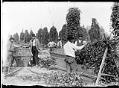
Photograph
Indigenous men at work picking hops, circa 1890
From the late 1860s to the early 1890s, hop farming was an important activity in the valleys of the Puget Sound region, including Puyallup, White River, and Snoqualmie. Indigenous workers came from throughout the Pacific Northwest, Canada, and Alaska (but especially from regional tribes like the Puyallup, Snoqualmie, Muckleshoot, Duwamish, Sammamish, Lummi, and Nisqually) as a seasonal labor force to…
ID Number:1991.79.36
Date:Circa 1890
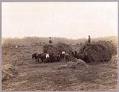
Photograph
Haying near Georgetown, Washington, circa 1914
Much of the Duwamish River Valley, south of Seattle, was quiet farmland before industrialization spread along its banks. Between 1911 and 1916, Walter Allen and Frank Perkins operated a photo studio in Georgetown, on the Duwamish, and documented the scenery and people of the area. In this Allen & Perkins photo, probably taken near Georgetown, farm workers rest during haying…
ID Number:1993.26.1
Date:Circa 1914
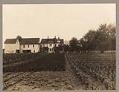
Photograph
Farmhouse and gardens near Georgetown, Washington, circa 1914
Much of the Duwamish River Valley, south of Seattle, was quiet farmland before industrialization spread along its banks. Between 1911 and 1916, Walter Allen and Frank Perkins operated a photo studio in Georgetown, on the Duwamish, and documented the scenery and people of the area.This Allen & Perkins photo, probably taken near Georgetown, shows a large farmhouse and barns beyond…
ID Number:1993.26.2
Date:Circa 1914
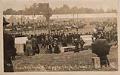
Photograph
Stock Exhibit at the Alaska-Yukon-Pacific Exposition, Seattle, 1909
The Alaska–Yukon–Pacific Exposition (AYPE) was a world's fair held in Seattle in 1909, publicizing the development of the Pacific Northwest. The fairgrounds became the campus of the University of Washington.Otto D. Goetze (b. 1871) was an American photographer who owned the Alaska Photo Studio in Seattle from 1909 to 1912. He also photographed the Alaska Gold Rush from 1891 to…
ID Number:1995.38.37.200
Date:1909
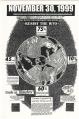
Poster
"Resist the WTO" poster, 1999
The Third Ministerial Conference of the World Trade Organization (WTO) was held in Seattle from November 30 to December 3, 1999. Trade ministers and other officials from the WTO's 135 member nations met in an unsuccessful attempt to plan negotiations to further deregulate free trade. Tens of thousands of activists for many causes gathered to protest what they saw as…
ID Number:2000.12.REF.8
Date:1999
Photograph
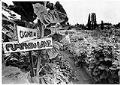
People working in P-Patch garden, Seattle, August 1974
"P-Patch," a term specific to Seattle, refers to a parcel of property used for gardening allotments. The "P" originally stood for "Picardo," after the family that loaned its northeast Seattle farm for a community garden on property first leased and later bought by the city. In 1973 the City of Seattle bought the Picardo Farm property and created a community…
ID Number:2000.107.072.25.04
Date:1974
Photograph
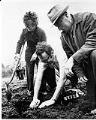
Councilman John Miller planting squash at P-Patch garden, Seattle, May 1974
"P-Patch," a term specific to Seattle, refers to a parcel of property used for gardening allotments. The "P" originally stood for "Picardo," after the family that loaned its northeast Seattle farm for a community garden on property first leased and later bought by the city. In 1973 the City of Seattle bought the Picardo Farm property and created a community…
ID Number:2000.107.072.25.06
Date:1974