1344 results for: Seattle Center
Photograph
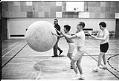
Group playing with a large ball in a PE class for the blind, Seattle, May 6, 1969
While working on a master’s degree project at Seattle’s Northwest Center, Dave Tucker realized the need for better physical education for blind students. He consolidated Seattle Public Schools’ PE programs for the blind and partially sighted and started classes in February 1968. Among his developments was the use of a large ball that students could push, climb on, and fall…
ID Number:2000.107.19720500.1.12
Date:1972
Photograph
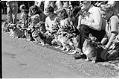
Corgis and their owners at Seattle Center, Seattle, August 27, 1972
On August 27, 1972, members of the Cascade Welsh Corgi Club gathered with their dogs at Seattle Center for the club's second annual “Corgi Walk.” This wasn’t a competition but a demonstration of the dogs’ obedience as they walked around the park. Here, members of the club and their pets wait for the beginning of the walk. Caption information source:…
ID Number:2000.107.19720827.2.27
Date:1972
Photograph
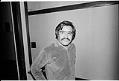
Roberto Gallegos, Seattle, October 13, 1972
While 1970 census figures showed that Spanish-speaking residents made up 5% of Seattle's population – similar in numbers to Black residents - the fact that they were scattered in various parts of the city made them less visible as an ethnic group. Language issues and historically based fears of deportation were also a factor, particularly for those from Mexico. In…
ID Number:2000.107.19721013.1.08a
Date:1972
Photograph
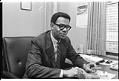
Alfred E. Cowles at his desk, Seattle, March 30, 1973
Alfred E. Cowles was appointed to the Seattle School Board in May 1969 representing a new district covering the Central Area. Later that year he was elected to keep his seat, becoming the first Black man elected to the Board. He served on the Board until 1973, when he moved to Washington, D.C. to lead the Center for Dispute Settlement,…
ID Number:2000.107.19730330.1.14
Date:1973
Photograph
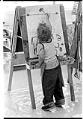
Terrez Weir painting at El Centro de la Raza's bilingual child care program, Seattle, September 1974
As more women started working outside the home, child day care and after-school activities became critical. In the Seattle area, El Centro de la Raza (The Center for People of All Races) stepped in to provide this. In 1974, El Centro opened a bilingual day care program in the basement of Beacon Hill United Methodist Church. The center, run by…
ID Number:2000.107.19740924.2.11
Date:1974
Photograph
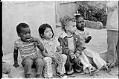
Children at El Centro de la Raza's bilingual child care program, Seattle, September 1974
As more women started working outside the home, child day care and after-school activities became critical. In the Seattle area, El Centro de la Raza (The Center for People of All Races) stepped in to provide this. In 1974, El Centro opened a bilingual day care program in the basement of Beacon Hill United Methodist Church. The center, run by…
ID Number:2000.107.19740924.2.14
Date:1974
Photograph
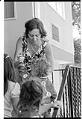
Director Lucia Rios at bilingual child care program sponsored by El Centro de la Raza, Seattle, September 1974
As more women started working outside the home, child day care and after-school activities became critical. In the Seattle area, El Centro de la Raza (The Center for People of All Races) stepped in to provide this. In 1974, El Centro opened a bilingual day care program in the basement of Beacon Hill United Methodist Church. The center, run by…
ID Number:2000.107.19740924.2.20
Date:1974
Photograph
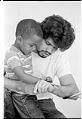
Bobby Richmond with teacher Jack Esparza at El Centro de la Raza's bilingual child care program, Seattle, September 1974
As more women started working outside the home, child day care and after-school activities became critical. In the Seattle area, El Centro de la Raza (The Center for People of All Races) stepped in to provide this. In 1974, El Centro opened a bilingual day care program in the basement of Beacon Hill United Methodist Church. The center, run by…
ID Number:2000.107.19740924.2.36
Date:1974
Photograph
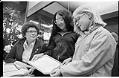
Women at the new Sound Savings and Loan Association, Seattle, May 26, 1977
When Sound Savings & Loan Association opened its doors on May 26, 1977, it was the first female-directed savings and loan institution west of the Mississippi. Some 500 shareholders, mostly women, invested $1.3 million to open the thrift bank, and the state of Washington contributed $100,000 to the effort. Billing itself “A Woman’s Place,” Sound Savings focused primarily on savings…
ID Number:2000.107.19770526.1.40
Date:1977
Photograph
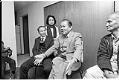
Urbano Quijance speaking about Filipino soldiers in WWII, January 17, 1985
Filipino soldiers began serving with the U.S. Army Forces of the Far East in 1941 when President Franklin Roosevelt offered full veterans’ benefits to Filipinos who enlisted. The Philippines at that time was a U.S. commonwealth, and Filipinos were U.S. nationals. 260,000 Filipinos fought alongside American forces during the war and more than 57,000 Filipino troops died. But once the…
ID Number:2000.107.19850117.1.28A
Date:1985