1344 results for: Seattle Center
Photograph
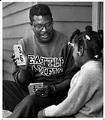
Edwin Wea showing flash card to girl at Black Family Center, Seattle, October 8, 1991
The Holly Park neighborhood of Seattle was built in the 1940s to house defense workers and veterans, but in the 1950s, it was converted into public housing under the Seattle Housing Authority (SHA). During its first few decades, Holly Park housed mostly Whites and some African Americans. By the early 1990s, 33% of Holly Park was African American and 49%…
ID Number:2000.107.228.06.01
Date:1991
Photograph
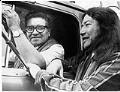
Bernie Whitebear receiving lumber delivered by Bill Boyd, Seattle, November 10, 1974
In 1970, a group of activists led by Bernie Whitebear (1937-2000), Sin-Aikst, or Sinixt (now one of the Confederated Tribes of the Colville Reservation), began a protest which culminated in approval for the development of both a cultural center for Indigenous peoples and a municipal park on decommissioned surplus land at Seattle's Fort Lawton site. After several years spent raising…
ID Number:2000.107.230.06.01
Date:1974
Photograph
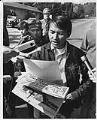
Bernie Whitebear reading proclamation ending protester's encampment at Fort Lawton, Seattle, April 3, 1970
On March 8, 1970, about 100 members and sympathizers of United Indian People's Council (later United Indians of All Tribes Foundation, or UIATF) occupied Fort Lawton, a 1,100-acre army post in Seattle's Magnolia neighborhood. They were inspired by the passage of a bill signed by President Richard Nixon, which granted non-federal entities the ability to obtain surplus federal lands for…
ID Number:2000.107.230.06.02
Date:1970
Photograph
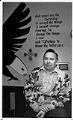
Leo Whiteford at Puyallup tribal substance-abuse treatment center, March 19, 1990
This photo shows Leo Whiteford, who was in charge of the Puyallup Indian substance abuse treatment center, sitting at the center. The Serenity Prayer, written by Reinhold Niebuhr and adopted by Alcoholics Anonymous (AA) in 1942, is painted on the wall behind him. As of 2019, the Puyallup Tribe's Community/Family Services Program continues to provide drug and alcohol screening, assessments…
ID Number:2000.107.230.07.01
Date:1990
Photograph
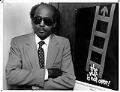
Harold Whitehead at Seattle Veterans Action Center, March 25, 1991
The Seattle Veterans Action Center (or Sea-VAC) was founded by Joseph Garcia in 1971 to provide readjustment assistance to veterans, especially minority, disadvantaged and disabled Vietnam war veterans. Services included family counseling, job-placement help, post-traumatic-stress-disorder therapy, substance-abuse counseling and housing aid, among others. In April 1991, Harold Whitehead, director of the Seattle Veterans Action Center, nine staff members, and heads…
ID Number:2000.107.230.07.02
Date:1991
Photograph
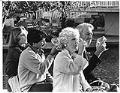
Oenophiles tasting wine at Seattle Center, August 27, 1979
Wine grapes and apples were among the first cultivated fruits in the Pacific Northwest. Initially planted here in 1827, both were cherished by early pioneering settlers, but whereas apples became a lucrative farm commodity early on, Washington-grown grapes and the local wine industry did not achieve widespread recognition until the 1970s. According to the Washington State Wine organization, as of…
ID Number:2000.107.232.03.01
Date:1979
Photograph
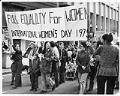
Women marching on International Women's Day, Seattle, March 8, 1975
This image was taken as about 300 women, men, and children marched through downtown Seattle in observance of International Women's Day, and to demand equitable working conditions for all. The group assembled at the Federal Building and paraded to Westlake Center, where they listened to speeches, including one on the history of International Women's Day, which was established in Europe…
ID Number:2000.107.232.25.01
Date:1975
Photograph
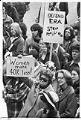
Demonstrators holding signs supporting ERA, Seattle, March 5, 1977
The Equal Rights Amendment (ERA) was introduced in the U. S. Congress for the first time in 1921 and has prompted conversations about the meaning of equality for women and men ever since. With the rise of the women's movement in the 1960s, the ERA garnered increasing support, was reintroduced to Congress in 1972, and was submitted to the state…
ID Number:2000.107.232.25.03
Date:1977
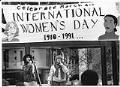
Photograph
Performers singing at International Women's Day rally, March 8, 1991
This image was taken as Susan Lewis, left, and Janet Stecher of the group Rebel Voices sing at the International Women's Day (IWD) rally held at Westlake Center in downtown Seattle. Lewis and Stecher have been performing together as Rebel Voices since 1989, and prior to that as The Belles of Hoboken, and Shays' Rebellion. Their concerts and workshops combine…
ID Number:2000.107.232.25.04
Date:1991
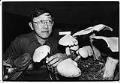
Photograph
Ben Woo with mushroom display at Pacific Science Center, Seattle, October 14, 1978
Asian community leader Benjamin Woo (1923-2008) was born in Seattle and attended Queen Anne High School and the University of Chicago. After military service he returned to Seattle and opened an architectural firm in Madison Park. He directed King County’s Construction and Facilities Management Department and served as president of the Seattle Chapter of the American Institute of Architects. Mr.…
ID Number:2000.107.232.28.07
Date:1978