80 results for: Greater Seattle, Inc.
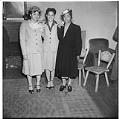
Photograph
Mrs. Meade posing with her daughters, Seattle, circa 1953
Christine Meade, left, and Vivian (Meade) Caver, pose with their mother, "Big Mama," in an unidentified living room. In 1942, Christine Meade became the first black professional hired by the Seattle YMCA to recruit and train volunteers for their servicemen clubs. After retirement, she volunteered with the Greater Seattle Church Council and United Way.
ID Number:2014.49.006.028.0087
Date:Circa 1945
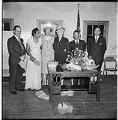
Photograph
Community leaders posing together, Seattle, circa 1953
Elizabeth Wells (2nd from left), Christine Meade (3rd from left), Dr. Felix Cooper (far right), Ernest White (2nd from right), and two unidentified others stand behind a desk with flowers.Christine Meade was the first black professional hired by the Seattle YMCA to recruit and train volunteers for their servicemen clubs. After retirement, she volunteered with the Greater Seattle Church Council…
ID Number:2014.49.006.028.0089
Date:Circa 1945
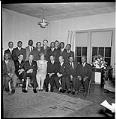
Photograph
Community leaders posing together, Seattle, circa 1953
Sixteen men and one woman pose formally near windows. The individuals in the back row are identified from left as George Taylor, Kenneth Stovall, Bruce Rowells, and five unidentified others. The individuals seated in the front row are identified from left as Elihue E. Spearman, Mr. Ward, Dr. Felix Cooper, Christine Meade, Ernest White, two unidentified others, and Powell Barnett.…
ID Number:2014.49.006.028.0090
Date:Circa 1945
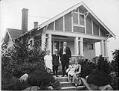
Photograph
Swedish-American family on porch of house, circa 1925
Between 1890 and 1910, large numbers of Swedes immigrated to the greater Seattle area. Swedes worked in the woods around Preston and High Point, in the Ballard mills, on the railroads building tunnels and laying tracks, in construction (contributing both labor and architectural skills), in the mines at Coal Creek, on the docks on Seattle's waterfront, and as farmers around…
ID Number:2016.59.66
Date:Circa 1925
Photograph
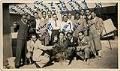
Jazz musicians in Shanghai, China, circa 1938
Many American jazz musicians traveled to Shanghai during the city's golden age in the 1930s, when "the Paris of the Orient" was the newest horizon on an increasingly international jazz music scene. For Black musicians, who were often excluded from white musicians' unions in the U. S. and subjected to other forms of segregation, Shanghai provided steady, well-paid work, and…
ID Number:2016.84.2.9.1
Date:Circa 1938

Photograph
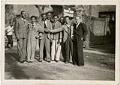
Band leaders in Shanghai, China, September 7, 1938
Many American jazz musicians traveled to Shanghai during the city's golden age in the 1930s, when "the Paris of the Orient" was the newest horizon on an increasingly international jazz music scene. For Black musicians, who were often excluded from white musicians' unions in the U. S. and subjected to other forms of segregation, Shanghai provided steady, well-paid work, and…
ID Number:2016.84.2.9.2
Date:1938
Photograph
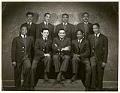
Musicians from Earl Whaley's band in China, September 7, 1938
Many American jazz musicians traveled to Shanghai during the city's golden age in the 1930s, when "the Paris of the Orient" was the newest horizon on an increasingly international jazz music scene. For Black musicians, who were often excluded from white musicians' unions in the U. S. and subjected to other forms of segregation, Shanghai provided steady, well-paid work, and…
ID Number:2016.84.2.9.3
Date:1938
Photograph
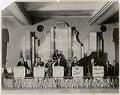
Earl Whaley's band on stage in Shanghai, China, December 20, 1934
Many American jazz musicians traveled to Shanghai during the city's golden age in the 1930s, when "the Paris of the Orient" was the newest horizon on an increasingly international jazz music scene. For Black musicians, who were often excluded from white musicians' unions in the U. S. and subjected to other forms of segregation, Shanghai provided steady, well-paid work, and…
ID Number:2016.84.2.10.1
Date:1934

Photograph
Earl Whaley's Orchestra photo collage, circa 1937
Many American jazz musicians traveled to Shanghai during the city's golden age in the 1930s, when "the Paris of the Orient" was the newest horizon on an increasingly international jazz music scene. For Black musicians, who were often excluded from white musicians' unions in the U. S. and subjected to other forms of segregation, Shanghai provided steady, well-paid work, and…
ID Number:2016.84.2.10.2
Date:Circa 1937
Photograph
Earl Whaley's band, Shanghai, China, circa 1937
Many American jazz musicians traveled to Shanghai during the city's golden age in the 1930s, when "the Paris of the Orient" was the newest horizon on an increasingly international jazz music scene. For Black musicians, who were often excluded from white musicians' unions in the U. S. and subjected to other forms of segregation, Shanghai provided steady, well-paid work, and…
ID Number:2016.84.2.10.3
Date:Circa 1937