80 results for: Greater Seattle, Inc.
Ephemera
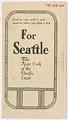
For Seattle: The New York of the Pacific Coast, 1906
The Seattle Commercial Club was incorporated on July 11, 1906, by a group of businessmen in order to "stimulate the civic spirit and patriotism of the citizens of Seattle; to procure a market for the produce of this vicinity; to encourage commerce and enterprise in all mercantile lines; to support all local industries and manufacturers; and to collect and impart…
ID Number:1947.25.22
Date:1906
Cartographic material
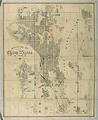
Anderson Map Co.'s Official Map of Greater Seattle, 1909
Seattle entrepreneur and amateur photographer O.P. (Oliver Phelps) Anderson (1859-1941) was the son of Alexander Jay Anderson (1832-1903), president of the Washington Territorial University (now University of Washington) from 1877-1882. O.P. trained as a draughtsman and by 1890 had started a civil engineering and map publishing business, O. P. Anderson & Company (later O. P. Anderson Map & Blue Print…
ID Number:1969.4750.1
Date:1909
Ephemera
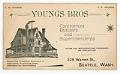
Youngs Bros. business card, circa 1890
Luther Burns Youngs (1858-1923) came from Kentucky to Seattle in 1883. A carpenter by trade, he started a construction business that became quickly profitable in Seattle's booming population. According to Seattle city directories, there were 3,553 residents in 1880 and 43,835 residents in 1890. Already serving as a member of the Board of Public Works, Mr. Youngs was appointed superintendent…
ID Number:1969.5072.103
Date:Circa 1890
Poster
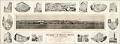
The Heart of Greater Seattle poster, June 1909
In 1909, prosperous Seattle proudly showed itself to the world as a place to do business. In addition to producing the Alaska-Yukon-Pacific Exposition world’s fair, city boosters published maps and other materials to promote commercial interests.This panorama, entitled “The Heart of Greater Seattle: The Gateway to Alaska and the Orient," shows several miles of the city’s waterfront and the Cascade…
ID Number:1982.20.47
Date:1909
Photograph
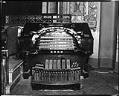
Organ at Coliseum Theatre, Seattle, circa 1920
By 1915, Seattle's downtown commercial core was booming. In March 1915, local lumber baron and businessman C. D. Stimson leased lots on the northeast corner of Fifth Avenue and Pike Street to the newly-formed Coliseum Company to build a theater designed specifically for movies, then called photoplays. The Coliseum Photo Playhouse was designed by noted theater architect B. Marcus Priteca,…
ID Number:1983.10.1883
Date:Circa 1920
Photograph
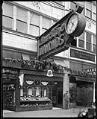
Ben Tipp Diamonds, Seattle, circa 1927
Ben Tipp was a Russian Jew who immigrated to the United States in 1898. By 1919 he was working in a Seattle jewelry store, and in 1922 he established his own business at 1408 2nd Avenue. He moved to 1431 3rd Avenue in 1926 and installed a large sign clock at this location. Signs in image: Block's Stores - [Newer]…
ID Number:1983.10.3861.2
Date:Circa 1927
Photograph
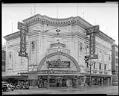
Coliseum Theatre, November 3, 1934
By 1915, Seattle's downtown commercial core was booming. In March 1915, local lumber baron and businessman C. D. Stimson leased lots on the northeast corner of Fifth Avenue and Pike Street to the newly-formed Coliseum Company to build a theater designed specifically for movies, then called photoplays. The Coliseum Photo Playhouse was designed by noted theater architect B. Marcus Priteca,…
ID Number:1983.10.4493
Date:1934
Photograph
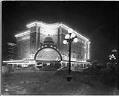
Coliseum Theatre on a snowy night, Seattle, February 1916
By 1915, Seattle's downtown commercial core was booming. In March 1915, local lumber baron and businessman C. D. Stimson leased lots on the northeast corner of Fifth Avenue and Pike Street to the newly-formed Coliseum Company to build a theater designed specifically for movies, then called photoplays. The Coliseum Photo Playhouse was designed by noted theater architect B. Marcus Priteca,…
ID Number:1983.10.8590
Date:1916
Ephemera
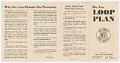
The New Loop Plan, issued by The City of Seattle, 1934
In 1919 the City of Seattle took over all of the city's street car lines and formed the Seattle Municipal Street Railway (today's METRO). Because of its steep hills, Seattle kept its cable car lines longer than any other American city except San Francisco, not replacing them until 1940 when buses that could handle the grades became available. Beginning on…
ID Number:1984.12.2
Date:1934
Videorecording
Oral history interview with Holt W. Webster, 1985
Holt Webster (1919-1992) was a pioneer in the freight industry, and one of the founders of Airborne Express, where he also served as chairman and chief executive officer. During World War II, Webster was a captain in the military Air Transport Command from 1942 through 1946. After the war, he worked for Northwest Airlines in Seattle from 1946 to 1951…
ID Number:1985.135.28
Date:1985