233 results for: Animals
Photograph
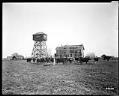
Straights Farm, circa 1925
Sometime during the 1920s, a photographer from the firm of Webster & Stevens snapped this image of a farmhouse and cattle, identifying it as "Straights Farm." No location was given, but the farm was probably in King County. Webster & Stevens number: 82235
ID Number:1983.10.6456
Date:Circa 1925
Photograph
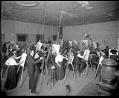
Life drawing class at Western Academy of the Beaux Arts , 1911
After the University of Washington moved to its present campus, a group of Seattle artists and architects held art classes in the old downtown university building. In 1908, they formed the Western Academy of the Beaux Arts and purchased land near Bellevue for an artists' community. This 1911 photo shows a Beaux Arts life drawing class. The artists' drawings are…
ID Number:1983.10.6640
Date:1911
Photograph
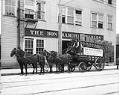
Bon Marche delivery wagon, Seattle, 1911
In 1890, German immigrant Edward Nordhoff and his wife Josephine invested their life savings of $1,200 to start The Bon Marche at First Avenue and Cedar Street. He modeled his new department store after one he had known in Paris. The Bon Marche moved to the corner of Second Avenue and Pike Street in 1896. By 1901, it had expanded…
ID Number:1983.10.6658
Date:1911
Photograph
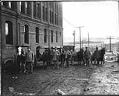
Postal employees and wagons, Seattle, circa 1911
Handwritten on sleeve: P.O. Collectors Group.Photographer's Reference Number: 1406
ID Number:1983.10.6798
Date:Circa 1911
Photograph
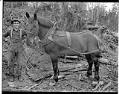
A logger and his horse, circa 1905
Horses were used widely in the logging industry because they were strong, surefooted, and intelligent. They could pull cut logs from steep slopes and dense woods.In this photo, taken sometime around 1905, a logger stands by his brawny horse. The horse's harness would be attached by ropes to one end of a log, and the logger would lead the animal…
ID Number:1983.10.6885
Date:Circa 1905
Photograph
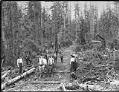
Horse team pulling log on skid road, circa 1902
At first, loggers used oxen to haul logs out of the woods. Later, they used horses, which were more intelligent and easier to handle. The teams pulled the logs along skid roads to a river or railroad line. Skid roads were built of logs laid across or along the track. Greasing the skid road logs made it easier to pull…
ID Number:1983.10.6887
Date:Circa 1902
Photograph
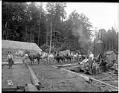
Horse team in logging camp, circa 1902
At first, loggers used oxen to haul logs out of the woods. Later, they used horses, which were more intelligent and easier to handle. The teams pulled the logs along skid roads to a river or railroad line. Handwritten on sleeve: 14 horse team & Donkey engine with crew at camp.Webster & Stevens number: 2447
ID Number:1983.10.6892
Date:Circa 1902
Photograph
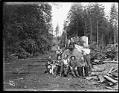
Children and logging crew with a big log, circa 1903
Sometime in the early 1900s, members of a logging crew and their children and dogs posed for a photographer from the Seattle firm of Webster & Stevens A big log provided a sign of the loggers' occupation as well as a convenient place for a little girl to sit. While the location of the photograph is unknown, it is probably…
ID Number:1983.10.6913
Date:Circa 1903
Photograph
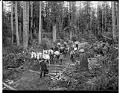
Horse team hauling logs on skid road, circa 1904
At first, loggers used oxen to haul logs out of the woods. Later, they used horses, which were more intelligent and easier to handle. The teams pulled the logs along skid roads to a river or railroad line. Skid roads were built of logs laid across or along the track. Greasing the skid road logs made it easier to pull…
ID Number:1983.10.6919
Date:Circa 1904
Photograph
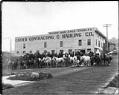
Horses outside Carter Contracting & Hauling Co., Seattle, 1905
Sign in image: Carter Contracting & Hauling Co. - Board and Sale Stables.Handwritten on sleeve: Carter Hauling Co. Teams 1905.Webster & Stevens number: 3563
ID Number:1983.10.7377.2
Date:1905